Did Archaeologists Discover an Ancient Seal of the Twelve Tribes?
TRENDING


10 min read


Is a 3700-year-old Egyptian bulla one of the greatest archaeological finds of all time or a typical item of its era?
An intriguing 3700-year-old cylindrical hematite bulla (seal impression), discovered in a northern Egyptian archaeological site and measuring just 1 cm by 2 cm in size is causing big controversy. When it was first discovered over 45 years ago, archaeologists determined it was a depiction of local pagan gods. But today some are taking a second look and questioning the original categorization. Could the depictions be symbols of the 12 tribes of Israel?
If the 12 tribes identification is correct, it would be the oldest Jewish object in existence.
The seal dates to the period the Israelites would have likely sojourned in Egypt and has 12 symbols. Most of these match the descriptions of the tribes found in the Torah, either in the blessings of Jacob to his sons in Genesis 49 or in the blessings of Moses to the tribes in Deuteronomy 33. Most are also the same symbols used today to depict the 12 tribes and are proudly displayed inside thousands of synagogues all over the world.
Besides the human figure in the center, the bulla depicts: A bull, watery waves, a bird, a lion, two hill-like objects, a snake, a wall like structure, branches with leaves, a deer/gazelle, a boat, two mushroom like objects and an arrowhead like object pointing down.
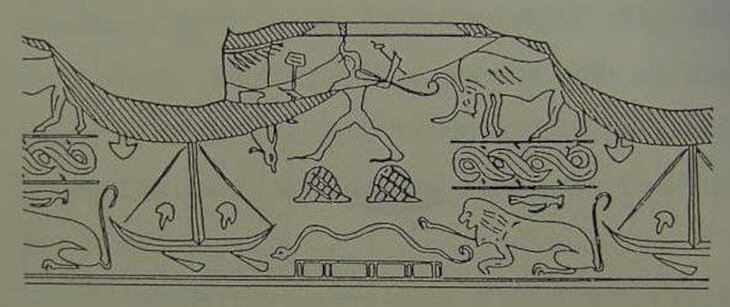 Rendering of the Impression of the Cylinder Seal
The majority of these symbols match those of the 12 tribes.
Five symbols correspond with those used by Jacob, just before his death, in his blessing to his sons in Genesis 49: Reuben is likened to water, Yehuda a lion, Zevulun a ship, Dan a snake and Naphtali a deer.
Three other symbols match those used by Moses in his blessings to the tribes, just before his death, in Deuteronomy 33: Joseph is likened to a bull, Benjamin to two hills and Asher to oil or an olive tree.
Of the remaining four tribal symbols, some can be found in other ancient Jewish sources. For example, the Midrash says Shimon’s symbol was the gates to the city of Shechem (Midrash BaMidbar Rabbah 2:7).
The supporters of the 12 tribes theory say the chances of all these symbols appearing “coincidentally” on the same small seal would be very small.
Discovering the Bulla
The bulla was found in 1979 at the Tell Ed Daba archaeological site (the historical Avaris) located in Egypt’s northeastern Nile delta. It was excavated by Prof. Manfred Bietak of the Austrian Institute for Egyptology. Bietak was the director of the digs from 1966 – 2009.
Seals were widely used in the ancient world, to put an owner’s stamp on commercial and legal documents or containers, and for tamper-proofing them. Typically the seal was first pressed into clay, wax or some other soft substance and then stamped on the folded document, sealing it. Often the seals were worn around the neck or as rings by officials or their representatives.
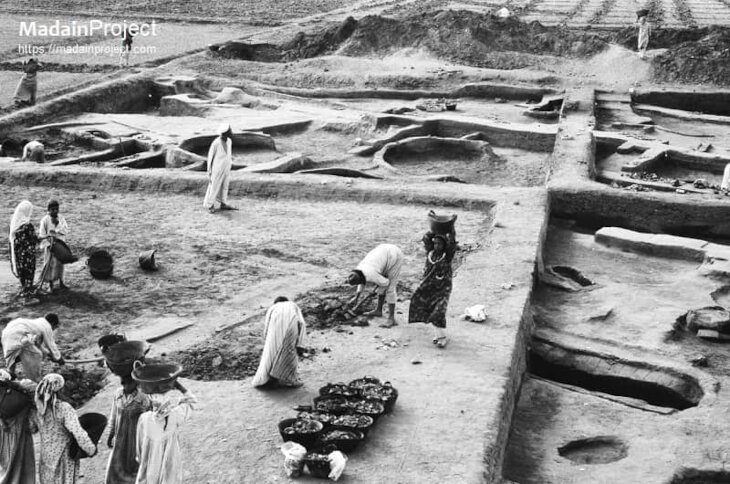 Excavations at the Tell Ed Daba archaeological site
Avaris, the location of the find, is situated in what many believe is the area of the Biblical Goshen – where the Jews in Egypt are said to have lived. The name “Goshen” is believed to be a derivative of the word “geshem” which means rain in Hebrew. And the location of Tell Ed Daba is, in fact, in the rainiest region of Egypt. The Book of Joshua suggests Goshen is continuous with Gaza.
The bulla is only one of numerous interesting finds suggesting an ancient Israelite presence in Egypt. This includes a statue of a Semitic foreigner wearing a multicolored coat, an Egyptian palace with twelve columns and twelve tombs behind it, typical Hebrew four room houses and Semitic burial plots unusual in Egypt. The bulla was found on the floor of the palace. Nine other seals, found at the same archaeological site, displayed the words “Yaqob-har”, which archaeologists have identified with the Hebrew name “Jacob”. In addition, ancient Hebrew like inscriptions have been found in the Sinai.
All this led well-known Egyptologist, David Rohl, to recognize the site as "the lost city of the Israelites located in the heart of the biblical land of Goshen…. and the palace of the vizier Joseph."
Rohl, however, is a contentious figure. Dubbed the most controversial Egyptologist in the world, he is famous for his “New Chronology” which brings forward conventional dating of Egyptian kings from the 19th to 25th dynasties. While most conventional Egyptologists reject the New Chronology, many admit that Rohl’s theory has valid points and should not be rejected out of hand. For example, Amélie Kuhrt, head of Ancient Near Eastern History at University College London, commented, "Many scholars feel sympathetic to the critique of weaknesses in the existing chronological framework, but most archaeologists and ancient historians are not convinced that the radical re-datings proposed stand up to close examination."
The bulla is unusual in that it shows a wide variety of very different symbols (a human, five different animals, four different natural elements and two different man-made objects) all of which appear disjointed, with no apparent connection between them. What could be the reason so many diverse symbols were inscribed on such a tiny object?
Canaanite Gods
When originally discovered in 1979, archaeologists identified the bulla as a depiction of local pagan deities. Bietak claimed it portrayed North-Syrian weather god Baal Zaphon/Hadad as patron of sailors. Others saw three Canaanite gods – the human figure was Baal-Zaphon standing upon twin peaks, with the depiction of El as a bull and Yam as the sea.
In 1984, Edith Porada, a specialist in cylinder seals, published a four-page paper* on the seal. She described the scene as, “a Syrian weather god in smiting posture, with a long curl projecting backwards, is seen in a powerful stride atop two mountains which have crisscross markings. In front of the god is a large goat, falling head downwards, toward the field.” Porada describes the water like waves as a common decorative style called “guilloche,” which often looked like braided or interwoven ribbons with rounded spaces between them.
One of the factors complicating the identification process is the uniqueness of the bulla’s design. Porada noted that the overall simplified style of this seal had no Syrian or Egyptian counterparts. She concluded that the seal is, “carved in a style dependent on, but not belonging to, known Syrian cylinder seals and that it may be the product of a local seal cutter. This seal cutter probably worked in the eighteenth century B.C.E. and selected motifs of special significance to his clientele.”
The Joseph Seal
The first one to identify it as a depiction of the 12 tribes was an epigrapher from Beit Shemesh – Rabbi Michael S. Bar-Ron. He dubbed it, “The Joseph Seal”. In his 23-page research paper, “The Seal of Joseph in His Palace at Tell Ed-Daba”, he fastidiously notes the correspondence between the symbols depicted on the Egyptian bulla and the symbols of the Twelve Tribes of Israel.
Bar-Ron is an expert in Proto-Sinaitic inscriptions in the Sinai and Egypt, Biblical textual variants and Samaritan Studies. He has both rabbinical accreditation and a B.A. in Physical & Biological Anthropology from the University of California San Diego. In his Egyptian research, he was mentored by Dr. Pieter Gert van der Veen, Deputy Professor of Biblical Archaeology at the University of Mainz.
 Rabbi Michael S. Bar-Ron
That Human Figure
But if it was a depiction of the twelve tribes, what is the human figure in the very center of the seal? Depictions of God are stringently forbidden in Judaism. This poses a real problem.
Some say the human like figure could be a depiction of the patriarch Jacob, father of the 12 tribes. But what if it is in fact an anthropomorphic depiction of God? How could this be a Jewish artifact? While 12 tribe supporters admit that depictions of God are taboo in Judaism, they note that this law was only declared at the giving of the Torah on Mount Sinai, an event which would have taken place long after the bulla’s creation.
According to Bar-On, not only do the symbols match those of the tribes, but most are shown in the birth order of the brothers. The main exception to this rule is the Joseph symbol, which appears first, he says, because he was viceroy of Egypt.
The order of the symbols in each column, from top to bottom, and right to left would be:
- Joseph (having firstborn status, with a double inheritance)
- Reuben (the deposed firstborn of Jacob)
- Levi (the third son of Jacob)
- Judah (the fourth son of Jacob)
- Dan (the fifth son of Jacob)
- Shimon beneath them all (likely because he was the leader in the sale of Joseph)
- Asher's place in the family, as the eighth son, is hinted at with an eight-leafed olive branch
- The symbols of the last five sons, Naftali, Gad, Asher, Issachar & Zevulun, all appear at the end. This is with the exception of the last son, Benjamin, Joseph’s maternal brother, who also has a special place, in the center of the seal.
There are three columns of symbols. The six sons of Leah and Rachel are given prominence in the seal – as they are mainly on the right side, while the four sons of the handmaidens appear mainly on the left side.
Experts Disagree
Bar-On’s intriguing thesis has garnered a wide audience, with over 10,000 views of his paper. But little of this has translated into support from the academic establishment. Why?
Supporters of the 12 tribes theory say that most Egyptologists would not be familiar with the symbols of the 12 tribes of Israel. But more importantly, they say that the political climate in Egypt does not allow for the discovery of any archaeological find that could strengthen Jewish claims to the Land of Israel. Had Bietak or any other Egyptologist made this claim, they would have been barred from Egypt for life.
Now that Bietak (82) is retired, however, he seems to be more willing to discuss an ancient Hebrew presence in Egypt. In a book on “Ancient Israel” published in 2021 by the Biblical Archaeology Society, we find the following. "Summing up the evidence of the eastern Delta and Western Thebes, we conclude that early Israelites most likely were in Egypt during the late Ramesside period." [Ch. 2. Egypt and the Exodus by Manfred Bietak and Gary A. Rendsburg]. In the book, he offers several proofs that Israelites lived in Ancient Egypt, including the presence of typical Israelite four-room houses, official Egyptian accounts that closely mimic Biblical narratives, Egyptian references to Goshen and more.
While Bar-Ron is certain of his identification, many remain skeptical and the seal remains the subject of fierce debate.
* (Porada, Edith. “The Cylinder Seal from Tell El-Dab’a.” American Journal of Archaeology 88, no. 4 (1984): 485-88. doi:10.2307/504736.)
RECOMMENDED NEXT READ




 Posts
Posts


Am I missing something, or is a picture of the actual seal not included in this intriguing article ?
No mention of Gad? maybe that the man in the middle. Gad is soldiers...
Asher listed twice above, so it appears you omitted Gad
The blessings of Moses were delivered 40 years after the exodus. A bit difficult to understand how his metaphoric animals could have made it onto a bulla that was presumably created years before the exodus.
Good point. Perhaps Moses was accessing an established tradition for his symbols.
Can't the man in the center be Pharaoh? It would make sense that if in fact this was Joseph's seal, or a seal from Joseph's royal house, it would show the entirety of the 12 tribes of Israel under the dominion of Pharaoh. The last thing a king would want in his own land is to have another nation with their own signs and symbols, unless of course those signs were used to show allegiance to that king. The answer seems so obvious to me that I'm convinced I'm missing something...