Why are they refusing to discuss it? | Dan Bongino Clips

| |||||||
| |||||||
Rumble Inc. | 218 Adelaide Street W, Suite 400, Toronto, ON, Canada M5H1W7 |

NEW YORK (AP) — Many of the conservative prelates who dominate the U.S. Conference of Catholic Bishops were appointed by Pope Emeritus Benedict XVI. His recent death deprives them of a symbolic figurehead but is unlikely to weaken their collective power or end the culture wars that have divided the USCCB, according to Catholic academics and clergy.
David Gibson, director of Fordham University’s Center on Religion and Culture, noted that conservative-leaning bishops were appointed over a 35-year period by Benedict and his predecessor, Pope John Paul II, and routinely prevail in voting over the relatively more liberal group of bishops appointed since 2013 by Pope Francis.
“That conservative core is better organized and, as shown by the recent election of USCCB officers, more motivated as it reacts against the more open and unpredictable style of Francis,” Gibson said via email.
“The Francis-style bishops are not as numerous nor as well-organized,” Gibson added. “But they are also contending with well-organized conservative Catholic activists who can make their jobs exceedingly difficult if those bishops are perceived as being too focused on social justice or other teachings perceived as ‘progressive.'”
The USCCB doesn't track the number of bishops appointed by individual popes, according to its spokesperson, Chieko Noguchi. A sociology professor who does do such tracking, Katie Hoegeman of Missouri State University, said says that of more than than 200 bishops now active in the USCCB, about half were initially appointed by Francis and half by his two predecessors.
Massimo Faggioli, a professor of historical theology at Villanova University, says he doesn’t foresee any major shift in the USCCB’s decision-making in the aftermath of Benedict’s death.
“It is a fact that whenever there’s an election (within the USCCB), the more conservative side always wins,” he said in a telephone interview.
One reason for the conservatives’ sustained dominance, Faggioli said, is that Benedict and John Paul II appointed bishops at relatively young ages. For example, outspoken conservative Salvatore Cordileone was 46 when named a bishop by John Paul in 2002; he was promoted to be archbishop of San Francisco by Benedict 10 years later.
Cordileone has been among the USCCB members to differ openly with Pope Francis on high-profile issues, notably barring U.S. Rep. Nancy Pelosi – a Catholic from San Francisco – from receiving Communion in the archdiocese because of her support for abortion rights. Francis has made clear he opposes using denial of Communion for this type of repudiation.
“It’s difficult to say what a Francis bishop stands for – they don’t correspond to a single profile,” Faggioli said, “It’s easy to say what a Benedict bishop stands for … they brought in a very distinct cultural war mentality.”
The divisions within the USCCB are so pronounced that they were highlighted in a statement from Timothy Broglio, the Archbishop of the Military Services, USA, after his election in November as the conference’s new president.
“We do suffer from a damaged unity,” Broglio said.
“We have a responsibility to cultivate that unity, which does not mean that we are carbon copies of one another or always have the same approaches to a problem.” he said. “It does mean that, if we disagree, we first speak among ourselves. We are not obliged to imitate the society around us by contributing to diatribes about others.”
One of the minority of U.S. bishops who energetically align with Pope Francis is John Stowe, bishop of Lexington, Kentucky.
During the November USCCB meeting at which Broglio was elected, Stowe unsuccessfully urged his fellow bishops to overhaul a longstanding statement on “Faithful Citizenship” so it would reflect some of Francis’ priorities, such as climate change and economic justice.
Stowe was subsequently asked by the Jesuit magazine America what he saw ahead for the USCCB during Broglio’s three-year term.
“We’re definitely not going to be going in the direction of Pope Francis any more than we have, and that’s unfortunate,” Stowe replied. “I hope Archbishop Broglio can bring us together a little bit better than we have been, but I’d also like to see Francis’ agenda much higher on the bishops’ priorities.”
America then asked Stowe if lay Catholics were wearying of the confrontational approach of some USCCB bishops.
“I think the conference is becoming more and more irrelevant to average Catholics,” Stowe replied.
Indeed, the hardline stances of many conservative U.S. bishops are not shared by a majority of lay Catholics, according to a poll from The Associated Press-NORC Center for Public Affairs Research in June. Most respondents said abortion should be legal, favored greater inclusion of LGBT people, and opposed the denial of Communion for politicians who support abortion rights.
Stowe was appointed bishop by Pope Francis in 2015.
Francis, in addition to his appointment of bishops, has appointed five cardinals during his papacy, most recently San Diego Bishop Robert McElroy. He was picked over higher-ranking prelates such as Cordileone and Los Angles Archbishop José H. Gomez
Cardinal Timothy Dolan, who has been the archbishop of New York since his appointment to that post by Benedict in 2009, expressed relief that the opposing ideological camps within the USCCB had responded to Benedict’s death with “inclusive praise.”
“I’m just very touched by it,” he told The Associated Press in Rome.
But he demurred when asked if the USCCB’s culture wars might subside.
“Unfortunately, you’re talking to a church historian, so I have to say, that is nothing new,” he said. “They’ve always been going on and they’ll continue.”
___
AP Vatican correspondent Nicole Winfield contributed to this report.
___
Associated Press religion coverage receives support through the AP’s collaboration with The Conversation US, with funding from Lilly Endowment Inc. The AP is solely responsible for this content.
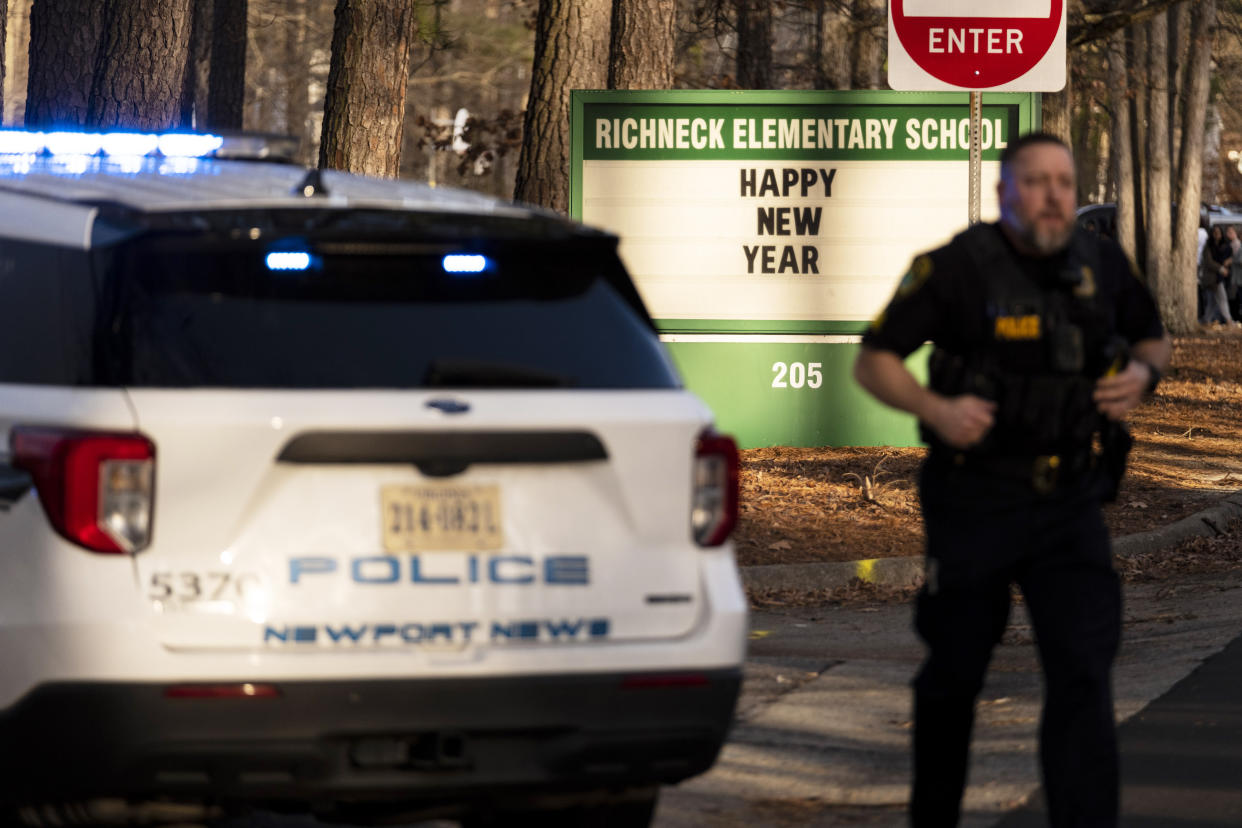
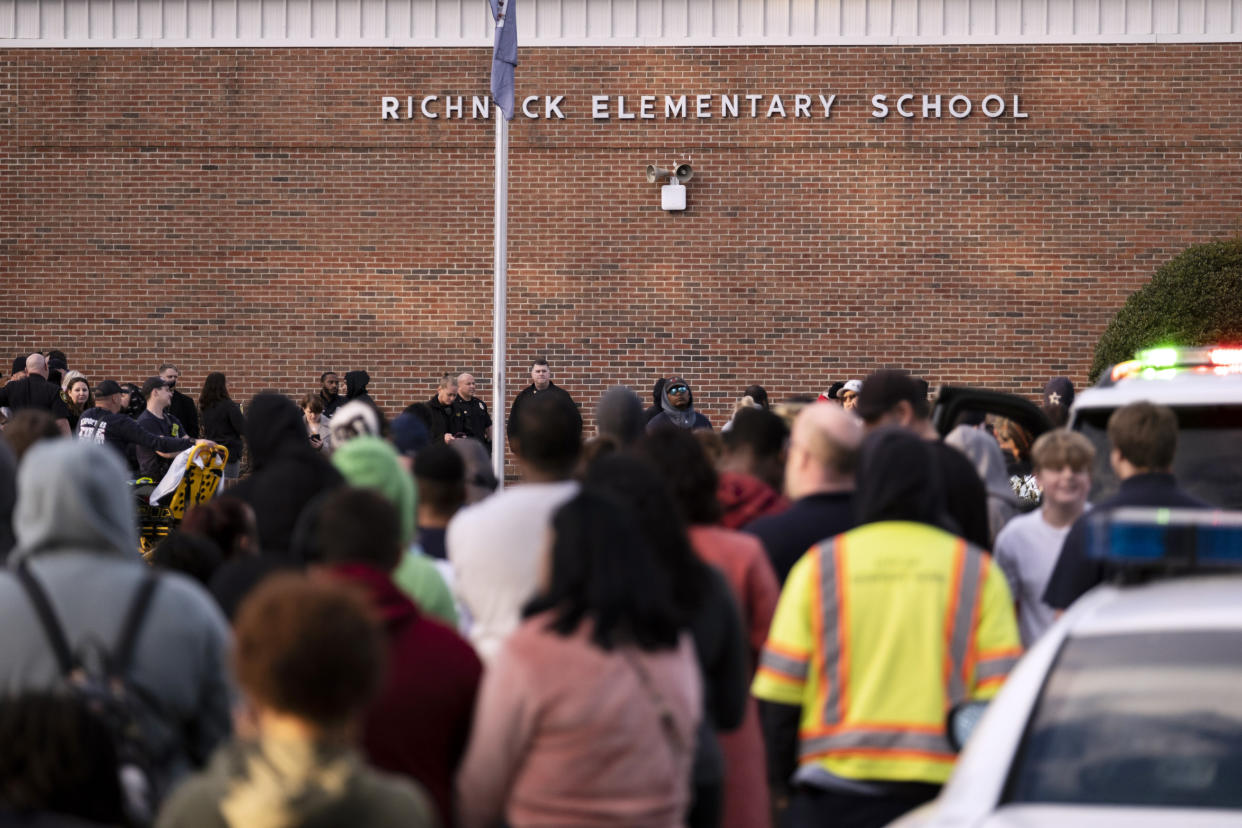
NORFOLK, Va. (AP) — A 6-year-old student shot and wounded a teacher at his school in Virginia during an altercation inside a first-grade classroom Friday, police and school officials in the city of Newport News said.
Experts said a school shooting involving a 6-year-old is extremely rare, although not unheard of, while Virginia law limits the ways in which a child that age can be punished for such a crime.
No students were injured in the shooting at Richneck Elementary School, police said. The teacher — a woman in her 30s — suffered life-threatening injuries. Her condition had improved somewhat by late afternoon, Newport News Police Chief Steve Drew said.
“We did not have a situation where someone was going around the school shooting,” Drew told reporters, later adding that the gunshot was not an accident.
Drew said the student and teacher had known in each other in a classroom setting.
He said the boy had a handgun in the classroom, and investigators were trying to figure out where he obtained it. The police chief did not provide further details about the shooting, the altercation or what happened inside the school.
Joselin Glover, whose son is in fourth grade, told The Virginian-Pilot newspaper she got a text from the school stating that one person was shot and another was in custody.
“My heart stopped,” she said. “I was freaking out, very nervous. Just wondering if that one person was my son.”
Carlos, her 9-year-old, was at recess. But he said he and his classmates were soon holed up in the back of a classroom.
“Most of the whole class was crying,” Carlos told the newspaper.
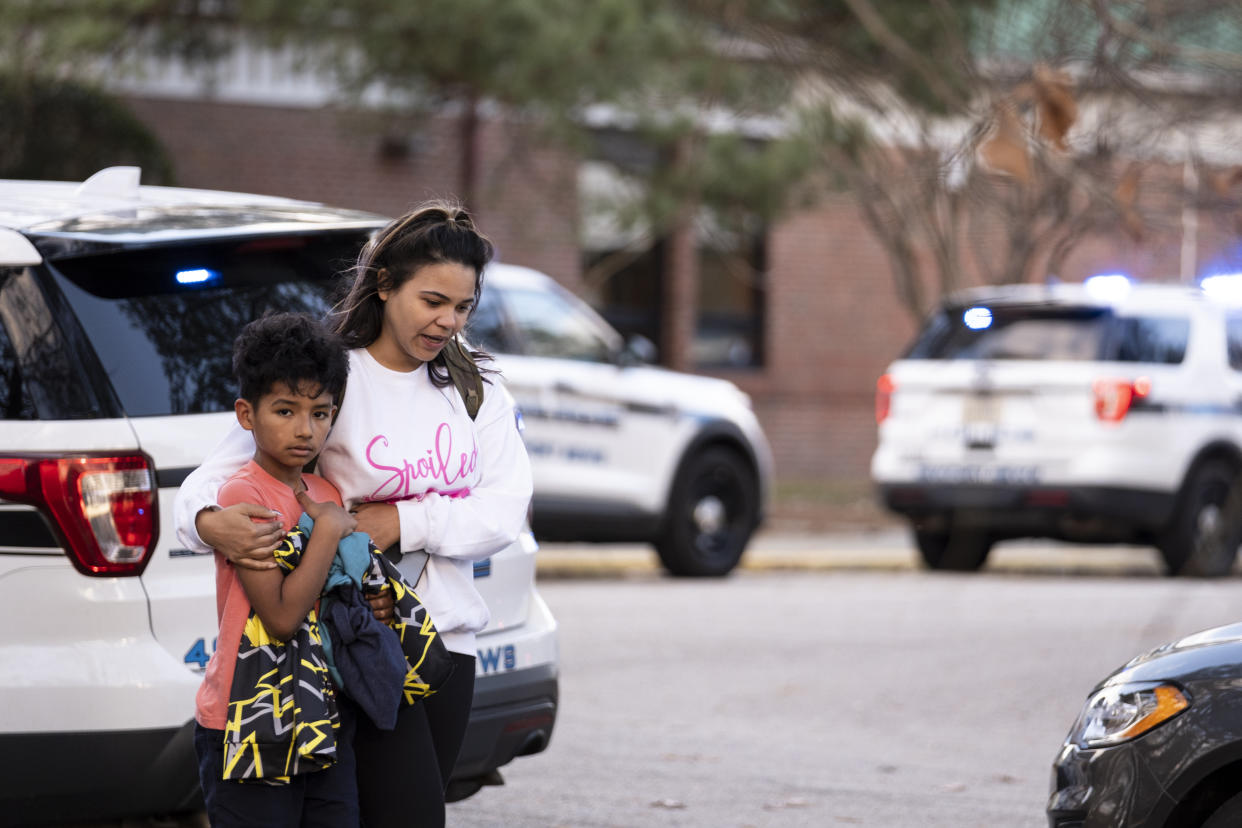
Parents and students were reunited at a gymnasium door, Newport News Public Schools said via Facebook.
The police chief did not specifically address questions about whether authorities were in touch with the boy’s parents, but said members of the police department were handling that investigation.
“We have been in contact with our commonwealth’s attorney (local prosecutor) and some other entities to help us best get services to this young man,” Drew said.
Newport News is a city of about 185,000 people in southeastern Virginia known for its shipyard, which builds the nation's aircraft carriers and other U.S. Navy vessels.
Richneck has about 550 students who are in kindergarten through fifth grade, according to the Virginia Department of Education’s website. School officials have already said that there will be no classes at the school on Monday.
“Today our students got a lesson in gun violence,” said George Parker III, Newport News schools superintendent, “and what guns can do to disrupt, not only an educational environment, but also a family, a community.”
Virginia law does not allow 6-year-olds to be tried as adults.
In addition, a 6-year-old is too young to be committed to the custody of the Department of Juvenile Justice if found guilty.
A juvenile judge would have authority, though, to revoke a parent’s custody and place a child under the purview of the Department of Social Services.
A school shooting involving a 6-year-old is extremely rare, said James Alan Fox, a criminologist at Boston’s Northeastern University.
Fox told The Associated Press Friday evening that he could think of one previous incident involving a child that age.
In 2000, a 6-year-old boy fired a bullet from a .32-caliber gun inside Buell Elementary near Flint, Michigan, 60 miles (96 kilometers) from Detroit, striking 6-year-old Kayla Rolland in the neck, according to an AP article from the time. She died a half-hour later.
Fox analyzed school shooting data sets going back to 1970 from the Center for Homeland Defense and Security, which is located at the Naval Postgraduate School in Monterey, California. He said the data listed school shootings involving children ages 7, 8, 9 and older, but not 6-year-olds.
Another factor that stands out about the Virginia shooting is that it occurred in a classroom, Fox said. Many occur outside a school building where students are unsupervised.
From 2010 through 2021, there were more than 800 school-related shootings in K-12 schools that involved 1,149 victims. Thirty percent of those occurred in the school building, said Fox, who published the 2010 book, “Violence and Security on Campus: From Preschool Through College.”
“There are students who killed teachers, more typically high school students,” Fox said. “I don’t know of other cases where a 6-year-old shot a teacher.”
___
Barakat reported from Falls Church, Virginia.

 Posts
All Comments
Posts
All Comments