Tuesday, March 10, 2015

Cuba Gives its 'Unconditional Support' to Venezuela against U.S.


Cuba Gives its 'Unconditional Support' to Venezuela against U.S.

إقرأ هذا الخبر بالعربية W460
Cuba rallied behind Venezuela on Tuesday, offering its closest ally "unconditional support" after U.S. President Barack Obama authorized new sanctions against officials of the turbulent South American oil producer.
The Cuban reaction marked its first public confrontation with the United States since the two countries began discussions in December on fully restoring diplomatic relations.
Cuba joins other leftist regional governments in closing ranks with Caracas in the deepening U.S.-Venezuela row.
An official statement published in the island's state-run media called Obama's executive order implementing the sanctions "arbitrary and aggressive."
"Cuba again reiterates its unconditional support and that of our people for the Bolivarian Revolution, the legitimate government of President Nicolas Maduro, and the heroic brotherly people of Venezuela," the statement said.
As Venezuela's economy spirals and Maduro cracks down against dissent, friendly nations said they would not tolerate foreign interference.
Ecuador's Foreign Minister warned Monday that the Southern American bloc UNASUR would not allow foreign intervention or a coup in Venezuela.
The European Union said Tuesday it has no plans to follow the U.S. lead and impose sanctions on Venezuela.
In Caracas, an irate Maduro pushed back against the new sanctions.
Shortly after they were announced he recalled his envoy to Washington and late Monday he denounced the U.S. action as "the most aggressive, unjust and harmful blow against Venezuela."
Maduro called the sanctions a "rude outburst" from Obama while surrounded by dozens of ministers and military leaders at the presidential palace.
"You have no right to attack us and declare that Venezuela is a threat to the people of the United States. The threat to the American people is yourselves," he said in the speech that lasted over two hours.
Venezuela's economy is in crisis, with soaring inflation and many basic goods unavailable or out of reach of most pocketbooks on the black market. Maduro has responded by stepping up a crackdown on dissent, arresting opposition figures and frequently speaking of coup plots.
In activating the sanctions, Obama called the situation in Venezuela "an extraordinary threat to the national security" of the United States.
The sanctions targeted Venezuelan officials who the United States said were linked to human rights abuses, including a crackdown on anti-government protests last year that left 43 people dead.
U.S. bank accounts and property of seven officials, including a police chief and intelligence chief, were frozen by the sanctions.
They extend and implement other penalties against the Venezuela adopted by the U.S. Congress last year.
"No one has the right to intervene in the internal affairs of a sovereign state or to declare, without foundation, someone a threat to national security," Cuba said.
"How is Venezuela a threat to America? A thousand miles away, without strategic weapons or having the means or staff to plot against the American constitutional order, the declaration sounds barely credible," the Havana statement said.
Cuban revolutionary leader Fidel Castro congratulated Maduro on his "brilliant and brave" stance against the U.S. in a letter also published Tuesday by the Cuban press.
"Your words will go down in history as proof that humanity can and must know the truth," Castro wrote.
Comments 0

Venezuela's Maduro Mocks Obama, Grants Himself "Special Powers" To Defend Against "Imperialist Aggression"

Venezuela's Maduro Mocks Obama, Grants Himself "Special Powers" To Defend Against "Imperialist Aggression"

Tyler Durden's picture


Maybe it is because the soap-opera factor of the puppet proxy civil war in east Ukraine is dying down, it is time for another major geopolitical diversion, and it appears that the administration's attention this time has fallen on Venezuela.
Perhaps he was tired of being accused for being too soft and engaging in a detente with not only Iran but Cuba, and so he decided to turn his attention on the one country he knew had absolutely no way of retaliating especially now that Venezuela's only asset, has become a liability and all production at current prices is a loss maker for Caracas.
Whatever the reason, as Reuters reported yesterday, the United States on Monday yesterday declared Venezuela a national security threat and ordered sanctions against seven officials from the oil-rich country in the worst bilateral
diplomatic dispute since socialist President Nicolas Maduro took office in 2013.
U.S. President Barack Obama issued and signed the executive order, which senior administration officials said did not target Venezuela's energy sector or broader economy. But the move stokes tensions between Washington and Caracas just as U.S. relations with Cuba, a longtime U.S. foe in Latin America and key ally to Venezuela, are set to be normalized. Declaring any country a threat to national security is the first step in starting a U.S. sanctions program. The same process has been followed with countries such as Iran and Syria, U.S. officials said.
The presented reason for the latest escalation was that, according to the White House, there are people whose actions undermined democratic processes or institutions, and who had committed acts of violence or abuse of human rights, and were involved in prohibiting or penalizing freedom of expression, or were government officials involved in public corruption. So just your run on the mill generic excuse to exercise waning superpower status.
"Venezuelan officials past and present who violate the human rights of Venezuelan citizens and engage in acts of public corruption will not be welcome here, and we now have the tools to block their assets and their use of U.S. financial systems," White House spokesman Josh Earnest said in a statement.

"We are deeply concerned by the Venezuelan government's efforts to escalate intimidation of its political opponents. Venezuela's problems cannot be solved by criminalizing dissent," he added.
And to think that in reality Maduro is perhaps the closest ideological peer to the US president.
As for the Venezuela president, he wasn't going to take this assault on his persona by the "imperialist" US president lying down. According to RT, he promptlyt accused the US of trying to “defeat” and “intervene in” his government.
Maduro called the sanctioned officials heroes. "President Barack Obama, representing the US imperialist elite, has personally decided to take on the task of defeating my government and intervening in Venezuela to control it,” Maduro said in a national TV address. “That’s why they have taken today’s measure.”

Maduro called the move a “colossal mistake” and “imperialist arrogance” similar to that of former US leaders such as Richard Nixon and George W. Bush.
Not surprisingly, Maduro promptly tried to turn Obama's action into his advantage by rounding the population "around the pole" of imperialist overreach, and casting himself as the tragic protagonist:
“I congratulate them,” he said, adding “it’s an honor” to be included on the US sanctions list. Maduro even named one of the sanctioned officials – national intelligence head Gustavo Gonzalez, the new interior minister.
And the biggest punchline: the Venezuela ruler will use the Obama executive order precisely as the catalyst to grant himself even more powers, because as Bloomberg reports, today Maduro will request the passage of an ‘anti-imperialist’ enabling law.
"I have put together a special law that gives me special powers to preserve the peace, the integrity and the sovereignty of the country before any situation that presents itself due to this imperialist aggression,” Venezuela President Nicolas Maduro says on state television.
Vice President Jorge Arreaza to deliver request tomorrow to National Assembly President Diosdado Cabello for a “special and extraordinary enabling law to defend the peace, the sovereignty, the tranquility and the integrity of our homeland,” Maduro says
“I will request an anti-imperialist enabling law to prepare us for all the scenarios,” Maduro said, adding that “I am obligated as head of government to apply the constitution in its entirety.”
Just like that with the stroke of a pen, Obama succeeds in cementing the public opinion against the US of yet another nation.  And perhaps just to show where Latin America's socialist allegiance really lies, despite Obama's "shift in policies" moments ago we saw this: CUBA SAYS `UNCONDITIONAL SUPPORT' FOR VENEZUELA AGAINST US: AFP.
Well, as long as Putin is the one who is isolated...
5
Your rating: None Average: 5 (14 votes)
 

- advertisements -

US Declares Venezuela a National Security Threat, Sanctions Top Officials

US Declares Venezuela a National Security Threat, Sanctions Top Officials
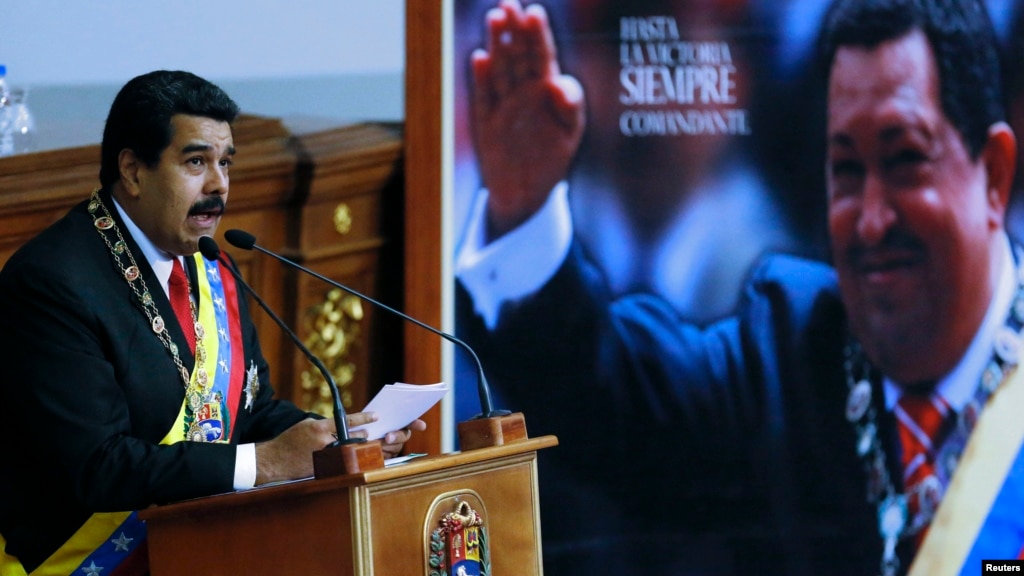
FILE - Venezuela's President Nicolas Maduro delivers his annual State of the Nation address at the National Assembly in Caracas, January 2015.

Reuters
The United States on Monday declared Venezuela a national security threat and ordered sanctions against seven officials from the oil-rich country in the worst bilateral diplomatic dispute since socialist President Nicolas Maduro took office in 2013.
U.S. President Barack Obama issued and signed the executive order, which senior administration officials said did not target Venezuela's energy sector or broader economy. But the move stokes tensions between Washington and Caracas just as U.S. relations with Cuba, a longtime U.S. foe in Latin America and key ally to Venezuela, are set to be normalized.
Declaring any country a threat to national security is the first step in starting a U.S. sanctions program. The same process has been followed with countries such as Iran and Syria, U.S. officials said.
The White House said the order targeted people whose actions undermined democratic processes or institutions, had committed acts of violence or abuse of human rights, were involved in prohibiting or penalizing freedom of expression, or were government officials involved in public corruption.
“Venezuelan officials past and present who violate the human rights of Venezuelan citizens and engage in acts of public corruption will not be welcome here, and we now have the tools to block their assets and their use of U.S. financial systems,” White House spokesman Josh Earnest said in a statement.
“We are deeply concerned by the Venezuelan government's efforts to escalate intimidation of its political opponents. Venezuela's problems cannot be solved by criminalizing dissent,” he added.
Venezuelan Foreign Minister Delcy Rodriguez told reporters that Caracas would respond to the U.S. move soon and later tweeted that Venezuela was calling home its charge d'affaires in Washington for consultations.
The two countries have not had full diplomatic representation since 2008, when late socialist leader Hugo Chavez expelled then-U.S. Ambassador Patrick Duddy. Washington at the time responded by expelling Venezuelan envoy Bernardo Alvarez.
The list of sanctioned individuals includes: Gustavo Gonzalez, head of state intelligence service Sebin; Manuel Perez, director of the national police; and Justo Noguero, a former National Guard commander who now runs state mining firm CVG. It also includes three other military officers and a state prosecutor.
The individuals' would have their property and interests in the United States blocked or frozen and would be denied entry into the United States. U.S. citizens and permanent residents would be prohibited from doing business with them.
Blame Game
The White House also called on Venezuela to release all political prisoners, including “dozens of students,” and warned against blaming Washington for its problems.
“We've seen many times that the Venezuelan government tries to distract from its own actions by blaming the United States or other members of the international community for events inside Venezuela,” Earnest said in the statement. “These efforts reflect a lack of seriousness on the part of the Venezuelan government to deal with the grave situation it faces.”
U.S. officials told reporters in a conference call that the executive order did not target the Venezuelan people or economy and stressed that upcoming legislative elections should be held without intimidation of the government's opponents.
The sanctions effectively confirm Venezuela as the United States' primary adversary in Latin America, a label that was for decades applied to Communist-run Cuba until Washington and Havana announced a diplomatic breakthrough in December.
Washington said last week it would respond through diplomatic channels to Venezuela's demand for it cut the U.S. Embassy's staff in Caracas after the government called for a plan within 15 days to reduce staff to 17 from 100 at the American facility.
Commercial ties between Venezuela and the United States have largely been unaffected by diplomatic flare-ups, which were common during the 14-year-rule of Chavez.
The United States is Venezuela's top trading partner, and the OPEC member in 2014 remained the fourth-largest supplier of crude to the United States at an average of 733,000 barrels per day - despite a decade-long effort by Caracas to diversify its oil shipments to China and India.
Opposition leader and twice-presidential candidate Henrique Capriles told Reuters the sanctions were a problem for a corrupt elite in the Maduro government, but not ordinary Venezuelans.
“It's not a problem with Venezuela or with Venezuelans; it's a problem for the corrupt ones," he said. "It doesn't affect we Venezuelans.”  

You May Like

FILE - In this Jan. 30, 2014, photo, volunteers destroy a poppy field near Loi Chyaram village in Myanmar.

Video Poppies, Power and Politics in Myanmar’s Kokang Conflict

The Myanmar government and various drug warlords, some backed by Chinese groups, have battled over the border region for decades More
A Chadian soldier peers into a burnt armored vehicle, which the Chadian military say belonged to insurgent group Boko Haram, after the Chadians destroyed it during battle in Gambaru, Feb. 26, 2015.

Can a Boko Haram-IS Merger Work?

Nigeria-based militant organization pledged allegiance to Islamic State group Saturday, leaving observers wondering about possible impact More

US Congressional Letter to Iran Stirs Controversy

Letter warns that any agreement regarding Iran’s nuclear weapons program not approved by Congress could be easily reversed by a future president More

Comment Sorting
Comment on this forum (2)
Comments
     
by: Xaaji Dhagax from: Somalia
March 10, 2015 5:44 AM
What does it mean "Venezuela is US national security threat"?
Is Venezuela became terrorist state in the eyes of America?

by: C L Who from: USA
March 10, 2015 1:46 AM
What?! This is the type of bonehead move I expect from a Republican administration. Democratic or Republican, looks like they are all imperialists when one scratches the surface very slightly.

Appalling and reprehensible act by the US.

Contact Form

Name

Email *

Message *