|


|

 |
Where is the outcry from Amnesty International and other human rights organizations? When an Arab country subjects Palestinians to actual apartheid measures, the international community is too busy lying about Israel's alleged abuses to take notice.
"It is estimated that 65% of the Palestinian refugees in Lebanon live under the poverty line." — UNRWA, October 2017.
Palestinians in Lebanon have long been prevented from practicing such professions as medicine and law, given that only the Lebanese could join professional syndicates.
Thirty-nine professions remain prohibited to Palestinians in the following fields: healthcare (general medicine, dentistry, nursing, midwifery, pharmacy) transport and fishing, services and daycare, engineering, law, tourism, and accounting.
Palestinian refugees in Lebanon are at risk of food insecurity, electricity blackouts, increased health problems and complications amid the shortages of medicine and health-care interventions. — UNRWA, January 2022.
"My husband works as a driver and earns less than two dollars a day. We mainly eat vegetables and beans because that's all we can afford. Meat and chicken have become a dream; we can't buy them because prices have increased so sharply. We no longer eat three meals a day, and sometimes I send my kids to bed without dinner." — Rihab Maajel, a 50-year-old Palestinian from Shabriha in southern Lebanon, UNRWA, January 2022.
"I fear that I may freeze to death this winter. I cannot afford to buy gas for heating." — Nawal Kayed, 66, Palestinian in Lebanon, UNRWA, 2022.
The group also noted that Palestinian refugees in Lebanon who want to receive medical treatment in a Lebanese hospital have to wait for weeks to obtain a permit. — palhrw.org, January 20, 2022.
When Palestinians in Lebanon cannot feed their children this winter, chalk it up to the world's unjust lethal obsession with Israel.
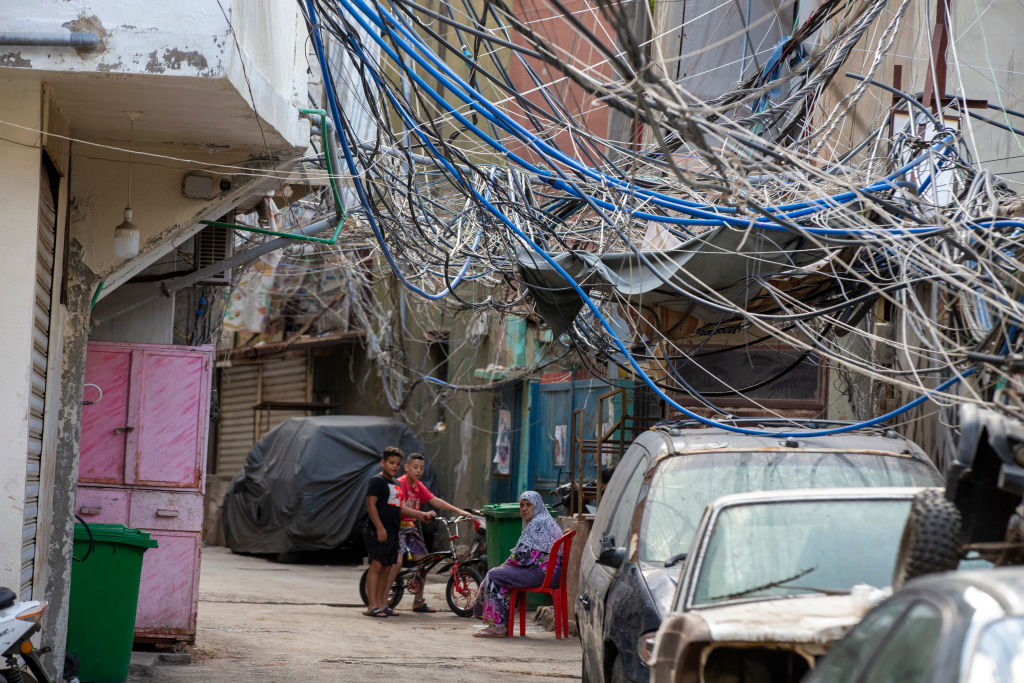 Five thousand homes belonging to Palestinians in Lebanon are at risk of collapsing and are in dire need of renovation, according to a report in the Lebanese newspaper Al-Akhbar. These are the kind of reports that Amnesty International and many human rights organizations around the world apparently choose to ignore because Israel is not involved. Pictured: Jerry-rigged electrical connections between apartment buildings in UNRWA's Borj al-Branjeh refugee camp for Palestinians in Beirut, Lebanon. (Photo by Nicolas Maeterlinck/Belga Mag/AFP via Getty Images) |
Five thousand homes belonging to Palestinians in Lebanon are at risk of collapsing and are in dire need of renovation, according to a report in the Lebanese newspaper Al-Akhbar.
These are the kind of reports that Amnesty International and many human rights organizations around the world apparently choose to ignore because Israel is not involved.
The report was published on the 25th anniversary of the Lebanese authorities' decision prohibiting the entry of construction and repair materials into Palestinian refugee camps in Lebanon without a permit. The decision was issued by the Lebanese government in 1997, and the order for its implementation was referred to the Ministry of Defense because the army is responsible for granting construction permits to the Palestinian refugee camps in Lebanon.
Seventeen years later, the Lebanese government allowed the entry of construction and restoration materials into the refugee camps, but reversed its decision after six months, without giving any reason.
The ban includes water pipes, electrical cables, wooden and iron doors, windows, cement, gravel, sand, tiles, water tanks, aluminum, glass and paint materials. A Palestinian who violates the ban and is caught trying to bring in any of the building or renovation materials without permission is arrested and transferred to an army barracks, where he is subject to an investigation and a fine.
Where is the outcry from Amnesty International and other human rights organizations? When an Arab country subjects Palestinians to actual apartheid measures, the international community is too busy lying about Israel's alleged abuses to take notice.
According to the report, 20,000 Palestinian homes in Lebanon urgently require repairs and renovation due to natural factors, and any natural disaster may endanger the lives of those living in the camps.
The report quoted an official with the United Nations Relief and Work Agency for Palestine Refugees (UNRWA) as saying that it was "only a matter of time before we witness a humanitarian catastrophe resulting from the poor conditions of the buildings."
In 2001, the Lebanese parliament approved law number 296, regarding the acquisition of real estate rights by "foreigners" in Lebanon. Various Lebanese governments have classified the Palestinians as "foreigners, refugees or stateless people," even though they were born in Lebanon. Palestinians, in addition, are generally not granted Lebanese citizenship. According to a report by the Norwegian Refugee Council:
"In 2001 the Lebanese Parliament amended the Right to Real Estate Acquisition for Foreigners... to prohibit non- Lebanese from acquiring real rights in Lebanon without a permit. The amendment was interpreted to specifically prohibit Palestinian refugees in Lebanon from acquiring real estate property rights... including through inheritance."
According to UNRWA, 63% of Palestinians in Lebanon reside in 12 refugee camps that are overcrowded and affected by sub-standard infrastructure, sanitation and housing. In addition, camp inhabitants have extremely limited abilities to improve their housing conditions, partly for economic reasons but also due to the Lebanese authorities' restrictions on the transfer of building materials into the camps. UNRWA notes:
"In the absence of Lebanese government presence in most of the camps, Palestinian political factions and armed groups exert some form of control. As a result, no single recognized authority exercises responsibility, including with respect to law enforcement. It is estimated that 65% of the Palestinian refugees in Lebanon live under the poverty line."
The issue of the entry of construction and repair materials into refugee camps is far from the only problem Palestinians have been facing in Lebanon.
Palestinians in Lebanon have long been prevented from practicing such professions as medicine and law, given that only the Lebanese could join professional syndicates.
In 1982, the Lebanese authorities further restricted the list of professions open to Palestinians, depriving them from working in more than 70 commercial and administrative professions.
In 1995, the restrictions were slightly lifted with the introduction of a new clause which exempted foreigners who were born in Lebanon, born to Lebanese mothers or married to Lebanese women from these restrictions.
UNRWA, however, has pointed out that Palestinians are still prohibited from practicing many professions, mainly due to the precondition of holding the Lebanese nationality. Thirty-nine professions remain prohibited to Palestinians in the following fields: healthcare (general medicine, dentistry, nursing, midwifery, pharmacy) transport and fishing, services and daycare, engineering, law, tourism, and accounting.
Another report published by UNRWA last month found that Palestinian refugees in Lebanon are at risk of food insecurity, electricity blackouts, increased health problems and complications amid the shortages of medicine and health-care interventions.
Rihab Maajel, a 50-year-old Palestinian from Shabriha in southern Lebanon, was quoted as saying:
"Today, we had potatoes for lunch. My husband works as a driver and earns less than two dollars a day. We mainly eat vegetables and beans because that's all we can afford. Meat and chicken have become a dream; we can't buy them because prices have increased so sharply. We no longer eat three meals a day, and sometimes I send my kids to bed without dinner."
Another Palestinian, Nawal Kayed, 66, said:
"I fear that I may freeze to death this winter. I cannot afford to buy gas for heating. The cash assistance I receive from UNRWA is barely enough to buy food and cover very basic needs."
Palestinians who fled from Syria to Lebanon over the past few years are also facing harsh and discriminatory measures.
A report published by the Beirut-based Palestinian Association for Human Rights (Witness) on January 20, 2022 revealed that Palestinian refugees from Syria to Lebanon suffer from the absence of legal protection, as the Lebanese authorities treat them as foreigners or tourists who must obtain a residence permit, which is renewed every six months.
"Palestinian refugees from Syria to Lebanon complain about the absence of UNRWA assistance," the group said. "This problem is considered one of the most difficult challenges, as refugees live in a state of anxiety and fear of arrest at any moment."
The group accused UNRWA of reducing the services it provides to the refugees, and noted that Palestinian refugees in Lebanon who want to receive medical treatment in a Lebanese hospital have to wait for weeks to obtain a permit. The group warned:
"The humanitarian situation of Palestinian refugees from Syria to Lebanon is extremely difficult... They do not enjoy legal protection in the full sense of the word. Because of the difficult conditions, their numbers have declined since the start of the Syrian crisis in 2011, from 100,000 to 27,000, with the majority believed to have emigrated from Lebanon. UNRWA bears full responsibility for their legal and humanitarian situation and is obligated to fulfill its moral and legal obligations towards them."
The director of the Lebanese-Palestinian Dialogue Committee, Abdel Nasser Al-Ayee, told the London-based Asharq Al-Awsat newspaper that many Palestinians have been fleeing Lebanon, especially over the past few years.
"The wave of Palestinian immigration from Lebanon has been on the rise since 2005, but the numbers doubled in the last two years... In 2020, between 6,000 and 8,000 Palestinians left Lebanon without returning, while in the next year 12,000 Palestinians left the country and did not return."
Palestinians in Lebanon will continue to suffer because of the discriminatory practices and policies of the Lebanese government -- but also because of the indifference of the international community.
Amnesty International and other human rights organizations are too busy bashing and delegitimizing Israel to pay attention to the real apartheid the Palestinians are experiencing in an Arab country. When Palestinians in Lebanon cannot feed their children this winter, chalk it up to the world's unjust lethal obsession with Israel.
Khaled Abu Toameh is an award-winning journalist based in Jerusalem.

|
The widespread violent unrest in Kazakhstan and subsequent arrival of mostly Russian troops who helped restore order last month exposed a further contest of rivals for power there between its ostensibly friendly neighbors, Russia and China.
One also might wonder if Russia was taking advantage of the crisis of the large Russian troop presence deployed along the Ukrainian border to divert the West's attention from Putin's objective of also eventually reabsorbing Kazakhstan into the Kremlin's orbit.
Russian troops already occupy portions of several former Soviet republics, including Georgia, the Ukraine, and Moldova -- "uninvited."
Russia also deploys elements of the former 201st Motorized Rifle Division on its base in Tajikistan, another former Soviet republic.
Kazakhstan is home to 15% of the world's supply of uranium -- necessary for nuclear weaponry as well as nuclear power plants, and is the world's largest producer of uranium.
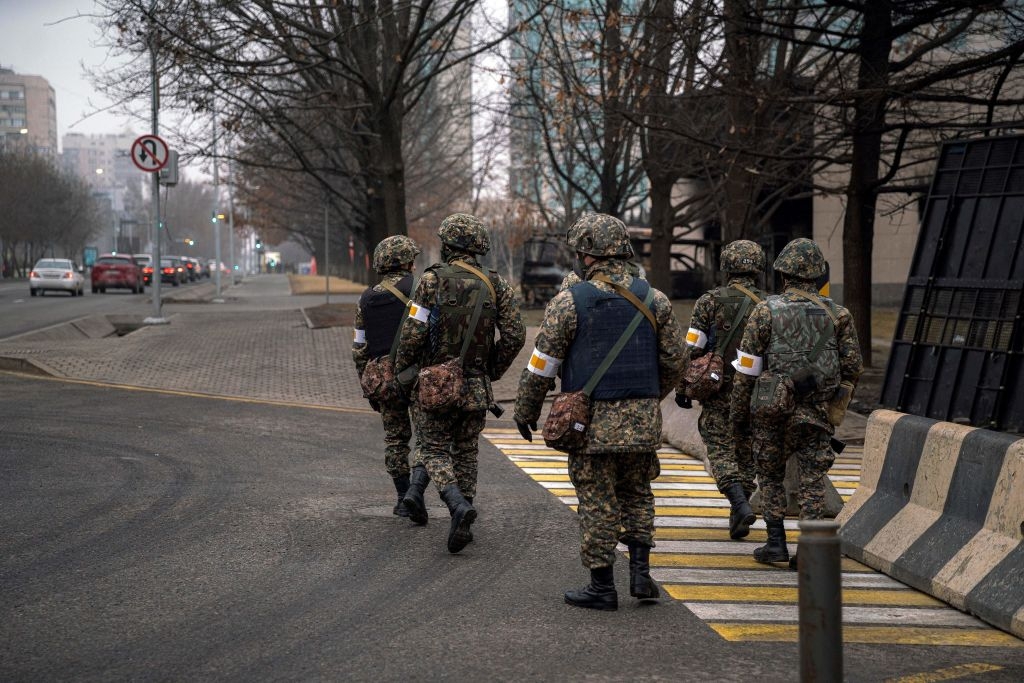 The widespread violent unrest in Kazakhstan and subsequent arrival of mostly Russian troops who helped restore order last month exposed a further contest of rivals for power there between its ostensibly friendly neighbors, Russia and China. Pictured: Kazakh soldiers patrol on a street in Almaty on January 10, 2022. (Photo by Alexandr Bogdanov/AFP via Getty Images) |
What can one believe about the recent events in Kazakhstan? According to the autocratic post-Soviet regime in Kazakhstan, peaceful protests by Kazakh citizens purportedly demonstrating against steep fuel price hikes implemented on New Year's Day were transformed into violent riots by foreign-trained terrorists. There is no indication, however, from the many thousands of arrested protestors that any of them were foreigners.
While the fuel price hike was the immediate cause of people taking to the streets of Kazakhstan's major cities, there also appears to be deep-seated anger over the wealth disparity between elites of the former Communist regime and the rest of the populace. By way of response, Kazakhstan's President Kassym-Jobart Tokayev, in an apparent attempt to reduce anti-regime anger, fired his cabinet and canceled the fuel price hike.
Tokayev, the hand-picked successor by the still powerful "retired" president and former Communist Party leader of Kazakhstan, Nur Sultan Nazarbayev, now claims that the unrest was a meticulously planned attempted coup that had internal support. Lending credence to Tokayev's accusation, while the rioting was at its peak, the president removed his unpopular predecessor, Nazarbayev, from his post as chairman of Kazakhstan's National Security Council. This move was followed on January 6 by the arrest on charges of treason of the country's former counterintelligence chief, Karim Massimov, just one day after he was fired by the president.
Unable to control the nationwide violence, Tokayev then activated the defense clause of the Russian-led Collective Security Organization (CSTO). Five days after the demonstrations began, troops from Russia and other signatories of the 1992 CSTO treaty, "flooded" Kazakhstan's Almaty airport and quickly helped restore order in the country's largest city.
One also might wonder if Russia was taking advantage of the crisis of the large Russian troop presence deployed along the Ukrainian border to divert the West's attention from Putin's objective of also eventually reabsorbing Kazakhstan into the Kremlin's orbit.
Russia's President Vladimir Putin, who once bemoaned the 1991 collapse of the Soviet Union "as the greatest geopolitical catastrophe of the century, is also quoted as belittling Kazakhstan's sovereignty by remarking in August 2014 that "Kazakhs never had a state." Putin's prime directive appears to be a desire to dominate the territorial space of the former Soviet empire which now consists of independent states. Russian troops already occupy portions of several former Soviet republics, including Georgia, the Ukraine, and Moldova -- "uninvited." Russia also deploys elements of the former 201st Motorized Rifle Division on its base in Tajikistan, another former Soviet republic.
Russia's most valued enterprise in Kazakhstan is the Baikonur launch site for Russian space missions. Russian soldiers, after entering Kazakhstan, quickly moved to protect it. The Kremlin might also believe that it has some responsibility for the welfare of Kazakhstan's 3.5 million ethnic Russians, most of whom live in the northern half of Kazakhstan.
China's primary interest in Kazakhstan seems to be that it serves as the Chinese Communist Party's Belt and Road Initiative (BRI) overland thoroughfare for export of Chinese goods to Europe and the Middle East. Kazakhstan, the world's ninth-largest country, is home to 15% of the world's supply of uranium -- necessary for nuclear weaponry as well as nuclear power plants. Most of Kazakhstan's 17 uranium mines are in the southeastern section of the country near its border with China. Kazakhstan -- the world's largest producer of uranium and now the main supplier to China's Nuclear Power Corporation -- sends more than half its annual uranium exports to China.
Kazakhstan is also blessed with huge oil fields at Tengiz and Karachaganak in the northwestern part of the country. China has investments in Kazakhstan's oil and gas reserves that give the Chinese about 24% and 13% control of these energy resources. As early as late 2019, the Kazakh regime announced that China had invested in 55 separate projects in Kazakhstan.
There is, apparently, another story behind Tokayev's request of the Kremlin-dominated CSTO security forces. Kazakhstan also is a member state of the Chinese-led Central Asian security pact, called the Shanghai Cooperation Organization (SCO) established in 2001. Only after Russian soldiers from the CSTO arrived in the Kazakh capital, did China make noise about assisting Kazakhstan to restore peace and security in the Central Asian country.
China's vocal but belated support for Kazakhstan appears politically paltry beside Moscow's quick response. The competition between these historical rivals for power and influence in Central Asia, it seems, is still being sorted out.
While both Russia and China have major investments in Kazakhstan, it is clear that Putin stole a march on Beijing by responding more rapidly to the Kazakh regime's request for security assistance. While reports indicate that CSTO units, including Russian troops are now exiting Kazakhstan, it is likely that the Kremlin will leave behind souvenirs, including military advisors, internal security officers, and logistical support technicians -- hinting at yet greater influence inside still another portion of the former Soviet empire.
Dr. Lawrence A. Franklin was the Iran Desk Officer for Secretary of Defense Rumsfeld. He also served on active duty with the U.S. Army and as a Colonel in the Air Force Reserve.
|

(ConservativeHub.com) – Since Afghanistan fell into the hands of the Taliban, reports indicate that the quality of life for its citizens has dramatically dropped. It’s especially difficult for women who are currently struggling in a battle for agency. They face extreme opposition as they try to fight for their rights, leaving them begging for help.
Women’s rights activists in Afghanistan are allegedly under threat. Kidnappings have become common, and according to activists, women have also faced public beatings, electric prods, and threats.
Activists Tamana Paryani and Parwana Ibrahimkhil reportedly became victims when armed men took them into custody on January 19. There’s been no word on either woman since the kidnapping. Since then, more women have gone missing, all with links to activist activities
According to human rights expert Sahar Fetrat, the Taliban uses these actions to send a message of power. They want them to see how protesting or activism of any kind will end; it’s about instilling fear and maintaining control.
Taliban officials, on the other hand, say they have nothing to do with the disappearances and blame the incidents on “rogue” elements within the group. But is that true?
After the Taliban took over the country, leaders have tried to convince the world the group had changed. They promised to treat women as equals and let them enjoy continued movements forward.
However, reports say that former female government workers, such as Khujasta Elham, have to sign in at work to make it look as if the new leadership is maintaining women within its ranks. Still, Elham and others receive no pay and cannot return to their former positions.
Despite the activist group’s efforts, news outlets suggest that women have lost their rights. Those who lived freely before the takeover now cower in fear; speaking out only brings hardship.
In January, representatives from the Taliban met with special envoys from Europe and the US to discuss formal recognition of the group and humanitarian aid to the nation. At that time, the other countries requested the group end all rights violations.
Afghanistan’s people are in a dire situation, but is there anything the US can do to help? How can the US and other countries best deal with a terrorist regime? If the US or another country steps in, will it even make a difference?

 Posts
All Comments
Posts
All Comments


