Democrats flew into a rage after Marco Rubio revealed the total number of USAID contracts canceled by DOGE
Mar 12, 2025
Gage Skidmore, CC BY-SA 3.0 https://creativecommons.org/licenses/by-sa/3.0, via Wikimedia Commons
Donald Trump shut down the USAID and gave Marco Rubio six weeks to determine if any programs should be preserved under the State Department.
The review is complete.
And Democrats flew into a rage after Marco Rubio revealed the total number of USAID contracts canceled by DOGE.
The Biden administration funneled more than $40 billion in taxpayer dollars per year to the United States Agency for International Development (USAID).
But an audit by Elon Musk’s DOGE exposed USAID as the most corrupt agency in the entire federal government.
The audit showed Democrats have been using USAID to fund DEI programs around the world and to topple foreign governments.
“For decades, the United States Agency for International Development (USAID) has been unaccountable to taxpayers as it funnels massive sums of money to the ridiculous — and, in many cases, malicious — pet projects of entrenched bureaucrats, with next-to-no oversight,” a White House press release read following DOGE’s audit.
All hell broke loose when Donald Trump shut down USAID and transferred the critical parts to Marco Rubio at the State Department.
Trump also placed all USAID direct-hire staffers on leave except for those deemed essential.
Employees were also notified that USAID “was beginning a reduction in force that would eliminate 2,000 U.S.-based jobs.”
A judge temporarily blocked Trump’s order placing the staff on leave.
However, that decision was overturned when a judge ruled that it was ok if the administration “deems it necessary to place thousands of workers on leave in order to review U.S.-backed foreign assistance.”
Donald Trump gave Marco Rubio six weeks to review all programs at the USAID and determine which, if any, should not be terminated.
Rubio just finished his six week review with the help of Elon Musk and DOGE.
Only 18% of the programs survived the audit.
83% were terminated that did not serve America’s interest.
“After a 6 week review we are officially cancelling 83% of the programs at USAID,” Rubio wrote on X.
“The 5200 contracts that are now cancelled spent tens of billions of dollars in ways that did not serve, (and in some cases even harmed), the core national interests of the United States,” he continued. “In consultation with Congress, we intend for the remaining 18% of programs we are keeping (approximately 1000) to now be administered more effectively under the State Department.”
He thanked DOGE for putting in long hours to help “achieve this overdue and historic reform.”
The media tried to drive a wedge between Rubio and Musk last week during the Cabinet meeting.
But they failed.
Musk commented on Rubio’s post and said he enjoyed working with him.
“Tough, but necessary,” Elon wrote.
“Good working with you,” he continued. “The important parts of USAID should always have been with Dept of State.”
Americans elected Donald Trump to take a sledgehammer to the federal bureaucracy.
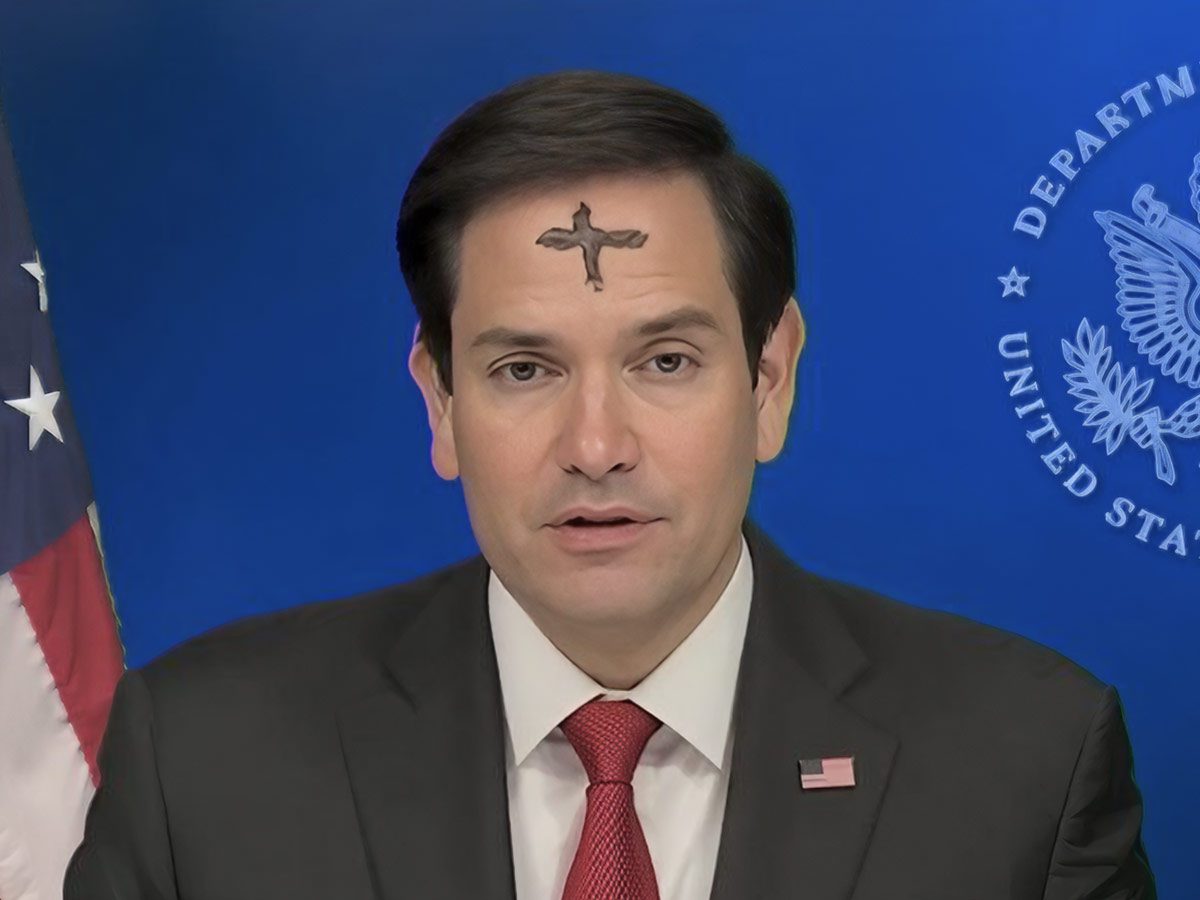
Secretary of State Marco Rubio appeared on a segment with Fox News bearing an ash cross on his forehead in commemoration of the Ash Wednesday holiday which marks the start of the Lenten season. Rubio appeared on the segment to discuss the war in Ukraine and Gaza with the cross prominently displayed. The cross is meant to be an identification with Christ, as well as sorrow for sins. The use of ashes reflects on human mortality, particularly as it relates to Genesis 3:19, which states, “Remember that you are dust, and to dust you shall return.”
Despite events unfolding in the world, the attention was turned to a question about the ashes. “Today is Ash Wednesday, a day of reflection and humility. For millions of Catholics in the United States and around the world, it is a day of faith that reminds us of our fragility and the need to do good,” he said. Rubio was raised Catholic but said in a previous interview he got “lazy” in his faith during the early years of his church. He attended an evangelical church with his wife and children before eventually returning to his Catholic roots.
The White House held an Ash Wednesday service for its staff in the Indian Treaty Room, although it is unclear if Rubio participated in that service or another. President Trump and First Lady Melania Trump issued a statement to recognize the holiday, saying, “This Ash Wednesday, we join in prayer with the tens of millions of American Catholics and other Christians beginning the holy season of Lent — a time of spiritual anticipation of the passion, death, and resurrection of Our Lord and Savior, Jesus Christ.”
Rubio received both praise and criticism for his public display of faith. “Marco Rubio not afraid to show his faith on TV- what a great example to us all,” wrote Ioana Ramona Bruynseels. Another user, however, took issue with Rubio supporting President Trump’s policies while wearing the cross. “Highly disturbing Marco Rubio carries the Ash Wednesday cross while discussing the slaughter of human beings in Gaza. Grotesque.” Other politicians have appeared in public capacities with ash crosses, including former president Joe Biden and former governor of Florida, Jeb Bush. According to sources close to Rubio, he “does not believe that expressing his faith is incompatible with his diplomatic duties.”
Join our mailing list to receive more stories like this delivered daily!
By filling out the form above, you will be signed up to receive Beliefnet's Daily Bible Reading newsletter and special partner offers. You may opt-out any time.
Paul, a servant of God and an apostle of Jesus Christ, to further the faith of God's elect and their knowledge of the truth which accords with godliness, in hope of eternal life which God, who never lies, promised ages ago and at the proper time manifested in his word through the preaching with which I have been entrusted by command of God our Savior; To Titus, my true child in a common faith: Grace and peace from God the Father and Christ Jesus our Savior. This is why I left you in Crete, that you might amend what was defective, and appoint elders in every town as I directed you, if any man is blameless, the husband of one wife, and his children are believers and not open to the charge of being profligate or insubordinate. For a bishop, as God's steward, must be blameless; he must not be arrogant or quick-tempered or a drunkard or violent or greedy for gain, but hospitable, a lover of goodness, master of himself, upright, holy, and self-controlled; he must hold firm to the sure word as taught, so that he may be able to give instruction in sound doctrine and also to confute those who contradict it. For there are many insubordinate men, empty talkers and deceivers, especially the circumcision party; they must be silenced, since they are upsetting whole families by teaching for base gain what they have no right to teach. One of themselves, a prophet of their own, said, "Cretans are always liars, evil beasts, lazy gluttons." This testimony is true. Therefore rebuke them sharply, that they may be sound in the faith, instead of giving heed to Jewish myths or to commands of men who reject the truth. To the pure all things are pure, but to the corrupt and unbelieving nothing is pure; their very minds and consciences are corrupted. They profess to know God, but they deny him by their deeds; they are detestable, disobedient, unfit for any good deed.
Judgment Day is coming, but do you know what you will be judged for? Like a final exam at the end of a semester, wouldn’t it be better to know what you are going to be tested on rather than flying blind on that fateful day? Four different times, Jesus spoke about a coming Judgment Day when the living and the dead must stand before Him and give an account of their lives. At the end of that day, one thing above all will be judged: what we did with Jesus, the Son of God. Did we accept Him, believe in Him and humbly walk under His authority? Or did we reject Him, ignore Him and live as if He never existed?
But that is not all that we will be judged for on Judgment Day. The Bible says that we will have to give an account for our entire lives. This is where many well-meaning Christians wade into confusion, projecting our priorities onto God, assuming that what is important to us is important to God. Just as dangerous, we assume that what is important to our church must be important to God. Because Judgment Day is so vital to Christians, the Bible is not silent on what we will and what we will not be judged for on that day. Judgment Day is the ultimate final exam, and God has already told us what to prepare for. Here are four surprising things that you will and will not be judged for on Judgment Day.
You won’t be judged for your intentions.
This is a trap that too many Christians fall into. We do not obey God like we know we should, but we feel like if we at least want to obey God if we intend to, that this somehow counts. Jesus told a story about this in Matthew 21:
What do you think? There was a man who had two sons. He went to the first and said, ‘Son, go and work today in the vineyard.’
‘I will not,’ he answered, but later he changed his mind and went.
Then the father went to the other son and said the same thing. He answered, ‘I will, sir,’ but he did not go. Which of the two did what his father wanted?
We can verbally tell God everything He wants to hear. We can agree with everything the Bible says. We can intend to live out as much of the Christian life as there is to live. But on Judgment Day, we will not be judged on our intentions but on our actions.
You won’t be judged for how much you attended church.
This one is tricky because this is the baseline expectation for most churches today. At the end of the day, success for most churches is getting you to come and sit in a pew for an hour a week. Singing along, making an offer, or even volunteering is extra credit. If you just show up, that is enough, or at least that is the expectation.
But that mistake is the very definition of church. When Jesus told Peter, “And I tell you that you are Peter, and on this rock I will build my church” (Matthew 16:18), the Greek word ‘church’ literally means ‘assembly’ or ‘gathering.’ Only later in church history would a Germanic word meaning ‘house of the Lord’ be translated into that verse. When Jesus talks about the church, He never means the building but the people. The church has never been the building. Church has never been something you attend in a specific building at a specific time. Church has always been the followers of Jesus, living out His commands in their daily lives. You will not be judged for how many services you attend, but you will be judged for how you live out His commands in your everyday world.
You will be judged for how you developed your potential.
When the disciples ask Jesus about the end times and the coming judgment, Jesus proceeds to tell them two stories, two parables. The first is known as the Parable of the Talents or the Parable of the Bags of Gold (Matthew 25:14-30). In this story, a master goes away on a long journey and gives three of his servants three different sums of money. When the master comes back (alluding to Judgment Day), he holds his servants accountable for what they did with what was given to them. The first two servants were given differing amounts, but both doubled what was given them. The second servant was not condemned because he did not earn as much profit as the first servant; he was commended because he did the best with what was given to him. The third servant was condemned not for squandering his money but for failing to leverage it and invest it.
Too often, Christians sit around moping because they don’t have this gift or this talent. You won’t be judged for someone else’s potential. Whether you have been given five talents, two talents or one talent, develop the potential that God has placed in your life. That is what you will be judged for on Judgment Day.
You will be judged for how you cared for others.
The second story (or parable) that Jesus tells His disciples about Judgment Day is known as the Parable of the Sheep and the Goats (Matthew 25:31-46). In this parable, the king comes and sits in judgment on his people. As he separates his people as one would separate the sheep from the goats, his criteria is what’s surprising:
Then the King will say to those on his right, ‘Come, you who are blessed by my Father; take your inheritance, the kingdom prepared for you since the creation of the world. For I was hungry, and you gave me something to eat; I was thirsty, and you gave me something to drink; I was a stranger, and you invited me in; I needed clothes, and you clothed me; I was sick, and you looked after me, I was in prison, and you came to visit me’ (Matthew 25:34-36).
His people are surprised at this criteria, and the king replies, ‘Truly I tell you, whatever you did for one of the least of these brothers and sisters of mine, you did for me’ (Matthew 25:40). This judgment is surprising is because it goes against how the average Christian is conditioned today. We know the greatest commandment is to love God with all of our heart, soul, mind and strength (Matthew 22:37). What we tend to do is separate that from our responsibility to love others. We think that if we focus all our attention on God, He will be pleased. Getting around to loving others is optional. But when Jesus gave us the greatest commandment in Matthew 22:37-38, He also added that just as important is ‘loving your neighbor as yourself.’ This speaks to the deeper truth that the best way to love God is to love others. On Judgment Day, this is what we will be held to account for.
The one thing Jesus repeated again and again is that Judgment Day is coming at a time when we least expect it. It is a final exam, but it will appear like a pop quiz without warning. That is why Jesus went to such lengths to teach His disciples and us how to pass this great final exam. Don’t just intend to obey God, obey Him. Don’t just attend church, be the church. Don’t complain about someone else’s potential; develop the potential given to you. And love God by loving His children. It is up to us to do our part and ace the test.
The Bible is full of wisdom, but it is often misquoted and misunderstood. The same goes for Jesus’ words. While the teachings of Jesus only lasted around three years prior to His death, in that short amount of time, a tremendous world of truth, myth, legend and superstition was built around Him. Even though Christians share a particular set of beliefs that they hold as essential to their faith, there are a wide range of interpretations and opinions when studying the Bible. Today, readers and carriers of the message often hear particular verses and passages in ways they were not intended to be heard.
While the Bible is often quoted, it is just as often misquoted. There are also a number of things that Christians will say or do that they think are biblical but are totally not rooted in Scripture. They may do these things based on false teachings, a limited understanding of God’s Word or simply because they believe that action holds little weight in God’s eyes. It’s important to know facts about the Bible and that we take God seriously, mainly if you are living by the Word and professing it to others. Here are six things Christians like to do that aren’t biblical.
Say things that aren’t in the Bible.
In Psalm 119:16, David promises God, “I shall delight in Your statutes; I shall not forget Your word.” In Deuteronomy 11:18-19, God encourages the Israelites, “You shall therefore impress these words of mine on your heart and soul, and you shall bind them as a sign on your hand, and they shall be as frontals on your forehead. You shall teach them to your sons, talking of them when you sit in your house and when you walk along the road and when you lie down and when you rise.”
As believers, we know we are to study the Bible, memorize it and obey it. But the Bible doesn’t always say what we think it says, and there are a number of phrases that sound like they come from the Bible, but they don’t. God left us the Bible as a written testimony of His Word. His truth is found in the Bible. Some sayings are simple rewordings of biblical truth, but others are dangerous heresy. Despite how clever or even edifying a quote may be, if it isn’t in the Bible, we have no guarantee that it is the Word of God.
Read horoscopes to determine future events.
The fascination with astrology and horoscopes undoubtedly reflects people’s desire for wisdom beyond their own and direction for the future. Astrology is the ancient belief that a person’s destiny can be found in the pattern of the stars and planets at the time of one’s birth. The “horoscope” is the chart that attempts to describe that destiny. The Bible mentions the astrologers of the royal court at Babylon and their inability to tell or interpret royal dreams (Daniel 2:10-11 and 4:7).
Isaiah the prophet spoke of astrologers with scorn: “Let your astrologers come forward, those stargazers who make predictions month by month, let them save you from what is coming upon you” (Isaiah 47:13). Astrology is offensive to God because it attributes to planets and stars the power that belongs to God alone and because it tries to find the Will of God by other means that God has appointed.
Tithing based on a sense of obligation.
Not very many people are comfortable talking about the ways they give monetarily to the church. Most would rather not talk about it at all. So many Christians look at tithing as a final issue when it’s really a matter of the heart. In the Old Testament, God instructed His people to tithe – give ten percent of their income to meet the needs of the religious, economic and political system of ancient Israel. In the New Testament, Jesus set a higher standard, though it was a less precise standard. The Bible says giving is to be done cheerfully, rather than as an obligation (2 Corinthians 9:6-7), and not for public recognition (Matthew 6:1-4). Too often, we treat our financial situation and other resources as though God needs them. Rather than give out of a place of gratitude and joy, we see ourselves as thrifty overseers, doling out scarce resources. We forget that every good thing comes down from our Father in heaven (James 1:17).
Blame karma.
Karma is a theological concept found in Buddhist and Hindu religions. It is the idea that how you live your life will determine the quality of life you will have after reincarnation. If you are unselfish, kind, and holy during your lifetime, you will be rewarded by being reincarnated into a pleasant life. However, if you live a life of selfishness and evil, you will be reincarnated into a less-than-pleasant lifestyle. In other words, you reap what you sew. Some Christians buy into the notion of karma, but this concept isn’t biblically based. Karma is based on the theological belief in reincarnation. The Bible rejects the idea of reincarnation; therefore, it does not support the idea of karma. The concept of reincarnation and karma is incompatible with what the Bible teaches about life, death and the sowing and reaping of eternal life.
Believing in superstition.
Superstition is based on the faith of an object having magical powers. Another word for superstition is “idolatry.” The Bible does not support the idea of things occurring by chance, but nothing is done outside of God’s sovereign control. Either He causes or allows everything in keeping with His divine plan (Acts 4:28; Ephesians 1:10). There are many types of superstitions in the world, ranging from benign – such as not walking under a ladder – to magic, divination, voodoo and sorcery. Idolatry is forbidden. These types of practices are dangerous because they open the minds of the practitioners to the influence of the devil. First Peter 5:8 warns us to “be self-controlled and alert. Your enemy, the devil, prowls around like around like a roaring lion looking for someone to devour.”
Drinking to get drunk.
Getting drunk is prohibited in the Bible. While it is a sin, for centuries, there has been significant debate around the topic of drinking in moderation and even more in recent years. With the shift toward postmodernism, practices that were once discouraged by the Christian community have been embraced and even promoted. Whether it be alcohol, drugs or some other addictive behavior, Jesus said, “You cannot serve two masters” (Matthew 6:24). When we get drunk, we are serving a master other than the Lord. Choosing to follow Jesus means choosing against our old sinful patterns and lifestyle. First Corinthians 6:10 lists drunkards among those who “will not inherit the kingdom of God.”
The Bible is the single most important book ever written. It is an eyewitness account of historical events of such magnitude that they have literally shaped the world in which we live. Without the Bible, the Western world and a good deal of the Eastern would be completely different today than if the events of the book had never occurred. The Bible is remarkable. It is unique. No other book has any such credentials. No other book even comes close. Our words and actions must align with our faith.


 Read Previous Post






 Posts
Posts

