
A seemingly unconventional figure is emerging as a leader within the Democratic Party, creating a noteworthy internal identity crisis.
Alexandria Ocasio-Cortez (AOC) is carving a prominent role within the Democratic Party as seen by her rising influence not only in policy discourse but also in public favor. A Co/efficient poll indicates that 26% of Democrat voters perceive AOC as the emblem of the party, rivaled only by the sentiment that “no one” holds the title. Such figures highlight a shifting dynamic that places Ocasio-Cortez on a possible trajectory towards a 2028 presidential bid.
AOC’s popularity stems largely from young and progressive voters who resonate with her anti-Trump stance and effective use of social media to communicate her initiatives. As Democrats grapple with the aftermath of losing the White House and Congress, her ability to challenge Republican policies and energize the base positions her as a contender for future leadership roles within the party.
Democratic voter sentiment appears bleak as only about one-third express optimism about the party’s future—down from 60% in mid-2024. Amidst this slump in confidence, Bernie Sanders remains a respected figure, yet fails to match the fervor surrounding AOC. Her ascendancy highlights a generational divide as senior Democrats like Chuck Schumer face dwindling favor among supporters.
“I’m not real high on Democrats right now,” said poll respondent Damien Williams, a 48-year-old Democrat from Cahokia Heights, Illinois. “To me, they’re not doing enough to push back against Trump.” – Damien Williams.
The survey further reveals that 55% of Democrats express dissatisfaction with the current processes of leadership selection, with unease about congressional districting and the Electoral College system. Republican counterparts, however, reflect a more optimistic outlook with 55% content about their party’s direction.
Considering current trajectories, speculation swirls around AOC making a potential bid for the presidency in 2028. Her relentless challenge against the Trump-era policies, seasoned rhetoric in congressional sessions, and partnerships with Bernie Sanders for boosting morale portray her as the dynamic leader Democrats may rally behind. Democrats perceive AOC as an asset in navigating their identity crisis, offering a fresh face capable of bridging generational gaps.
“Currently, there is no consensus on the face of the Democrat Party, as a majority of voters either give the title to AOC (26%) or simply say there is none (26%). Bernie Sanders falls in a distant second, followed by a handful of others who fail to reach double digits.” – Co/efficient poll.
As Democrats navigate these turbulent political waters, the focus remains on fostering effective, unified leadership capable of resonating with Americans across the board to solidify the party platform for forthcoming electoral contests.
| ||||||||||||||||||||||||||||||||||||||
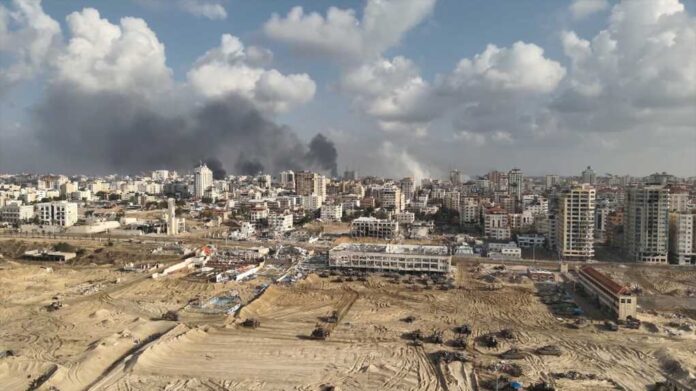
Arab leaders gathered in Baghdad, urgently calling for a ceasefire and humanitarian aid for Gaza amidst ongoing conflicts.
The Arab League summit in Baghdad spotlighted the dire situation in Gaza, urging immediate international action. Leaders called forfinancial support from global institutions to fund the reconstruction of the war-torn area, stressing the urgency of delivering humanitarian aid without barriers. The meeting, attended by key figures like Iraq’s Prime Minister Mohammed Shia al-Sudani and UN Secretary-General Antonio Guterres, underscored a united front in addressing Gaza’s ongoing crisis.
Prime Minister al-Sudani condemned the atrocities in Gaza, labeling them as genocide. To aid reconstruction efforts, Iraq announced a $20 million contribution, emphasizing Iraq’s commitment to reversing Gaza’s devastation. The summit called for an end to violence not only in Gaza but also in the West Bank, reflecting an urgent need for peace and stability in the region. Leaders stressed that rebuilding efforts must ensure Gaza’s 2.4 million residents remain undisturbed in their homeland.
The summit also witnessed influential international participation, with both UN and Spanish leaders criticizing the conditions in Gaza. UN Secretary-General Guterres argued for a permanent ceasefire, the release of hostages, and unobstructed aid flow to Gaza. Spanish Prime Minister Pedro Sanchez proposed that the International Criminal Court should examine whether Israel complies with aid delivery protocols. These interventions from global figures underscore the imperatives of international humanitarian principles.
“We need a permanent ceasefire now, the unconditional release of the hostages now, and the free flow of humanitarian aid ending the blockade now.” – United Nations chief Antonio Guterres.
While some members of the Arab League focused on Gaza, there were broader discussions addressing regional stability, including Syria’s situation post-Bashar al-Assad. The summit’s timing alongside US-Iran nuclear talks brought an additional layer of geopolitical complexity, highlighting the interconnectedness of Middle Eastern affairs. U.S. President Donald Trump’s Middle East tour, suggesting potential US involvement in Gaza, was a point of contention, further increasing the stakes and pressures faced by summit attendees.
This gathering marked a historic occasion for Iraq, hosting the summit for the first time since 2012. It served as an opportunity to showcase Iraq’s stabilizing role on the regional stage and its capacity to bridge gaps within the Arab world. Beyond the immediate crises, the summit highlighted the collective resolve of Arab nations to push for long-term peace and economic stability, committing to initiatives that promise not only immediate relief but sustainable growth and cooperation.
“This genocide [in Gaza] has reached a level of ugliness unparalleled in all conflicts in history.” – Iraq’s Prime Minister Mohammed Shia al-Sudani.
The summit’s resolutions emphasized a roadmap for rebuilding and reconciliation, aiming to craft a future where violence and misunderstanding no longer overshadow the possibilities for a peaceful co-existence and development. For Gaza and its inhabitants, this gathering promised not just reconstruction, but a renewed hope for enduring stability and progress.

 Posts
All Comments
Posts
All Comments