Wednesday, January 8, 2020

Jewish Prayer brought to you by by My Jewish Learning A Recipe for Happiness Eilu Devarim: A Recipe for Happiness


If you are having trouble viewing this email, click here.

 
Jewish Prayer
brought to you by
by My Jewish Learning
A Recipe for Happiness
This relatively obscure prayer offers deep psychological insight into the components of human happiness. The daily actions it recommends are remarkably consistent with what contemporary psychology has learned about living a happy life. 

 
Say a Prayer
Blessings for the Morning
Eilu Devarim is recited each day as part of a series of introductory blessings and psalms that kick off morning services. 
 
Torah
Happiness Through Gratitude
Modern science has shown that expressing gratitude has many positive effects, from improved health to greater happiness. Modeh Ani is another morning prayer that expresses thanks for the daily miracle of renewed life. 
 
Looking Beyond
You Shall Be Joyful
Jewish tradition requires one to be happy, but are our emotions really in our control? 
Prayer has been the foundation of Jewish ritual and practice for thousands of years, but you may still wonder how and why to say the prayers in the canon. At My Jewish Learning, we invite you to explore the deeper side of prayer. Each week we'll share a unique exploration of a particular Jewish prayer, plus offer background materials and more to enhance your understanding. In the meantime, you can explore all of MJL's prayer resources here.
 
Image
 
 
Facebook
 
Twitter
 
Instagram
 
YouTube


Western Feminists AWOL in Supporting Abused and Dissident Muslim Women by Phyllis Chesler Special to IPT News


Steven Emerson, Executive DirectorJanuary 8, 2020

Western Feminists AWOL in Supporting Abused and Dissident Muslim Women

by Phyllis Chesler
Special to IPT News
January 8, 2020

Muslim and ex-Muslim feminists and dissidents have been risking torture and death in the Middle EastCentral AsiaAfrica, and the Far East by refusing to wear the hijab and by adopting other Western ways.
Bizarrely, Western feminists and accomplished and powerful women, including diplomats and politicians, are donning the hijab as a gesture of culture "sensitivity" and as a symbol of resistance to alleged racism.
For example, the American female lawyers defending the jihadists in Guantanamo Bay, including 9/11 mastermind Khalid Sheikh Mohammed, are wearing hijabs and abayas so they will not "offend" their clients, and as a way of gaining their trust.
"Women on Mr. Mohammed's team mostly wear long skirts and other loose-fitting clothes topped by a variety of colorful scarves, shawls, head coverings and, in at least one instance, a one-piece, pull-on hijab," the New York Times reported Dec. 27.
Something is radically wrong with this picture, and I've been writing about it for more than 20 years in book after book. My strongest allies are brave Muslim and ex-Muslim women and men, as well as other tribal feminist activists (Sikhs, Hindus). With exceptions – like Eleanor Smeal's campaign against the Afghan burqa in the 1990s – most liberals, leftists, and feminists support Sharia-compliant customs of all kinds. Westerners support barbaric behaviors due to the influence of multi-cultural relativism, a commitment to tolerating even the intolerant, and as a statement against Western racism. In doing so, they betray their own feminist and humanitarian principles.
The hijab is a symbol of female subordination. When Western feminists fetishize it, they also cover for the extreme and barbaric abuse of women that often is hidden beneath the Islamic veil.
Ex-Muslim Yasmine Mohammed, a Canadian citizen of Egyptian and Palestinian ancestry, just published a dramatic and heartbreaking memoir, Unveiled: How Western Liberals Empower Radical Islam. In it, she describes a childhood of horror, one in which as a girl, "you are taught to be ashamed of everything you do, everything you are."
Daily beating, strangling, slapping, hair pulling, death threats, and domestic servitude are normalized, as is the most extreme verbal abuse, mainly from her mother: "I pissed you out," she said. "You are my urine...You are a turd that I should have flushed...You are nothing."
Yasmine Mohammed's childhood reads like a page taken from my book, Woman's Inhumanity to Woman, a book that major feminist leaders in the West cautioned me not to publish lest the "men use it against us."
But Yasmine understands:
"Quite often, unfortunately, in misogynistic societies, mothers are vicious to their daughters. Exerting power over their (female) children is the only domain where it is acceptable."
Yasmine is taught to bow to her mother every morning, to literally kiss her mother's feet. She is sleep-deprived, forced to rise before dawn to memorize the Qur'an. Yasmine's mother ignores the fact that her husband (Yasmine's stepfather) is "molesting" Yasmine and participates happily in her daughter's being beaten, hung upside down from a hook "like a dead animal" so that the soles of her feet could be whipped. Yasmine dealt with the pain inflicted by the torturous punishments by escaping her body, "disassociating" is the word currently used in psychiatry.
Like other victims of torture, and prisoners of war and combat, such extreme childhood abuse leads to Post Traumatic Stress Disorder. It is rarely valorized or viewed compassionately when the sufferer is a woman.
Eventually, Yasmine's mother forces her into an arranged marriage with a man – whom the mother herself covets and endlessly tries to seduce – who turns out to be an al-Qaida operative who rapes and beats her. He flees—but is ultimately jailed in Egypt as a jihadist.
If I had not read at least 50 other memoirs published mainly by Muslim and ex-Muslim women, but also by or about Sikh and Hindu tribal childhoods, all of which detail similar childhoods, I would probably view Yasmine's tale as a one-off. However, it is a terrifying typical account of growing up in a tribal family, trapped with a mother whose only power resides in tormenting, breaking, controlling, and destroying her daughters.
For similar examples of normalized extreme child abuse, we have Ayaan Hirsi Ali's Infidel; Sami Alrabaa's Veiled Atrocities; Sunny Angel's Wings; Sarbit Kaur Athwal's Shamed, Aruna Papp's Unworthy Creature, Jasvinder Sanghera's Shame, Soraya Mire's The Girl with Three Legs, andSouad's Burned Alive.
Sunny (Sunita) Angel, a UK-based Hindu, is stalked and kidnapped by a sadistic Muslim man who has told her he is a Hindu. Her family thinks so little of her that they do not try to find or rescue her. Daily, he beats her "black and blue," locks her in, day after day, does not allow her to use a bathroom, starves her, sometimes "knocks her unconscious," and keeps her in darkness for "days on end." He also forces her to watch pornography so she can learn how to "please him." Sunny is soon covered in "hundreds of scars (from) cuts, burns, or whip marks."
This man knew Sunny was vulnerable because he'd observed how her family had demeaned, bullied, abused and "treated (her) with contempt" even in public. When Sunny escaped and returned home, she "went to hug Mum but she recoiled. 'I don't want you, I don't want you.' My mother's hostility left me empty." Finally, Sunny, similarly abused in a face-saving arranged marriage, turns to her father for help. He tells her: "You belong to them now. They can do whatever they want."
In The Girl with Three Legs: A Memoir, Somali-American Muslim, Soraya Mire writes about her mother's insistence that she be genitally mutilated and about what happened when the butchering went south. Doctors wanted to open her scar but her mother refused, thus sentencing Mire to a lifetime of pain caused by edema, inflammation around the scar, a permanent urinary tract infection...a vaginal obstruction, blood clots, and a swollen abdomen." Her mother refused surgery: "Tell these doctors I respect their opinions but they have to show respect for our life."
The scar sealing her vagina was proof of Soraya's virginity.
Then, Soraya was married off to a first cousin who happened to be a sadistic drug addict. He torture-rapes her on their wedding night. Soraya turns to her mother for help—to the woman whose values Soraya herself has internalized.
Thus, for years, Soraya herself refuses to open her scar. She finally does so.
Many abused victims, both Muslim and non-Muslim, often return to their families for help. In the West, abused women tend to marry men who abuse them. Tribal women are forced into arranged marriages in which they are routinely abused. Too many face honor violence from relatives if they step out of line even slightly.
Soraya begins to help other genitally mutilated African women. After receiving a Winnie Mandela Award for the Upliftment of African Women at the John Jay College of Criminal Justice in New York, she rushes to call...her mother! "Mother listened calmly, then said: 'You would win all the awards and become famous but you will always be nothing to me.'"
Like Soraya, no matter how extreme the abuse, both Yasmine and Sunny continued to cling to their mothers, unable to give up the illusion of connectedness. All three return again and again to the mothers, who continue to express nothing but hate for their daughters.
Girls who have suffered such extreme abuse also have identities which are defined only as that of a daughter, sister, cousin, and wife; they would have a hard time breaking free, even to save their own lives. They do not exist, psychologically, as individuals and have been taught that they do not really deserve to live. This is what got me interested in studying the variables associated with successful escapes from honor violence.
Yasmine tried to escape when she was still a child but a politically correct Canadian judge sent her back into an abusive home despite the evidence of physical abuse. "The judge ruled that corporal punishment wasn't against the law in Canada," she wrote, "and due to our 'culture,' sometimes those punishments can be more severe than the average Canadian household."
Yasmine wonders: Had she been "white," would the authorities have removed her and sanctioned the parents/step parents who believed in practicing child torture?
What Yasmine does not understand is why Western feminists have refused to stand with feminist dissidents such as herself. In addition, "(the Western authorities) only see the skin color or the ethnicity of the perpetrator, not the acts they commit."
Lost in all these politically correct narratives are the fates of girls and women of color who are being tortured or slaughtered by their families for "honor's" sake and/or who are being jailed, tortured, or murdered for refusing to wear hijab, marry their first cousins, and for adopting other Western ways.
When some fundamentalist/Islamist Muslim parents or husbands enter a family, they may force women and girls to "cover" and excessively monitor female behavior. Zeyno Baran's The Other Muslims: Moderate and Secular, and Samia Labidi's essay in this collection strongly illustrate this fact.
Some years ago, the London based Centre for Social Cohesion posited that such ownership, coercion, and forced "covering" of women could be correlated with support for, or even the perpetration of, violent jihad. Common sense suggests that this might be the case but hard evidence eludes us. At the very least, such Sharia-compliant family control of women may function as a breeding ground for infidel hatred and for blood libels against Jews.
Therefore, I very much look forward to Abigail R. Esman's forthcoming book from Potomac Press on this very subject. Here is Esman, in a personal interview about this work:
"The oppression of women is closely related to a tendency towards violence ... Since the abuse of women and a warrior-hero view of masculinity are inherent to honor cultures such as Islam (and often as well in Latin America), there tends to be a good likelihood that men who grow up witnessing the abuse of women — and especially those who are abused themselves as boys — will grow up to be violent and to associate their manliness and honor with violence and conquest. This makes them easily radicalized by jihadist recruiters who promise them eternal honor, eternal admiration (love), confirmation of their manliness, and power."
Dr. Phyllis Chesler is the author of 18 books, including "A Politically Incorrect Feminist," "Islamic Gender Apartheid," and "A Family Conspiracy: Honor Killing and "An American Bride in Kabul." She is a Fellow at the Middle East Forum.
The IPT accepts no funding from outside the United States, or from any governmental agency or political or religious institutions. Your support of The Investigative Project on Terrorism is critical in winning a battle we cannot afford to lose. All donations are tax-deductible. Click here to donate online. The Investigative Project on Terrorism Foundation is a recognized 501(c)3 organization.  

Swing district Dems face unhappy voter base after impeachment vote

January 7, 2020 by Patriot News Alerts

House Speaker Nancy Pelosi (D-CA) has charged ahead with impeachment without regard to how voters may respond in 2020, and it’s backfiring in a way that has the potential to end her reign as her party’s leader.
A poll conducted by NMB Research in select swing districts found that voters aren’t thrilled with their representatives who voted to impeach President Trump.

Because of this, the 2020 election could see a wave of red-state Democrats tossed from office for capitulating to House leadership rather than voting in a manner more representative of their base.

Impeachment spells trouble

According to an American Action Network survey conducted by NMB Research, voters in several swing districts registered disapproval of their representatives’ support for impeachment.
Democrats won several seats in 2018 in districts President Trump won in 2016. Voters in those areas are clearly having buyers remorse, and now Republicans are targeting those seats in a bid to regain the House majority.
The survey also found that “Constituents remain opposed to impeaching the President by large majorities – in all cases, they oppose impeaching Trump by a margin wider than their vote to elect President Trump in the first place.”

The districts included in the survey were New York’s 22nd Congressional District, South Carolina’s 1st Congressional District, and New Mexico’s 2nd Congressional District, seats currently held by Reps. Anthony Brindisi (D-NY), Xochitl Torres Small (D-NM), and Joe Cunningham (D-SC), respectively.
Brindisi saw 53% of his constituents take a less favorable view of his performance after his vote for impeachment, and Cunningham and Torres Small saw similar drops in popularity with their constituents after voting for impeachment.
Poll results cannot be relied on as the gospel truth, but they do establish trends. In this case, the trajectory seems to show that Democrats have a significant reason to worry about the upcoming election.

Republicans ready to take the House

Republicans smell blood in the water and are ready to fight for the majority. Representative Guy Reschenthaler (R-PA) said, “I think we’re going to get a lot of those seats back and take back the House in 2020.”
 
Ads by Revcontent

Only time will tell, but one thing is for sure: Nancy Pelosi may have doomed her own leadership position by doubling down on an impeachment effort that is increasingly alienating voters.
The radical wing of the Democrat Party was committed to impeachment by any means necessary. Those means apparently also included sacrificing the support of the party’s voter base.

Why Young People Leave The Church

News ImageBY JOHN STONESTREET/BREAKPOINT.ORG JANUARY 08, 2020
Share this article:
 Share
 Tweet
 Email
 Share
 Print

You know what I'm happy to leave behind in the 2010s? All those headlines about how Millennials are killing everything. "Millennials are killing mayonnaise,"  "Millennials are killing golf," and "Millennials are killing real estate because they spend all their money on avocado toast." Yes, those are real headlines.

Sadly, there's at least one Millennial-related headline we can't leave in the last decade: Millennials are killing churches.

According to Pew Research, four in ten Americans between the ages of 23 and 38 now say they are religiously unaffiliated. This is the biggest drop in religiosity between generations ever recorded.

While part of the hemorrhaging is explained by the forty-year decline in mainline Protestant bodies, evangelicals are not off the hook. We cannot say that conservative theology, in and of itself, is enough to shrink-proof your church. The Southern Baptist Convention, for example, America's largest evangelical denomination, just hit a 30-year membership low.

Young people have left evangelical churches and are still leaving, and new data can fix some of our wrong thinking about it.

For instance, I've heard for years that young people who leave church in their college years will come back, as if nothing can or should be done about it. Let's set aside for a moment what should be obvious, that we should never be okay with anyone ever rejecting Christ or His church.

According to a study by the American Enterprise Institute, Millennials who drop out of church often end up staying away permanently. Maybe in the past, young adults who wandered away tended to become religious again when they got married and had kids. But things have changed, and there seem to be three main differences.
First, many young adults today who leave the church never had strong religious ties to begin with. Whether their parents didn't attend services regularly or they were passed back and forth between homes with different beliefs, many young adults weren't raised with God or His people at the center of their lives.

Second, those who drop out and have gotten married tend to have a spouse who is also not religious. For obvious reasons, this makes them less likely to go through the effort of making it to Sunday services or raising their families in the faith.

Finally, Millennial church dropouts are unlikely to view religion as a necessary part of teaching their own children morality. This is quite a change from past generations, which often returned to church after a youthful rumspringa because they had kids and wanted them to grow up to be good people.

Another claim I often hear these days is that growing number of dropouts is actually a good thing because it is separating true believers from cultural Christians. I get the spirit behind this claim, but it's misguided in at least two ways.

First, God often uses the culture we are born in to introduce us to Christ. Think about it: Are you more likely to hear about your need for Jesus in a culture with a church on every corner, or in a culture in which churches have been turned into bars? And second, the Gospel still has an effect on those who come to church for the wrong reasons, like social acceptability.

So what lesson can we take from this new data?

First the bad news: We really are losing a generation of young churchgoers, and they're probably not coming back--at least not if we stay the current course.

The good news: We now know with even greater clarity the difference parents make, and we can apply that with members of Generation Z. Parents who prioritize church as a central part of their family life, who teach their children to take Christianity seriously, and who encourage them to marry fellow believers, have the best chance of seeing not only their children but also their grandchildren in the pews beside them.

All of this is why I'm a fan of Summit Ministries, the premiere Christian worldview training program for young adults.

Summit's two-week-long summer conferences are held in Colorado and Georgia. I've seen the results up close and have been a part of watching hundreds of young people learn to defend and embrace their faith in a way that will last.

If you have a young person that would benefit from some Biblical worldview training be sure to check them out here.


Understanding Iran's End Times Eschatology - The Mahdi & The Mosque

News ImageBY MICHAEL SNYDER /END OF THE AMERICAN DREAM JANUARY 08, 2020
Share this article:
 Share
 Tweet
 Email
 Share
 Print

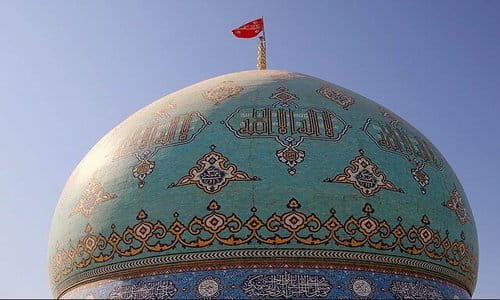
For the first time ever, a blood red flag is being flown over the famous Jamkaran Mosque in the Iranian "holy city" of Qom.  And as I will explain below, the fact that this mosque is directly associated with the Mahdi makes this symbolic gesture doubly significant.  

The hoisting of this flag was broadcast on Iranian state television, and it was obviously intended to send a message to Shiites all over the globe.  So precisely what was that message?  

Well, we are being told that according to Shiite tradition a red flag represents both "blood spilled unjustly" and a call for revenge...

Red flags in Shiite tradition symbolise both blood spilled unjustly and serve as a call to avenge a person who is slain.

It is the first time in history that the red flag has been hoisted on top of the Jamkaran mosque in the Iranian city and comes after warnings of harsh retaliation against the US.

Red flags have also been spotted flying at anti-U.S. demonstrations in Tehran over the past few days.

Clearly, the Iranians want blood.  They will never, ever forgive us for the killing of Qassem Soleimani, and their faith requires that he be avenged.

There is also a message inscribed on the blood red flag that is now flying above the Jamkaran Mosque, and apparently it is a reference to the death of the grandson of Muhammad...

The flag, inscribed with the words "Those who want to avenge the blood of Hussein," was hoisted above the mosque's shrine for what local reports claimed was the first time in history, according to the Daily Mail.

The grandson of Muhammad, Hussein was decapitated in A.D. 680 during the Second Islamic Civil War, when Muslims were fighting over who was the proper successor to their prophet. The act was met with bloody retaliation from Muslims who considered Hussein's death unjust and sought to avenge him.

Obviously the Iranians are viewing this as something much bigger than simply extracting sufficient revenge for the death of a deeply loved national leader.

Rather, they seem to be using this moment as a call to wage jihad against all of the enemies of Shia Islam.

And as I mentioned above, the fact that this flag was raised over this particular mosque is a very big deal.

The Jamarkaran Mosque is considered to be one of the holiest sites in Shia Islam, and it is also associated with the future reappearance of the Mahdi.  In fact, as the flag was being hoisted there was a direct reference to the Mahdi...

As the flag was raised in Qom, the mosque speakers called, 'O Allah, hasten your custodian reappearance,' a reference to the end-times reappearance of the Mahdi.

In Iran today, most of the national leaders believe that the 12th imam, Muhammad al-Mahdi, was born in Iraq in 869 and never died.  Just before judgement day, the Mahdi is supposed to reappear along with Jesus during a time of war and chaos "to bring peace to the world and establish Islam as the ruling faith across the globe".  

It is also commonly believed that the Mahdi is coming very soon, and so that explains why so many top Iranians seem to relish the thought that war could be coming.  They need war to come first in order for the Mahdi to appear, and since the Mahdi is supposed to return during the coming apocalyptic war and establish Shia Islam as the faith of the entire planet, they aren't exactly too concerned about the threats that President Trump is making.
It is so important to understand the mindset of these radical Shiites.

If they die as martyrs, they will be rewarded as such in the afterlife.

If they live through the coming holy war, they will get to see the coming of the Mahdi, and they will help to institute the global rule of Shia Islam.

So in either case, they believe that they can't lose.

At this point, what they want is blood.  In fact, even the daughter of Qassem Soleimani is asking for vengeance.  Just check out what she just asked Iranian President Hassan Rouhani...

'Who is going to avenge my father's blood?' One of the commander's daughters asked.

In response, Rouhani promised her that 'everyone will take revenge' and assured her as she wept, 'we will, we will avenge his blood, you don't worry.'

There is no question that Iran is going to strike back and the recent missile attacks on US bases is surely just the start of something bigger.

And it won't just be a one time deal.  They are going to hit us repeatedly, and they have already identified 35 potential targets...

IRAN today pinpointed 35 "key US targets" for revenge after its top general was assassinated - with America expecting retaliation "within weeks".

Hours later, rockets were fired near the US Embassy in Baghdad and at an airbase housing American troops, according to reports.

Unfortunately, we didn't have to wait long for the violence to begin.  In fact, the Green Zone in Baghdad has been targeted by rockets for two days in a row...

At least three explosions were reported Sunday inside the heavily-fortified Green Zone -- which houses the U.S. Embassy, Balad Air Base and Iraqi government buildings -- in the second attack of its kind after the U.S.-led airstrike that killed Iranian Gen. Qassem Soleimani.

A total of six Katyusha rockets -- three inside the Green Zone and three in the nearby Jadriya area -- hit Baghdad, according to a statement by Iraq's military, as Reuters reported.

Of course President Trump is not going to put up with this, and he has warned the Iranians that he has identified 52 Iranian targets that could potentially be hit...

Showing no signs of seeking to ease tensions raised by the strike he ordered that killed Soleimani and Iranian-backed Iraqi militia leader Abu Mahdi al-Muhandis at Baghdad airport on Friday, Trump issued a threat to Iran on Twitter. The strike has raised the specter of wider conflict in the Middle East.

Iran, Trump wrote, "is talking very boldly about targeting certain USA assets" in revenge for Soleimani's death. Trump said the United States has "targeted 52 Iranian sites" and that some were "at a very high level & important to Iran & the Iranian culture, and those targets, and Iran itself, WILL BE HIT VERY FAST AND VERY HARD."

Following that tweet, many on the left harshly criticized Trump for potentially targeting cultural sites, but Trump subsequently doubled down on that threat...

"They're allowed to kill our people, they're allowed to torture and maim our people, they're allowed to use roadside bombs and blow up our people and we're not allowed to touch their cultural site? It doesn't work that way," Trump told reporters.

"If they do anything there will be major retaliation."

Does anyone see a way that war with Iran can be avoided at this point?

Because I certainly don't.

The Trump administration and the Iranians will both keep escalating things until a full-blown cataclysmic war erupts in the Middle East, and it will be a war that will inevitably involve Israel as well.  This Middle East war will greatly accelerate the development of "the perfect storm" that I keep talking about, and none of our lives will ever be the same again.

Those that think that this is a crisis that will blow over in a few days or a few weeks are not being rational.

The Iranians will never, ever, ever forgive what Trump has done, and Soleimani's successor is assuring everyone that we will soon "see the bodies of Americans all over the Middle East"...

Esmail Ghaani, the successor to slain Iranian general Qassem Soleimani, threatened the US Friday following his appointment to head the Revolutionary Guards' foreign operations arm.

"Be patient, and you will see the bodies of Americans all over the Middle East," Ghaani said.

There is no stopping this now.

War is coming, and the death and destruction it will bring will shock the entire planet.

Originally published at End of The American Dream - reposted with permission.

Contact Form

Name

Email *

Message *