Friday, May 1, 2020

Italian churches prepare to resume funerals after eight-week ban
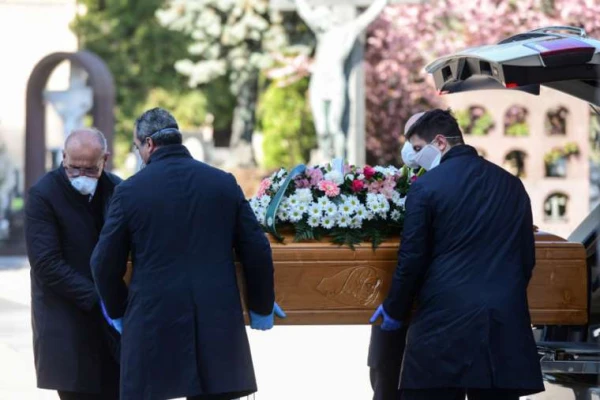
Rome Newsroom, Apr 30, 2020 / 11:45 am (CNA).- After eight weeks without funerals, Italian families will be able finally to gather together to mourn and pray at funeral Masses for the victims of the coronavirus starting May 4.
In Milan, the largest city in Italy’s coronavirus epicenter, priests are preparing for an influx of funeral requests in the coming weeks in the Lombardy region, where 13,679 have died.
Fr. Mario Antonelli, who oversees liturgies on behalf of the Archdiocese of Milan, told CNA that archdiocesan leadership met April 30 to coordinate guidelines for Catholic funerals as more than 36,000 people remain positive for COVID-19 in their region.
“I am moved, thinking of so many dear people who have wanted [a funeral] and still desire one,” Fr. Antonelli said April 30.
He said that the church in Milan is ready like the Good Samaritan to “pour oil and wine on the wounds of many who have suffered the death of a loved one with the terrible agony of not being able to say goodbye and embrace.”
A Catholic funeral is “not just a solemn farewell from loved ones,” the priest explained, adding that it expresses a pain like childbirth. “It is the cry of pain and loneliness that becomes a song of hope and communion with the desire for an everlasting love.”
Funerals in Milan will occur on an individual basis with no more than 15 people in attendance, as required by “phase two” of the Italian government’s coronavirus measures. 
Priests are asked to notify local authorities when a funeral is scheduled to take place and ensure that social distancing measures defined by the diocese are followed throughout the liturgy. 
Milan is home to the Ambrosian rite, the Catholic liturgical rite named for St. Ambrose, who led the diocese in the 4th century.
“According to the Ambrosian rite, the funeral liturgy includes three ‘stations’: the visit / blessing of the body with the family; community celebration (with or without Mass); and burial rites at the cemetery,” Antonelli explained. 
“Trying to reconcile the sense of the liturgy … and the sense of civic responsibility, we ask the priests to refrain from visiting the family of the deceased to bless the body,” he said.
While Milan archdiocese is limiting priests from the traditional blessing of the body in the home of the family, the funeral Mass and burial rites will be able to take place at a church or “preferably” at a cemetery, Antonelli added. 
During the nearly two months without Masses and funerals, dioceses in northern Italy have been maintaining telephone lines for grieving families with spiritual counsel and psychological services. In Milan, the service is called “Hello, is this an angel?” and is operated by priests and religious who spend time on the phone with the sick, the mourning, and the lonely. 
Aside from funerals, public Masses will still not be allowed throughout Italy under the government’s May 4 coronavirus restrictions. As Italy eases its lockdown, it remains unclear when public Masses will be allowed by the Italian government.
Italian bishops have been critical of Prime Minister Giuseppe Conte’s latest coronavirus measures, announced on April 26, saying that they “arbitrarily exclude the possibility of celebrating Mass with the people."
According to the prime minister’s April 26 announcement, the easing of lockdown measures will allow retail stores, museums, and libraries to reopen beginning May 18 and restaurants, bars, and hair salons June 1.
Movement between Italian regions, within regions, and within cities and towns is still prohibited except under strict cases of necessity.
In a letter April 23, Cardinal Gualtiero Bassetti of Perugia, the president of the Italian bishops' conference, wrote that “the time has come to resume the celebration of the Sunday Eucharist, and church funerals, baptisms and all the other sacraments, naturally following those measures necessary to guarantee security in the presence of more people in public places.”

If you value the news and views Catholic World Report provides, please consider donating to support our efforts. Your contribution will help us continue to make CWR available to all readers worldwide for free, without a subscription. Thank you for your generosity!
Click here for more information on donating to CWR. Click here to sign up for our newsletter.

Chinese government resumes removal of crosses from church buildings ( I Fear this will happen here in America if we have a Democrat President. It will Mark the Beginning of The End of Christianity & The End of America) 

CNA Staff, Apr 30, 2020 / 02:00 pm (CNA).- As the Chinese government makes progress containing the COVID-19 pandemic, authorities have resumed action to remove crosses from buildings and crackdown on religious practice.
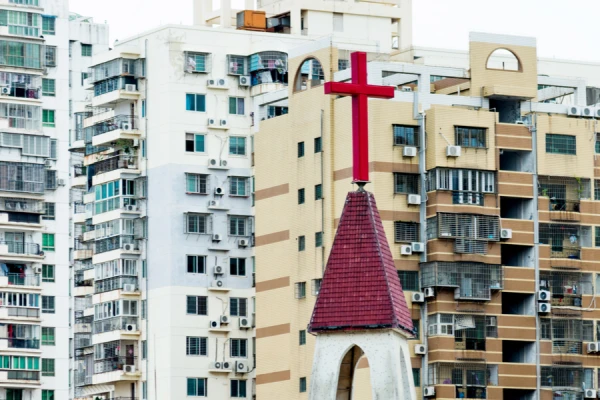
The latest round of enforcement actions have included the removal of crosses from buildings belonging to the state-run churches. According to a report from UCA News, priests say they are cooperating in the removal of exterior crosses in hopes that entire church buildings will not be demolished or converted into a building for secular use.  
According to a parishioner in the Chinese province of Anhui named John, Chinese officials cut down the cross from the top of Our Lady of the Rosary Church on April 18. Our Lady of the Rosary belongs to the Chinese Patriotic Catholic Association (CPCA, the Catholic Church officially sanctioned by the Chinese Communist Party and operating both in communion with Rome and under state control. 
The bishops of the CPCA, who were in many cases illicitly consecrated and under official excommunication, were received into full communion with Rome as part of the Vatican’s 2018 provisional agreement with China. The full terms of the China deal were not released to the public but have been reported to include the right of state authorities to propose and veto candidates for the episcopacy in China. 
John, speaking to UCA News, explained that on April 13, the leaders of Our Lady of the Rosary–which does not have a member of the clergy assigned to it, and all religious activities are organized by the laity–asked the city authorities about making repairs to the church building. Three days later, the community director of the city requested keys and access to the church, in order to remove its cross. 
Concerned parishioners went to Bishop Joseph Liux Xinhong of the Diocese of Anhui, who told them to request more information from the local CPCA office. The local CPCA office said they did not know of any plan to remove the cross from the building. 
Xinhong was one of the bishops who had his excommunication lifted and his position recognized by the Vatican following the 2018 provisional deal. 

On April 17, the parish community leader said that he had been given “directions from superiors” regarding removing the cross. The following day, said John, the cross was removed by a “team of young people.”
Elsewhere in the province of Anhui, on April 19 a cross was removed from a church in Suzhou City during pre-dawn hours, presumably to avoid the chance of a crowd protesting its removal. A man from the diocese named Paul told UCA News that the removal had previously been scheduled for the afternoon. 
Paul said that police officers blocked people from entering the church or taking pictures of the removal, and that a cell phone had been confiscated after it captured a picture of the cross coming down. 
In Hefei City, which is also located in the Anhui province, authorities on April 27 took a cross off a building for a Protestant church. 
A priest from the Diocese of Anhui, identified only as “Father Chen,” told UCA News that these sorts of activities are “happening all over the mainland” and are not limited to one diocese or province. 
 “If the churches don’t unite to resist, many more crosses will be removed,” he said.
In September 2017, China enacted strict new regulations concerning religion. Since then, authorities have been vigilant in enforcing permitting requirements. Churches that are not found to be in compliance are destroyed. 

If you value the news and views Catholic World Report provides, please consider donating to support our efforts. Your contribution will help us continue to make CWR available to all readers worldwide for free, without a subscription. Thank you for your generosity!
Click here for more information on donating to CWR. Click here to sign up for our newsletter.
Monks of Norcia praying with ‘greater intensity’ during coronavirus

Rome Newsroom, Apr 30, 2020 / 02:01 pm (CNA).- In the central Italian countryside, at the edge of the Umbrian woods just outside Norcia, a group of Benedictine monks prays and works from well before the sun rises until it sets.
This much has not changed in the monks’ lives during Italy’s coronavirus lockdown; but what has is the visitors they receive at the monastery.
“Usually we have some guests coming from all over the world… visitors coming from Italy or the U.S., friends or retreatants,” Fr. Benedict Nivakoff, O.S.B., told CNA by phone.
“And so, the total absence of those people, of that presence, has just focused our prayer all the more and we try to do what we are called to do more seriously,” he said.
“The main thing is a greater intensity of prayer for all those who are suffering.”
Nivakoff is the prior of the monks living at the site of St. Benedict’s birth. After religious life was suppressed in the area in the 1800s, a group led by Fr. Cassian Folsom was given permission to re-establish the monastery and moved there in 2000.
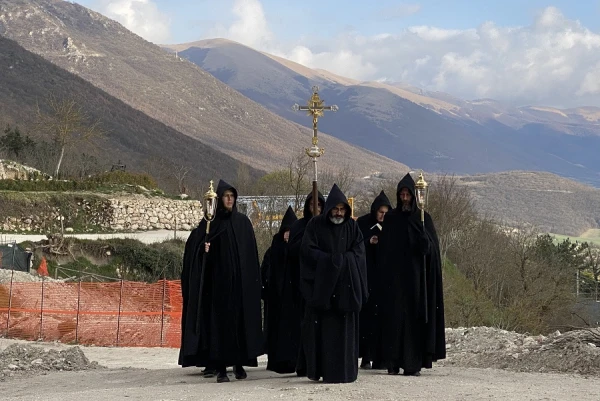
The prior said when the coronavirus was at its height in Italy, the monks did a traditional procession around the property with relics of the true cross.

“And that’s a way of praying for people, invoking the saints and calling down God’s help and his mercy on the country and on the world,” he said.
St. Benedict himself “experienced plagues, famines, sickness, death, not to mention relentless attacks of the devil on him and on his monks. He saw all of those as occasions for the monks themselves and for him to renew his trust and his faith in God,” Nivakoff said.
There is a “sad and persistent temptation,” he explained, to think “the world can solve these problems, but in fact, this world is passing away and God is the only answer to the suffering that we see.”
“So St. Benedict’s message, if you will, would be that all these things that happen can work for the good, and that is for the good of … each man and woman, each monk, in drawing closer to God.”
The monks in Norcia experienced tragedy first-hand four and a half years ago when several earthquakes, including one of 6.6-magnitude, struck central Italy and Norcia in August and October 2016.
The earthquakes destroyed hundreds of homes and the monk’s own buildings, including the Basilica of St. Benedict.
They have been rebuilding, but construction has been on hold during Italy’s lockdown, Nivakoff said, noting that it may, God willing, be able to start back up in a few weeks.
“The earthquake taught us many things and maybe one of the more relevant lessons for today is to resist the temptation that everything should go back exactly as it was,” he said.
“We thought after the earthquake, ‘well the answer is [to rebuild] everything as good if not better than before.’”
“But at the root of that is a fallacy, that this is a world, and we are men touched by original sin, who will only really have happiness and completion and real restoration in heaven,” the prior said.
He noted, “we can and do and need to work to improve things and to bring order where there is chaos and disorder but not at the risk of making this world into the destination and the goal,” because “it isn’t; it’s our temporary place so that we might get to heaven.”
“The earthquake really helped us to see that in a visible form, because the ground was literally shaking beneath our feet,” he said, “and the buildings we had called home to us and to our neighbors, our families, our friends, all the people here in Italy that we know, in central Italy, as all that fell apart.”
He said this “has called for trust and faith that is hard to muster in these days when the faith is so minimal.”
According to Nivakoff, “there are so many” lessons from monastic life that could help people quarantined in their homes right now, but he emphasized “two principle challenges to solitude.”
The first is for those who are in quarantine with others. As for monks who live with other monks, charity is very important when living in the midst of many people, he said.
“This really calls for lots and lots of patience, [and] to remember that patience with others always begins with patience with ourselves,” he explained. “Accepting our sins, accepting our faults, accepting that God is patient with us, and being patient with ourselves, helps us to be more patient with others.”
He added that silence can be a really useful tool in these circumstances: “Not speaking, not responding to the irritating or difficult or perhaps provocative things … people we live with say.”
“Especially under quarantine, the people we live with are probably going to still be with us in a few hours and maybe our passions will have calmed down by then” to respond in a better way, he said.
The second principle he drew on is for those who are living alone, such as the elderly or the young.
“For them, the quarantine really means an eremitical lifestyle. And for them the hardest temptations are sadness, acedia,” Nivakoff said.
“Sadness, which can be good because it can help us to lament our sins, lament not being with God, but at the same time can be a very inward looking and very self-pitying emotion, that stems from expectations not fulfilled.”
He recommended lots of humility and accepting that you are not in charge, not placing hope in things one does not have any control over.
“We have a lot more control over whether we say our prayers at noon than whether the government stops the lockdown in one week,” he pointed out. “The ways to combat sadness are this: to make goals that depend on me, and to put our trust and hope in God.”
Nivakoff also noted that there is a lot of talk right now about the importance of regaining the liberties men and women have had and avoiding “overreach of the government.”
“And that might be true, but from a Christian perspective, it is that we men and women need to accept the limitations that this disease brings on us,” he said.
“So even this terrible virus we need to see as permitted by [God] for some good purpose and the most traditional understanding of that is for some kind of purification.”
“So, we ask for God’s mercy because we need it.”
So during the coronavirus pandemic, the monks continue their prayer and their work taking care of the animals, gardening, cooking, cleaning, and managing the nearby forest.
To support themselves the monks also brew beer, and because it is sold through the internet, the coronavirus has not negatively impacted sales.
“And thank God, that model has really been blessed at this time because with so many people not being able to leave their home, many have taken it as an occasion to sample some monastic beer,” Nivakoff said.
“We continue to export from Italy to the United States and beer is available and it seems to delight many hearts there and we are very happy.”

If you value the news and views Catholic World Report provides, please consider donating to support our efforts. Your contribution will help us continue to make CWR available to all readers worldwide for free, without a subscription. Thank you for your generosity!
Click here for more information on donating to CWR. Click here to sign up for our newsletter.

The Dispatch: More from CWR...

May is an opportune month for taking up the Rosary

Pope Francis encourages us to make use of the “restrictions of the pandemic…to rediscover the beauty of praying the Rosary at home in the month of May.”
(Anuja Mary/Unsplash.com)
May is my favorite month of the year. The blooming of spring flowers make it the most beautiful, while the happy occasions of first Holy Communions, May Crownings, and ordinations make it the most joyful. It is fitting, then, that the most beautiful and joyful month of the year be dedicated to she who is God’s most beautiful creation and who is the “Cause of our Joy”—the Blessed Virgin Mary.
With the coronavirus pandemic still gripping the world and keeping so many away from their parish churches, there will be the temptation to submit to the disappointment of all this and think we’ve lost out on all the beauty and joy May usually brings. All is not lost, however! Let’s not overlook the opportunity the government-mandated quarantine provides to deepen our Catholic faith by simply having more time to pray. We can still make this the most beautiful and joyful May yet, if we use this situation to build a foundation for a lasting good in our spiritual lives.
A meme has been circulating around the internet ribbing those who have been using their time stuck in self-isolation to binge watch Netflix, with the reminder that when Shakespeare was quarantined during an outbreak of the plague in London he made use of his time to write King Lear. Whether this is true or not, the spirit behind the meme is most helpful. We ought to use the time we still have before we return to the ordinary circumstances of our busy daily lives to bring some measure of good out of the terrible situation we find ourselves in. In a letter issued to all the faithful on April 25th, Pope Francis encouraged Catholics to make use of the “restrictions of the pandemic…to rediscover the beauty of praying the Rosary at home in the month of May.”
The Holy Father’s letter reminds me of a chapter in Willa Cather’s novel Death Comes for the Archbishop titled “The Month of Mary”. It details the joy of a missionary priest in the midst of a sickness that confines him to bed. What could possibly be the “cause of his joy” in the midst of such a trial? It was the time his sickness afforded him to be able to honor Mary throughout the month of May in a manner he had not been able to for so many years on account of his busy life as a missionary. It’s a touching chapter worth quoting at length:
At last, in 1858, Father Vaillant was sent to arrange the debated boundaries with the Mexican Bishops. He started in the autumn and spent the whole winter on the road, going from El Paso del Norte west to Tucson, on to Santa Magdalena and Guaymas, a seaport town on the gulf of California, and did some seafaring on the Pacific before he turned homeward.
On his return trip he was stricken with malarial fever, resulting from exposure and bad water, and lay seriously ill in a cactus desert in Arizona. Word of his illness came to Santa Fé by an Indian runner, and Father Latour and Jacinto rode across New Mexico and half of Arizona, found Father Vaillant, and brought him back by easy stages.
He was ill in the Bishop’s house for two months…
It was the month of Mary and the month of May. Father Vaillant was lying on an army cot, covered with blankets…
This was a very happy season for Father Vaillant. For years he had not been able properly to observe this month which in his boyhood he had selected to be the holy month of the year for him, dedicated to the contemplation of his Gracious Patroness. In his former missionary life, on the Great Lakes, he used always to go into retreat at this season. But here there was no time for such things. Last year, in May, he had been on his way to the Hopi Indians, riding thirty miles a day; marrying, baptizing, confessing as he went, making camp in the sand-hills at night. His devotions had been constantly interrupted by practical considerations.
But this year, because of his illness, the month of Mary he had been able to give to Mary; to Her he had consecrated his waking hours. At night he sank to sleep with the sense of Her protection. In the morning when he awoke, before he had opened his eyes, he was conscious of a special sweetness in the air,—Mary, and the month of May. Alma Mater redemptoris! Once more he had been able to worship with the ardor of a young religious, for whom religion is pure personal devotion, unalloyed by expediency and the benumbing cares of a missionary’s work. Once again this had been his month; his Patroness had given it to him, the season that had always meant so much in his religious life.
Like Shakespeare, we can be productive in the free time we still have on account of this pandemic. Like Father Vaillant from Cather’s novel, we can be productive in the best sense, that is, spiritually, by deepening our devotion to the Mother of God. And like Pope Francis wishes, we can do this by praying the Rosary every day, especially as a family.
Even without the joyful moments that usually come this time of the year in the life of our parishes, one day we may be able to look back on as the best of our lives if it is when we took up the practice of praying the Rosary everyday. As Our Lady promises, “Devotion to my Rosary is a great sign of predestination.”

If you value the news and views Catholic World Report provides, please consider donating to support our efforts. Your contribution will help us continue to make CWR available to all readers worldwide for free, without a subscription. Thank you for your generosity!
Click here for more information on donating to CWR. Click here to sign up for our newsletter.

About Father Seán Connolly  32 Articles
Father Seán Connolly is a priest of the Archdiocese of New York. He attended Saint Joseph’s Seminary, Dunwoodie, where he received a Bachelor of Sacred Theology as well as a Master of Divinity and a Master of Arts. He currently serves as parochial vicar at the Parish of St. Joseph in Middletown, New York.

Contact Form

Name

Email *

Message *