Friday, May 1, 2020

The Dispatch: More from CWR...

Experts offer a path to reopening churches, and the sacraments

An April 28 document from the Thomistic Institute outlines a multi-phase proposal for resumption and expansion of public Masses while remaining in conformity with public health guidelines in force in different places.
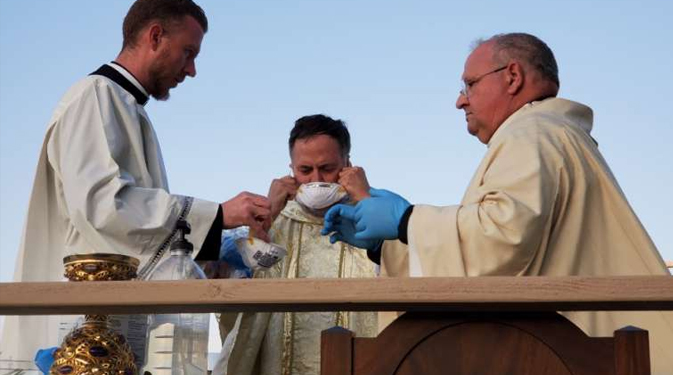
Bishop Peter Baldacchino celebrates Mass on Holy Thursday. (Credit: David McNamara/Diocese of Las Cruces)
CNA Staff, Apr 30, 2020 / 04:00 pm (CNA).- As more Catholic dioceses begin to resume public Masses during the coronavirus pandemic, a group of theologians and medical experts has provided guidance for doing so as safely as possible.
“With proper safeguards to prevent infection, and integrating the scientific guidance of public health authorities as outlined below, it is possible to provide the Mass and the sacraments to the faithful in this period,” said a group of Dominican theologians and experts on infectious diseases this week.
The Working Group on Infectious Disease Protocols for Sacraments & Pastoral Care, a project of the Thomistic Institute, issued a document this week that aims to give guidance on  “how Catholic sacraments can be provided in the midst of the current pandemic” under U.S. and global health standards.
The April 28 document from the Thomistic Institute outlines a multi-phase proposal for resumption and expansion of public Masses while remaining in conformity with public health guidelines in force in different places.
In “Phase 1,” the “Sunday obligation” to attend Mass should be dispensed, the elderly and those at high risk of COVID-19 should be encouraged to stay home, and those with symptoms should not attend Mass, the working group said.
Other safeguards should be in place, such as requirements for attendees to wear face masks or cloth coverings and an overall limit on the number of attendees. This number depends “on the guidance of public health authorities,” the document says, and could be more than 10 people provided that a church is large enough to seat everyone with at least six feet of distance in between.
Seating should be provided by ushers in designated areas so that all attendees can be seated in an orderly manner and remain spaced apart; after the end of Mass, they could be dismissed row by row so as not to result in a crowd leaving the church all at once, the working group said.

Priests should not offer Mass while wearing gloves and a facemask, especially if they are spaced far enough apart from ministers and attendees.
“A further consideration: the Mass is imbued with powerful sacramental and liturgical symbolism. Wearing a mask and gloves would be a detrimental counter-sign in this context, and it is not warranted by considerations of hygiene if the priest remains a proper distance from the congregation,” the group states.
Mass could be offered without distribution of Holy Communion, or Communion could be distributed at the end of Mass, the group said. After the final blessing, the priest would remove his chasuble, use hand sanitizer, retrieve newly-consecrated hosts from the tabernacle, pray the “Agnus Dei” prayer at the altar while holding up a single host, and then proceed to distribute Communion.
Those who wish to receive could approach the altar, spaced six feet apart. If the priest believed he touched the hands or mouth of a recipient, he could use hand sanitizer that is sitting on a table next to him.
It could be possible to receive Holy Communion on the tongue within public health guidelines, the document states:
“Given the Church’s existing guidance on this point (see Redemptionis Sacramentum , no. 92), and recognizing the differing judgments and sensibilities that are involved, we believe that, with the precautions listed here, it is possible to distribute on the tongue without unreasonable risk.”
In addition to the four dioceses that initially announced the resumption of public Masses, other bishops have followed suit in the last several days.
In Fort Worth, Texas, Bishop Michael Olson announced on Wednesday that public Masses would resume in the diocese the  weekend of May 2-3, and that parishes would again be offering the sacrament of Confession not just on an appointment basis.
Olson reiterated that he has dispensed Catholics from the Sunday obligation, instructed those feeling ill to refrain from attending Mass, and encouraged those over the age of 60 to attend a Mass exclusively for their age group if their parish offered one.
He also encouraged attendees to practice proper safeguards, such as wearing face coverings and maintaining social distancing. Once a church reached capacity with the faithful seated at proper distances from each other, overflow seating could be provided in a nearby hall or attendees could stand outside or follow a livestream of Mass from their cars, with Holy Communion offered to all those outside the church at a designated area, and not to be administered on the tongue.
The Diocese of Fargo will also resume public Masses on May 4, although with the Sunday obligation still dispensed. The elderly and those at high risk of COVID-19 “are strongly encouraged to stay home,” according to a letter from Bishop John Folda.
Other common safeguards, such as the wearing of face masks, social distancing, and a limit on the overall number of Mass attendees, will be in force. Masses will not feature singing by the congregation or by choirs, and Holy Communion can only be received in the hand.
Bishop Richard Stika of Knoxville, Tennessee, said that public Masses are planned for “over Pentecost weekend and then daily following,” but that the Sunday obligation will still be dispensed. Pentecost Sunday falls on May 31 in 2020.
Requirements for Mass attendees include wearing face masks, proper social distancing, and limits on the overall number of attendees.

In Oklahoma, Archbishop Paul Coakley of Oklahoma City and Bishop David Konderla of Tulsa said they were setting up a joint task force to establish a timeline for public Masses to resume and would announce a timeline on May 6.
Founded in 2009, the Thomistic Institute is part of the Pontifical Faculty of the Dominican House of Studies in Washington, D.C.  It has already produced similar guidelines for the sacrament of Confession during the pandemic.

If you value the news and views Catholic World Report provides, please consider donating to support our efforts. Your contribution will help us continue to make CWR available to all readers worldwide for free, without a subscription. Thank you for your generosity!
Click here for more information on donating to CWR. Click here to sign up for our newsletter.

About Catholic News Agency  401 Articles
Catholic News Agency (www.catholicnewsagency.com)
The Dispatch: More from CWR...

The Idolatry of Eros and the Corporeality of God

Matthew Clemente’s Eros Crucified is philosophy of religion done by a young scholar in such a way as to give one great hope for the future not just of the discipline, but of Catholic letters and intellectual culture more generally.
(Image: Ricky Turner @ricky_turner | Unsplash.com)
I have been wondering for some time about how Christian teaching on matters sexual can be presented in more theologically substantial ways than “thou shalt not masturbate/fornicate/sodomize, etc.” Such an approach, however necessary as a moral baseline, cuts little ice with most people (Christian or otherwise) and invariably invites immediate rejoinders about hierarchical hypocrisy. Such an approach also risks being intellectually stunted, especially if it is deemed sufficient. The undergraduates in my classes who have just emerged from Catholic schools all know what the commandments and catechism forbid, but they have no clue how any of this is connected to God or why any of it matters.
One possible way forward is through a renewed awareness of the pervasive, distortive power of idolatry, which is a very regular theme of the writing and preaching of the current pope, and has also been given compelling expression by CWR’s editor. I have been thinking for some time now of how self-protectively constricted our vision of idolatry is, and how many of us likely assume that whereas we’re not constructing cows out of gold, we must be good, right?
But as I argued in my book Everything Hidden Shall Be Revealed: Ridding the Church of Abuses of Sex and Power, our propensity for idolatry is so sly and pervasive that we even make idols out of popes and priests. Recognizing the pervasiveness of idolatry may offer us a way of renewing Catholic moral teaching, assisting people to see that sexual sin, to use one significant example, is less an offense against some spiritualized and semi-gnostic notion of “purity” and more an offense of idolatry understood concretely as the substitution of, or attachment to, some lesser desire in such a way as to displace God (and frequently other human beings, too, if one thinks of pornography usage displacing marital relations).
Along comes a new and exhilarating book that takes up these issues—and many others—in rich, diverse, and compelling ways. That book is Matthew Clemente’s Eros Crucified: Death, Desire, and the Divine in Psychoanalysis and Philosophy of Religion, just published by Routledge.
One popular, and often dreaded, buzzword in the academy today is “intersectionality,” which is just a newer version of the idea Newman first demonstrated so winsomely: “all knowledge forms one whole.” Clemente, a young Catholic philosopher of religion at Boston College, lives Newman’s method in this book (without mentioning him). Clemente ranges freely across theology and philosophy, refusing to allow them to be forcibly separated via an act of what Paul Ricoeur famously called “controlled schizophrenia.” But Clemente’s point, and method, is not merely reflective of current academic preoccupations to bring things together. It is, in fact, the only method on offer to human thinkers, who cannot (and must not) be bamboozled into seeing the world as divisible, the end result of which is the creation of some “private” sphere labelled the “secular” from which God has been exiled into some other sealed sphere called “religion.” In philosophizing in this way, Clemente is reflecting some of the best insights of recent philosophers including Charles Taylor and one of Clemente’s mentors, the philosopher (and Greek Orthodox priest) John Panteleimon Manoussakis.
It is, it seems to me, the mark of an especially good scholar that he or she can cover endlessly and almost tediously tilled ground and still be able to raise up age-old questions in a vibrant and compelling way. Clemente does this when he raises a question we gloss over even during Lent when contemplating and venerating the tortured and traumatized body of Christ on the Cross: “do we understand, do we value the corporeality that God has made his own?” In other words, we may all rattle off from memory the Johannine prologue (“the word became flesh”), and for thirty years now Catholics have heard a great deal about a “theology of the body,” but have we ever stopped to contemplate the staggering implications of God assuming a body—the scandal of the incarnation, and all this means for every aspect of our human life?
Clemente wants us to think about the corporeality of God and its nakedly erotic self-giving in the Eucharist (“this is my body”) as well as its implications for us as human beings in our quotidian living, desiring, and dying, our lovemaking and birth-giving. (Clemente’s one-and-a-half-page conclusion, a meditation on watching and waiting with his wife give birth to their first son, packs in more biblical theology than a year’s worth of homilies from your average preacher.) Clemente writes with verve and a wide sweep of philosophy and theology, ancient and modern. All this learning, including considerable insights from psychoanalytic thought, is rendered in a way that is at once lively and serious.

In addition to cogent writing, there is also the author’s quietly confident engagement of many thinkers whom too many Christians have so often loathed and avoided, chiefly Nietzsche and Freud. This semester I have been trying to teach my students to think like the Church, unafraid to discover the truth wherever it may be, including in such people as Freud, whose Future of an Illusion we read. I have sought to inculcate in them the method of “despoiling the Egyptians” (as the Fathers called it, and did), finding what Justin Martyr called the spermatikos logos or seeds of the Word wherever they are. Clemente’s book is an outstanding model of this, serenely stating where Nietzsche, Freud, and others have valid points that we need to learn, and with equal serenity and without a shred of disdain disagreeing with both men where they may be wrong. Better still, Clemente has a knack for showing where such men are not nearly so radical as they have been made out to be, and where the gospel is more radical still than either of them.
Clemente goes right to some of the most controversial writings, beginning with Freud’s Beyond the Pleasure Principle. That book, whose centenary of publication is this year, was so strange even to other psychoanalysts that they politely ignored it. Freud’s first and most sycophantic biographer, Ernest Jones, passed over it in about two schizoid sentences in his three-volume biography of Freud. (Freud can scarcely sneeze without Jones normally spending half a chapter discussing its meaning.) Clemente uses Beyond the Pleasure Principle extensively in his first chapter to set up the discussion about our repetition compulsions and our death-dealing ways.
These insights were not original to Freud. As I recently argued elsewhere, Evagrius of Pontus was psychoanalytic avant la lettre. For Clemente, it is Augustine of Hippo (ch.2) who likewise had crucial insights that Freud would later recapitulate, the connection between the two being discerned by the farouche French psychoanalyst (and erstwhile Catholic) Jacques Lacan, who once said that “St. Augustine…foreshadowed psychoanalysis.” Manoussakis has also noted that Beyond the Pleasure Principle bears “a close resemblance to the Confessions.
Freud returns in Clemente’s fourth chapter, where Clemente treats more explicitly one of the questions he outlined in his preface: how has “eros has become for us an idol”? The relationship between eros and Thanatos occupies this chapter and the rest of the book, which concludes, fittingly, with a discussion of the resurrection.
I will not tell you how Clemente answers these questions but only encourage you to read the book and enjoy the ride through the works of ancient and medieval philosophers and theologians as well as such leading lights of the contemporary academy as Jean-Luc Marion, Julia Kristeva, Emmanuel Falque, Slavoj Žižek, and Richard Kearney, inter alia. These, in turn, are joined by novelists and poets (Chesterton, Dostoevsky, C.S. Lewis, Graham Greene, inter alia) and prominent Catholic theologians such as Hans Urs von Balthasar. (The one name I did not find anywhere in the book, to my surprise, was Joseph Ratzinger, who reflected rather winsomely on eros in Deus Caritas Est. Nor is Paul Axton’s recent and relevant book, The Psychotheology of Sin and Salvation cited here.)
In sum, Eros Crucified is philosophy of religion done by a young scholar in such a way as to give one great hope for the future not just of the discipline, but of Catholic letters and intellectual culture more generally.

If you value the news and views Catholic World Report provides, please consider donating to support our efforts. Your contribution will help us continue to make CWR available to all readers worldwide for free, without a subscription. Thank you for your generosity!
Click here for more information on donating to CWR. Click here to sign up for our newsletter.

About Dr. Adam A. J. DeVille  81 Articles
Dr. Adam A. J. DeVille is associate professor and chairman of the Department of Theology-Philosophy, University of Saint Francis (Fort Wayne, IN) and author of Orthodoxy and the Roman Papacy (University of Notre Dame, 2011).

Bishops will ‘consecrate’ the US and Canada to Mary. Here’s what that means

CNA Staff, Apr 30, 2020 / 02:23 pm (CNA).- The bishops of both the United States and Canada are set to consecrate their nations to Mary, Mother of the Church on May 1.
In fact, this will be a reconsecration, as both countries have been consecrated to Mary before— as has the entire world, several times.
Reconsecrating the country, the US bishops said in an April 23 announcement, is meant to serve as a reminder to the faithful of Mary’s witness to the Gospel, and as a way of asking for Mary’s intercession before Jesus on behalf of those in need.
“Every year, the Church seeks the special intercession of the Mother of God during the month of May. This year, we seek the assistance of Our Lady all the more earnestly as we face together the effects of the global pandemic,” Archbishop Jose Gomez, president of the US bishops, said in his April 22 letter announcing the consecration.
To Jesus through Mary
A person or nation that is consecrated is set aside for a holy purpose.
The Vatican’s Congregation for Divine Worship defines consecration to Mary as an overt recognition of the “singular role of Mary in the Mystery of Christ and of the Church, of the universal and exemplary importance of her witness to the Gospel, of trust in her intercession, and of the efficacy of her patronage.”
St. Louis de Montfort, a 17th-century French priest, was “one of the great masters of the spirituality underlying the act of consecration to Mary,” the congregation wrote, noting that de Montfort proposed to the faithful “consecration to Jesus through Mary.”
Pope St. John Paul II— who consecrated the entire Church and world to Mary three times during his pontificate— taught that by consecrating oneself to Mary, we accept her help in offering ourselves fully to Jesus.
“It means accepting her help—by having recourse to her motherly heart, which beneath the cross was opened to love for every human being, for the whole world—in order to offer the world, the individual human being, mankind as a whole, and all the nations to him who is infinitely holy,” the pope said in May 1982.
Renewing Marian entrustments
Bishop John Carroll of Baltimore, the first bishop of the United States, promoted devotion to Mary, the Mother of God, and placed the United States under her protection in a pastoral letter of 1792, the US bishops wrote in an April 23 announcement.
Later, in 1847, Pope Pius IX approved the US bishops’ decision to name the Blessed Virgin Mary, under the title of the Immaculate Conception, as the Patroness of the United States.
The U.S. bishops once again consecrated the nation to Mary during the 1959 dedication of the National Shrine of the Immaculate Conception in Washington, D.C.
Canada was first consecrated to Mary at a National Marian Congress in Ottawa in 1947, then again in 1954. The bishops last renewed the consecration on July 2, 2017.
The bishops of many other countries over the years— including, most recently, Mexico and the countries of Latin America and the Caribbean on Easter Sunday— have consecrated their nations to Mary.
After receiving more than 300 letters during the coronavirus pandemic, the bishops of Italy will also consecrate the nation to Mary on May 1, at a shrine in northern Italy.
In addition, several popes have consecrated the entire Church and world to Mary.
Pope Pius XII consecrated the entire world to the Immaculate Heart of Mary on October 31, 1942, and Pope St. John Paul II renewed that consecration on May 13, 1982, again on March 25, 1984, and once more on Oct. 8, 2000.
Pope Francis during Oct. 2013 renewed the consecration of the world to the Immaculate Heart of Mary, and dedicated his pontificate to Our Lady of Fatima.
Prayers during the pandemic
The May 1 renewal of consecration does not change the designation of Mary as the Patroness of the United States under the title of the Immaculate Conception, the US bishops clarified, but rather “reaffirms and renews previous Marian entrustments.”
The title “Mary, Mother of the Church” was given to the Blessed Mother by Pope St. Paul VI at the Second Vatican Council, and a memorial under the title was added to the Church’s liturgical calendar in 2018.
The act of consecration to Mary, Archbishop Gomez said, “will give the Church the occasion to pray for Our Lady’s continued protection of the vulnerable, healing of the unwell, and wisdom for those who work to cure this terrible virus.”


If you value the news and views Catholic World Report provides, please consider donating to support our efforts. Your contribution will help us continue to make CWR available to all readers worldwide for free, without a subscription. Thank you for your generosity!
Click here for more information on donating to CWR. Click here to sign up for our newsletter.

Contact Form

Name

Email *

Message *