Denver Newsroom, May 1, 2020 / 04:00 am (
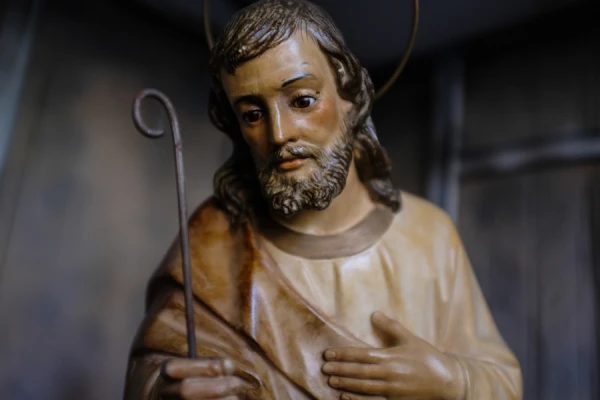
CNA).- Mass unemployment is a deeply unwelcome background for this year’s Feast of Saint Joseph the Worker, but the Catholic celebration has lessons for everyone, regardless of job situation, according to two priests with expertise on St. Joseph and the dignity of work.
Citing the Holy Family’s escape to Egypt, devotional writer
Father Donald Calloway said St. Joseph is “very empathetic” towards those suffering unemployment.
“He himself at some point would have been unemployed in the Flight to Egypt,” the priest told CNA. “They had to pack up everything and go to a foreign country with nothing. They didn’t plan on that.”
Calloway, author of the book “Consecration to St. Joseph: The Wonders of Our Spiritual Father,” is an Ohio-based priest of the Marian Fathers of the Immaculate Conception.
He suggested that St. Joseph “at some point was surely quite concerned: how is he going to find work in a foreign country, not knowing the language, not knowing the people?”
At least 30.3 million Americans have filed for unemployment in the last six weeks, in what is perhaps the worst unemployment situation in the country’s history, CNBC reports. Many others are working from home under coronavirus travel restrictions, while countless workers face newly dangerous workplaces where they may be at risk of contracting the coronavirus and taking it home to their families.
Father Sinclair Oubre, a labor advocate, similarly thought of the Flight into Egypt as a period of joblessness for St. Joseph—and also a period that showed an example of virtues.
“He remains focused: stay open, continue to struggle, do not get broken down. He was able to build up a livelihood for him and his family,” said Oubre. “For those who are unemployed, St. Joseph gives us a model of not allowing the difficulties of life to crush one’s spirit, but rather trusting in God’s providence, and in adding to that providence our own attitude and strong work ethic.”
Oubre is pastoral moderator of the Catholic Labor Network and the Beaumont diocese’s director of the Apostleship of the Seas, which serves seafarers and others in sea-based work.
The Feast of St. Joseph the Worker was inaugurated by Pope Pius XII, who announced it on May 1, 1955 in an audience with Italian workers. To them he described St. Joseph as “the humble craftsman of Nazareth” who “not only personifies the dignity of the manual laborer with God and the Holy Church,” but is “also always the provident custodian of you and your families.”
Pius XII encouraged continued religious formation for adult workers and said it was an “atrocious slander” to charge that the Church is “an ally of capitalism against the workers.”
“She, mother and teacher of all, is always particularly solicitous for her children who find themselves in the most difficult conditions, and also in fact has validly contributed to the achievement of honest progress already achieved by various categories of workers,” the pope said.
While the Church has rejected various systems of Marxist socialism, Pius XII said, no priest or Christian can remain deaf to a cry for justice and a spirit of brotherhood. The Church cannot ignore that the worker who seeks to improve his condition but faces obstacles opposed to the “order of God” and God’s will for earthly goods.
May 1 is observed as Labor Day in many countries, though not the United States. Calloway said that at the time of the declaration, communism was a serious threat that sought to take over a longtime celebration of work.
The observance originated in the late nineteenth century in the American labor movement’s May 1 protests against excessively long workdays.
“Workers complained that these long hours were punishing on the body and left them no time to tend to family duties or to improve themselves through education,” Clayton Sinyai, executive director of the Catholic Labor Network, told CNA.
Calloway reflected that most people in life are workers, whether outside or at a desk.
“They can find a model in St. Joseph the Worker,” he said. “No matter what your work is, you can bring God into it and it can be beneficial to you, your family, and society as a whole.”
Oubre said there is much to learn from reflecting upon how St. Joseph’s work nurtured and protected the Virgin Mary and Jesus, and so was a form of sanctification of the world.
“If Joseph did not do what he did, there was no way the Virgin Mary, a pregnant single maiden, could have survived in that environment,” Oubre said.
“We come to realize that the work that we do is not just for this world, but rather we can work to help build the kingdom of God,” he continued. “The work that we do cares for our family members and our children and helps build up the future generations that are there.”
Calloway warned against “ideologies of what work should be.”
“It can become enslavement. People can turn into workaholics. There’s a misunderstanding of what work is meant to be,” he said.
For him, the feast day shows the importance of family and the importance of rest, given that God spoke to St. Joseph in his dreams.
St Joseph gave dignity to work “because, as the one chosen to be the earthly father of Jesus, he taught the Son of God to do manual labor,” said Calloway. “He was entrusted with teaching the son of God a trade, to be a carpenter.”
“We’re not called to be slaves to a trade, or to find our ultimate meaning of life in our work, but to allow our work to glorify God, to build up the human community, to be a source of joy to everyone,” he continued. “The fruit of your labor is meant to be enjoyed by yourself and others, but not at the expense of harming others or depriving them of a just wage or overworking them, or having working conditions that are beyond human dignity.”
Oubre found a similar lesson, saying “our work is always at the service of our family, our community, our society, of the world itself.”
While some business owners and workers hope to see a speedy end to restrictions and business closures intended to slow the spread of the coronavirus, Oubre warned that opening a non-essential business to make money might not be prudent. He used the example of a football stadium, excessively focused on opening in August, even if it packs people into a situation that potentially spreads a dangerous disease.
“I don’t know if that’s the most prudent decision coming out of the spirit of service, at this particular time,” he said. “That’s not something we have to do right now.”
“St. Joseph gives us that image of humble service work,” Oubre emphasized. “If we want to go back to work right now, we need to make sure that it grows out of a spirit of humility and service and promotion of the common good.”
Some of those who have jobs are protesting work conditions they believe to be dangerous. They have organized May 1 protests and walkouts at Amazon, Instacart, Whole Foods, Walmart, Target, FedEx and others, citing health and safety concerns during the epidemic, the news and commentary site The Intercept reports.
Oubre said these protesters too must recognize the importance of the work in a spirit of humility, service and promoting the common good.
Calloway too reflected on the dueling positions of workers objecting to coronavirus protections, while other workers are protesting to seek improved protections.
“We’re in uncharted territory,” he said. “That’s where we move into the spiritual aspect of asking St. Joseph to give us wisdom to help us know what to do in this tricky situation. Be cautious, of course, we don’t want to spread this thing. But at the same time, people have to get their jobs back. We can't go on like this for long. We can’t sustain it.”
Calloway said no worker is meant to work in isolation and “just be selfish about his employment.”
“Work is meant to benefit himself and others,” he said. “It’s when we become stingy and selfish that we begin to hoard, and we take for ourselves gigantic salaries while your workers are getting pennies.”
St. Joseph is described as “the most just” in the New Testament, and would have been a just man in his labor as well, the priest said.
For Oubre, the Feast of St. Joseph the Worker is a time to remember “invisible workers.”
“No matter how humble work may be, and how much it may be considered low-skilled, or semi-skilled, it is absolutely essential to the quality of life of the nation,” said Oubre. “No matter how society looks upon the job, it becomes a very, very important task. If that task were not done, the more respected, prestigious work can’t happen.”
The coronavirus epidemic has drawn support and recognition to the risky work of doctors and nurses. Oubre noted that housekeepers and cleaners at the hospital may go unnoticed but are critical in keeping infections down and maintaining the safety of doctors, nurses and patients, while other hospital support staff also deserve their due credit.
Grocery store checkers, too, are “literally putting their lives on the line interacting with the public” so that people can continue to feed themselves, the priest said.
“All of a sudden the checkout girl at Kroger’s is not just some high school kid we’re going to deal with, and go on. She becomes an essential person helping people fulfill their needs,” Oubre said. “She’s putting her physical health on the line, by being in a public realm, interacting with hundreds of people a day.”
If you value the news and views Catholic World Report provides,
please consider donating to support our efforts. Your contribution will help us continue to make CWR available to all readers worldwide for free, without a subscription. Thank you for your generosity!






 Posts
Posts

