Welcome to "Jack's Celestial Quest," a podcast where we dive into an epic journey of faith, courage, and indwelling transformation. In today's episode, we discover Jack’s new name and the power of the Lion of Judah.
THE LION OF JUDAH BEGINS TRAINING JACK
Jack's journey to the Celestial City of Zion began with a divine calling that set him on a path of transformation and purpose. As he embarked on this sacred quest, he encountered the majestic Lion of Judah, a symbol of strength and righteousness. The Lion, with eyes that blazed with wisdom and power, took Jack under His wing, recognizing the light within him. Through rigorous training, the Lion imparted invaluable lessons on courage, faith, and unwavering commitment to truth. Jack's heart and spirit were molded by the Lion's teachings, preparing him for the challenges and triumphs that lay ahead.
In a moment of profound revelation, the Lion of Judah bestowed upon Jack a new name: The Guardian of Truth. This name was not merely a title but a reflection of Jack's divine purpose. Jack was entrusted with the sacred duty of upholding and defending the principles of righteousness and integrity as The Guardian of Truth. Jack felt a renewed sense of strength and determination with his new identity. Armed with a sword of light and life, a guiding staff, reflecting the wisdom and power of the Lion’s investment in Jack’s new weapon that glowed with eternal light.
He continued his journey toward the Celestial City of Zion, ready to face any obstacle with the unwavering conviction that truth and justice would prevail. After all, Jack now knew he was the Guardian of Truth.
Join us as we follow Jack's incredible quest, discovering the lessons and revelations that await him on this adventurous pilgrimage. Grab your headphones, settle in, and prepare to be inspired by the tale of "Jack's Celestial Quest."
Let's walk the gold brick road together. Welcome to "Jack's Celestial Quest." To listen to past episodes of Jack’s journey, visit HERE.
The End Times Chronicles is host to Jack, The Celestial Quest Series - a reader-supported publication. To receive new posts and support my work, consider becoming a free or paid subscriber.
The audio is the original production of Jack’s journey. Enjoy the adventure. We will release a new Jack adventure every other Thursday throughout 2025-26.
We want to extend our eternal gratitude to each of you for taking the time to read our publications and engage with our posts. Your support and interest mean the world to us, and it motivates us to continue creating content that resonates with you. Thank you for being a part of our community and for your valuable feedback and encouragement. We look forward to sharing more with you and growing together in this journey. Until next time…
The LORD had said to Abram, "Leave your native country, your relatives, and your father's family, and go to the land that I will show you. I will make you into a great nation. I will bless you and make you famous, and you will be a blessing to others. I will bless those who bless you and curse those who treat you with contempt. All the families on earth will be blessed through you." Genesis 12:1-9 NLT
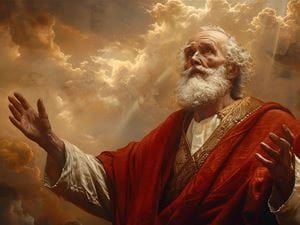
There's Abram, minding his business and tending to his flock of sheep, when suddenly, he's interrupted by a thunderous voice that no one else hears. And then, the voice says something so absurd by common sense that most people of the day would consider him to be a heretic.
"A father of many nations?!" He is a middle-aged man (in 18th century BCE standards) with no children who lived modestly with little means for any desirable lifestyle. This voice, which would later be understood as the Creator of the Universe, chose him–not Pharoah, not a regional scholar, not even someone wealthy. It was him.
The video player is currently playing an ad.
Why? Of all the people who lived near the Nile and Mesopotamia Rivers, why Abram? The question bewilders many theologians today, but the answers are relatively simple.
Home on the range.
Abram–who later became Abraham–is an important figure in theology. Whether that study of God is in Christianity, Judaism, or Islam, "Father Abraham" is revered as a role model of faith. Clerics, Rabbis, and Imams agree that God called Abram to lead a chosen people, but no one points out any external reasons. It wasn't because of his prestige or treasure. His legacy wasn't impressive to local scholars either.
Abram's father was a polytheist. Joshua 24 tells us Terah worshipped false gods. He led his two other sons, Nahor and Haran, to do the same. It doesn't mean he didn't know the God of Adam and Noah, but he certainly didn't vow to a life of complete allegiance. This uncertain lifestyle of devotion may be because they were a nomadic family, which means they picked up habits and rituals from various cultures and people from Ur to Canaan to Haran, where Terah eventually died.
At that time, Ur of the Chaldeans was in Sumeria, the earliest known civilization in world history. Over 1,000 miles northeast of what is modern-day Kuwait was Haran. Drive 1,000 miles from your house. Accents are different. Cultures are various. And not one person thinks the same way you do. Ancient civilizations were no different. Despite the travels and influences of their wandering lifestyle, Abraham thought on his own and figured out that God was Yahweh and should be exalted alone.
So, when the God of these chosen people–the Israelites–told Abram to leave his father's house, that wasn't an act of faith. It was obedience that didn't require Abram to be challenged. Leaving his home wasn't the sterling choice he made.
It's where he was going that matters to believers of each faith.
The road less traveled.
Abram roamed in the middle of the Syrian Desert and along the Zagros Mountains. Everywhere was a foreign land. There was no GPS, just a camel and celestial navigation.
Verse four says, "So Abram went, as the Lord told him." Much like Noah, who did "all that the Lord commanded him," it was obedience and a firm understanding that their thoughts were not their own (Isaiah 55:8-9). God asks Abram to do something, so he packs up what he owns and takes his family wherever the Spirit of the Lord leads.
"By faith, Abraham, when called to go to a place he would later receive as his inheritance, obeyed and went, even though he did not know where he was going." Hebrews 11:8 NIV
Abraham didn't think of his name becoming great as an inheritance. He couldn't be clear about what he was obeying to do. God said, "Go," and he went–by faith.
We need an app, verification from someone who has been to where we're going, proof the place is there, and the shortest way possible with no toll roads. Abram needed a word. That was it.
Trust in the Lord was all he needed. "Even though he did not know where he was going," he went. God knew he would go, take his family, and raise his sons in the way of the Lord. He trusted Abram. We have the will to do what is asked of us. It was God's choice to look at all humanity and select this simple man in Ur to go where He pointed.
"For I have chosen him, so that he may command his children and his household after him to keep the way of the LORD by doing righteousness and justice, so that the LORD may bring upon Abraham what He has spoken about him." Genesis 18:19 ESV
Follow a higher calling.
There were tens of thousands of people God could have chosen, but he needed an immediate "Yes." Abram thought separately from worldly or familial influences. He was accustomed to living abroad. He was a father of purpose and a man of courage. And, above all other reasons, he had a heart after God.
If all those personal stars hadn't aligned, Abram may have chosen to do otherwise or doubted the voice of the Lord in his heart. God needed more than a servant; He required a soldier—someone who would march through the sand dunes with purpose. That walk was more than following a command; it was to reach a goal. This was a source of pride for Abram. God called, and he answered.
The man who would be Abraham, a "father of many nations," understood God had a reason. It was a reason he didn't know. This riddle wouldn't be answered for years, which some theologians believe to be over a decade. In that time, it took Abram to walk from Haran to Canaan, but it still wouldn't be long enough to fathom the breadth of God's vision of the future.
"Then He brought him outside and said, 'Look now toward heaven, and count the stars if you are able to number them.' And He said to him, 'So shall your descendants be.'" Genesis 15:5 NKJV
It wouldn't be fulfilled for millennia, but one of those descendants would be the only begotten Son of God. There was a divine purpose for Abram's choice, which was so Jesus could make His choice.
"But you are a chosen people, a royal priesthood, a holy nation, God's special possession, that you may declare the praises of him who called you out of darkness into his wonderful light. Once you were not a people, but now you are the people of God; once you had not received mercy, but now you have received mercy." 1 Peter 2:9-10 NIV
Abram was a normal man. When he was named Abraham, that normalcy didn't leave. That was witnessed in some of his other poor choices, such as taking a shortcut through Egypt and lying about his wife's identity (Genesis 12:10-20), separating from his cousin Lot in Sodom (Genesis 13:1-18), or his most egregious mistake of taking Hagar as his concubine and conceiving Ishmael (Genesis 16:1-16).
In His omniscience, God knew those choices would come from the same man. Yet, God chose Abram because when it was necessary, He knew Abram would choose God.
The Rich Man As he was setting out on a journey, a man ran up and knelt before him, and asked him, ‘Good Teacher, what must I do to inherit eternal life?’ Jesus said to him, ‘Why do you call me good? No one is good but God alone. You know the commandments: “You shall not murder; You shall not commit adultery; You shall not steal; You shall not bear false witness; You shall not defraud; Honour your father and mother.” ’ He said to him, ‘Teacher, I have kept all these since my youth.’ Jesus, looking at him, loved him and said, ‘You lack one thing; go, sell what you own, and give the money to the poor, and you will have treasure in heaven; then come, follow me.’ When he heard this, he was shocked and went away grieving, for he had many possessions. Then Jesus looked around and said to his disciples, ‘How hard it will be for those who have wealth to enter the kingdom of God!’ And the disciples were perplexed at these words. But Jesus said to them again, ‘Children, how hard it is to enter the kingdom of God! It is easier for a camel to go through the eye of a needle than for someone who is rich to enter the kingdom of God.’ They were greatly astounded and said to one another, ‘Then who can be saved?’ Jesus looked at them and said, ‘For mortals it is impossible, but not for God; for God all things are possible.’ Peter began to say to him, ‘Look, we have left everything and followed you.’ Jesus said, ‘Truly I tell you, there is no one who has left house or brothers or sisters or mother or father or children or fields, for my sake and for the sake of the good news, who will not receive a hundredfold now in this age—houses, brothers and sisters, mothers and children, and fields, with persecutions—and in the age to come eternal life. But many who are first will be last, and the last will be first.’




 Posts
Posts

