Friday, November 1, 2019

Millions of masks distributed to students in 'gas chamber' Delhi (Dear Father God, Please Save Us From Our-self's)

Delhi Chief Minister Arvind Kejriwal distributing masks to studentsImage copyrightTWITTER/@ARVINDKEJRIWAL
Image captionDelhi Chief Minister Arvind Kejriwal has been handing out masks to school students
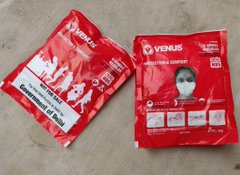
Five million masks are being distributed at schools in India's capital, Delhi, after pollution made the air so toxic officials were forced to declare a public health emergency.
A Supreme Court mandated panel imposed several restrictions in the city and two neighbouring states, as air quality deteriorated to "severe" levels.
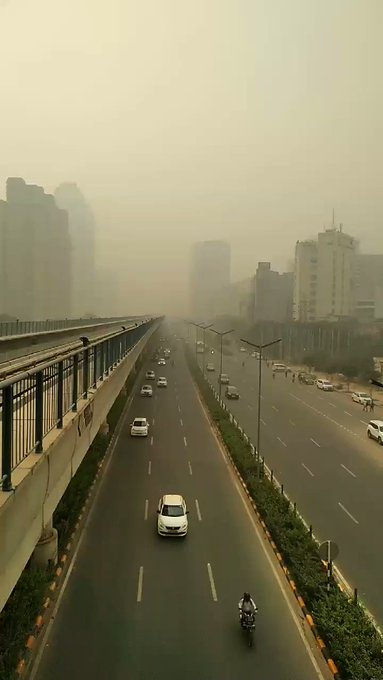
Dangerous particulate levels in the air are about 20 times the WHO maximum.
The city's schools have also been closed until at least next Tuesday.
All construction has been halted for a week and fireworks have been banned. From Monday, the city will introduce a temporary scheme so that only cars with odd or even numbered licence plates can drive on given days, in a bid to cut traffic pollution.
Delhi's Chief Minister Arvind Kejriwal said Delhi had been turned into a "gas chamber".
Presentational white space
The masks are being handed out to students and their parents, and Mr Kejriwal has asked people to use them as much as possible.
The levels of tiny particulate matter (known as PM2.5) that enter deep into the lungs are 533 micrograms per cubic metre in the city. The WHO recommends that the PM2.5 levels should not be more than 25 micrograms per cubic metre on average in 24 hours.


How thick is the pollution?

As thick white smog blanketed the city, residents started tweeting pictures of their surroundings.
Photos of German leader Angela Merkel's official visit showed the obscuring effect of the smog at the presidential palace - though both leaders ignored the declared public health emergency and declined to wear masks.

Indian Prime Minister Narendra Modi (L) and Chancellor of Germany Angela Merkel (R) talk at Rashtrapati Bhavan, India"s presidential palace in New Delhi, India, 01 November 2019Image copyrightEPA
Image captionThe German and Indian leaders met at India's presidential palace amid the smog
Many local residents are furious that the situation remains the same year after year.
"I didn't realise how bad it would get," one resident said. "Do we really want our kids to grow up in such an environment? No one really cares, no one wants to improve the situation."
The hashtags #DelhiAirQuality and #FightAgainstDelhiPollition are trending on Twitter.
Presentational white space
The thick smog also raised concerns for the weekend's cricket clash between India and Bangladesh. A 2017 match in similar polluted conditions led to Sri Lankan players vomiting on the pitch.
But Bangladesh's coach said that despite "scratchy eyes" and sore throats among his players, the game would go ahead.

Bangladesh cricket team head coach Russell Domingo (R) and bowling coach Daniel Vettori wearing face masks watch the team during a practice session at Arun Jaitley Cricket Stadium in New Delhi on November 1, 2019,Image copyrightAFP
Image captionRussell Domingo (R) wore a mask to training, but said his players would get on with it
"No-one is dying," he told the Press Trust of India.
"Look, there's a bit of pollution in Bangladesh as well, so it's a not a massive shock unlike some other countries. The players have just got on with the game and haven't complained too much about it," he said.

Why is the pollution so bad?

One of the main reasons for air quality in the city worsening every year in November and December is that farmers in the neighbouring states of Punjab and Haryana burn crop stubble to clear their fields. It's made worse by the fireworks during the Hindu festival of Diwali.
There are other reasons too, including construction dust, factory and vehicular emissions, but farm fires remain the biggest culprit.

Media captionA hair-raising drive through the Delhi smog
More than two million farmers burn 23 million tonnes of crop residue on some 80,000 sq km of farmland in northern India every winter.
The stubble smoke is a lethal cocktail of particulate matter, carbon dioxide, nitrogen dioxide and sulphur dioxide.
Using satellite data, Harvard University researchers estimated that nearly half of Delhi's air pollution between 2012 and 2016 was due to stubble burning.
The burning is so widespread that it even shows up in satellite photos from Nasa.

What are PM 2.5 particles?

Infographic
  • Particulate matter, or PM, 2.5 is a type of pollution involving fine particles less than 2.5 microns (0.0025mm) in diameter
  • A second type, PM 10, is of coarser particles with a diameter of up to 10 microns
  • Some occur naturally - e.g. from dust storms and forest fires, others from human industrial processes
  • They often consist of fragments that are small enough to reach the lungs or, in the smallest cases, to cross into the bloodstream as well

More on this story

WAS THE CORNER OF GOD'S ALTAR FOUND IN SHILOH, WEST BANK?

WAS THE CORNER OF GOD'S ALTAR FOUND IN SHILOH, WEST BANK?

The discovery, said Dr. Scott Stripling, is consistent with what he expected to find in the fields of the ancient city where the tabernacle for the Ark of the Covenant once stood.

BY 
 
 OCTOBER 31, 2019 20:58
 

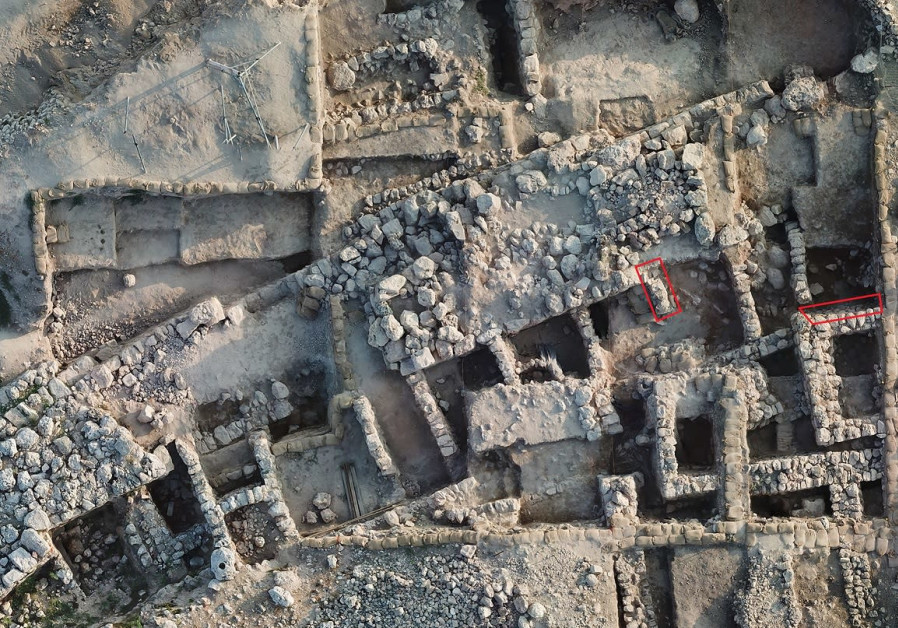
    Aerial view of the excavations at Shiloh
    Aerial view of the excavations at Shiloh. (photo credit: COURTESY ASSOCIATES FOR BIBLICAL RESEARCH)
    “When the news reached Joab, who had conspired with Adonijah though not with Absalom, he fled to the tent of the Lord and took hold of the horns of the altar” (1 Kings 2:28).

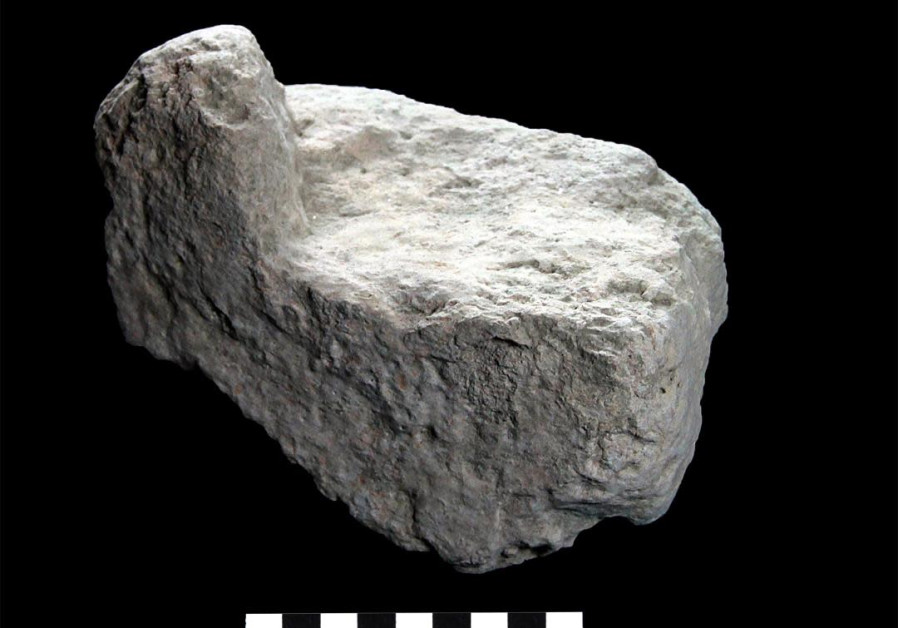
    This passage in the Bible may have come to life just a few weeks ago for a team of 200 archaeologists and volunteers, who have been excavating in the field of ancient Shiloh. This summer, under the guidance of Dr. Scott Stripling, they made the discovery of a horn, which was one of the four corners of an ancient altar, as described in Kings.
    The corner of the horned altar found at the Shiloh excavations in the West Bank (Credit: Courtesy Associates for Biblical Research)The corner of the horned altar found at the Shiloh excavations in the West Bank (Credit: Courtesy Associates for Biblical Research)

    The find, said Stripling, director of excavations at ancient Shiloh and head of the Associates for Biblical Research, is consistent with what he expected to find in the fields of the ancient city where, according to the biblical account, the tabernacle for the Ark of the Covenant once stood.

    Stripling is a “biblical archaeologist.” He has been excavating the land of Israel for decades. He directed excavations at Khirbet el-Maqatir from 2013 to 2017, served as a field supervisor of the Tall el-Hammam Excavation Project from 2005 to 2010, and was a supervisor of the Jerusalem Temple Mount Salvage Project, as well.

    His Shiloh team is made up of archaeologists and volunteers from 11 universities around the world – an interdisciplinary team of scientists, historians and biblical scholars. In the last three years, they uncovered multiple large pithoi – “famous Israelite collar-rimmed jars” – inside a series of “storage rooms” that they found surround the ancient city.

    These jars, more of which were found over the 2019 summer, likely held grains and fruits – tithes in Stripling’s words, brought by the Israelites to the Temple.

    A MOST exciting find at the end of summer 2018, Stripling said, was a ceramic pomegranate.

    “The pomegranate is a sacred motif,” he said. “The only sites in Israel where we have found pomegranates like this one have been Levitical sites.”

    The pomegranate measures between 2.5 and three inches and has hooks by which it could be hung, he explained. Stripling said a similar pomegranate was found nearly 100 years earlier by another excavation team. He said the Bible describes pomegranates hanging from the bottom of the robe of the High Priest, who served in Shiloh for more than three centuries – after the conquest of Canaan and until King David established Jerusalem as the eternal capital of the Jewish nation.

    “Make pomegranates of blue, purple and scarlet yarn around the hem of the robe, with gold bells between them,” reads Exodus 23:33 in reference to the High Priest’s dress.

    There are seven sacred foods in the land of Israel – two grains and five fruits, Stripling explained. But only one of them “goes into the presence of God, only one of them is sacred, and that is pomegranate… The pomegranate is a major motif of the Tabernacle and the Temples.

    Scott Stripling (Credit: Courtesy Associates for Biblical Research)Scott Stripling (Credit: Courtesy Associates for Biblical Research)

    “The Bible and other ancient religious texts is what has driven archeology in this region,” Stripling said, proud to hold the holy book in one hand and a shovel in his other. “We have to recognize the validity of the Bible… I am comfortable with the biblical story – and now we have proof of that story, really.”

    But not everyone agrees.


    WHILE THE site was first excavated nearly 100 years ago in 1922 by a Danish expedition, which returned two more times in 1926 and 1932, the most recent excavation – and the most extensive one before Stripling’s – was done by a team led by Tel Aviv University Professor Israel Finkelstein from 1981 to 1984.

    Finkelstein discovered a large bone deposit that was dated to the Late Bronze Age (around 1483–1177 BCE, according to Stripling), which he said provided evidence of a Canaanite sacrificial system at Shiloh.

    The timing also works with the biblical narrative, and Stripling saw the ancient Jewish text in those bones, as well.

    “These were kosher and young animals, many with signs of burn or butcher marks on them, and they were mostly from the right side of the animal,” Stripling explained. “This did not mean much to Finkelstein. For me it was Leviticus Chapter 7: The right side of the animal was the priest’s portion, which would have been consumed at Shiloh. It would have been sacrificed, eaten by the priest and the bones disposed.”

    He uses a big word to describe when this happens: verisimilitude.

    “It means consistency between what we read in the text and what we find on the ground,” he said.

    There are essentially two schools when it comes to biblical archaeology: maximalists and minimalists.

    “Maximalists are those who really dig with one hand and read the Bible with the other,” explained Jacob Wright, a professor of Hebrew Bible at Emory University in Atlanta. “They see the Bible as primary source on par with the archaeological witness.”

    In contrast, Minimalists, he said, try to disconnect their findings from the holy text and often have a political agenda of delegitimizing the modern State of Israel.

    He said Maximalists and Minimalists hold extremist views and that most archaeologists fall somewhere in the middle.


    “ARCHAEOLOGY HAS one story to tell and the biblical narrative has another,” according to Wright.

    “Let’s imagine we find a lot of things related to a cultic sanctuary at Shiloh and the Bible describes it the same way: Does that prove the biblical narrative is true?” Wright asked. “No. But it does indicate this site was an important cultic center. Who knows? You don’t want to jump to conclusions.”

    With this, Stripling expressed similar sentiments. As such, he said that he uses the most modern technology to help him on his scientific yet faithful journey.

    Six years ago, his excavation team used their first drone to take pictures and create a site map of a different site. “Everyone stopped working to take pictures of the drone,” he recalled.

    Now, the team takes 1,000 drone shots every day and compresses them to make 3-D images so they can see the site from many different angles. They don’t draw plans; they hover the drone over the field to capture the perfect picture and take notes directly onto the image.

    Supervisors use iPads to jot down findings; the data is automatically collected on Stripling’s own iPad simultaneously, allowing him to make data-driven decisions in the field.

    Most recently, he built a unique wet-sifting station at Shiloh, modeled after the one used for the Temple Mount Sifting Project.

    Volunteers are trained to use the washing station, water tower, hoses and nozzles to go through the finds, capturing at least 80% more evidence than they did in years prior. Now, the Associates for Biblical Research are writing up their wet sifting process and will create a blueprint on which other archeology teams can model.

    Dr. Eilat Mazar, of the Institute of Archaeology of the Hebrew University in Jerusalem – the granddaughter of Benjamin Mazar who excavated the land of Israel under the British Mandate – is known for her advice: “Let the stones speak for themselves.”

    “We can discover the date of a structure,” said Brent Nagtegaal, Jerusalem representative of the Armstrong International Cultural Foundation, “but without the Bible, we don’t understand its context… The Bible is the best tool that archaeologists have in Israel.”

    Join Jerusalem Post Premium Plus now for just $5 and upgrade your experience with an ads-free website and exclusive content. Click here>>

    YOU MIGHT ALSO LIKE

    Contact Form

    Name

    Email *

    Message *