Judge Blocks Louisiana Law Requiring Schools to Display Ten Commandments


by Jorge Gomez • 5 minutes
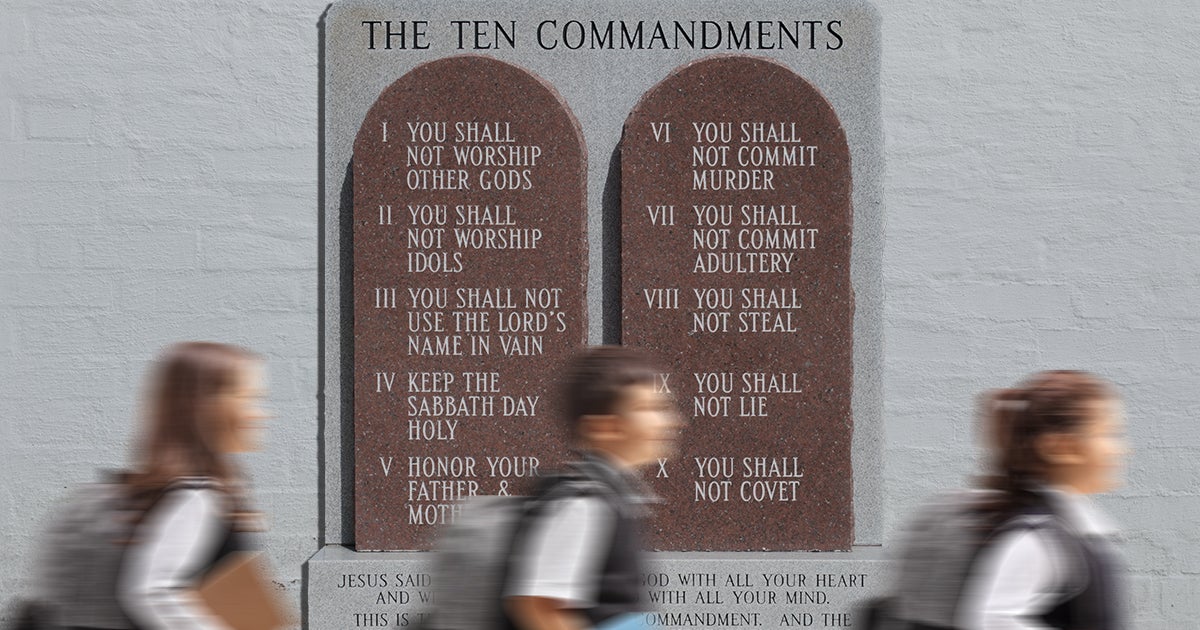
A federal district court judge ruled against Louisiana’s law requiring the Ten Commandments to be displayed in public schools. The opinion said the law violates the Free Exercise and Establishment Clauses of the First Amendment.
Gov. Jeff Landry signed the law in June. It directed all public K-12 classrooms and state-funded universities to display a poster-sized printout of the Ten Commandments. Louisiana was the first state to enact such a requirement since 1980.
Additionally, Louisiana’s law requires a context statement to be attached to the display explaining the role of the Ten Commandments in American history and our legal system. Schools may—but are not required to—also post the Declaration of Independence, the Mayflower Compact and the Northwest Ordinance of 1787.
“We strongly disagree with the court’s decision and will immediately appeal,” said Louisiana Attorney General Elizabeth Murrill, who defended the law before the district court.
The legal challenge was brought by several families with children in Louisiana public schools. They are represented by the American Civil Liberties Union, the ACLU of Louisiana, Americans United for Separation of Church and State and the Freedom from Religion Foundation.
The judge’s opinion stated that the law is “coercive to students, and, for all practical purposes, they cannot opt out of viewing the Ten Commandments when they are displayed in every classroom, every day of the year, every year of their education.” It also cited the Supreme Court’s ruling in Stone v. Graham, in which the Court struck down a similar Kentucky law.
First Liberty Executive General Counsel Hiram Sasser explained that this is an outdated precedent. “Unfortunately for the ACLU, their entire case is built on sand. Stone v. Graham is a relic of a previous time when the Lemon test censored religion from public life and is no longer good law,” Sasser said.
First Liberty’s landmark Supreme Court rulings in Kennedy v. Bremerton and American Legion v. American Humanist Association changed the legal test for religious expression on public property. The Court overturned decades of bad precedent that caused many historic religious symbols to be scrubbed from the public square. The Court created a new test, writing that “the Establishment Clause must be interpreted by ‘reference to historical practices and understandings.’”
What’s more, in Kennedy, the Supreme Court rejected the notion that the mere presence of religious expression or imagery is somehow coercive. Instead, the Court found no coercion “where there is no evidence anyone sought to persuade or force students to participate.”
The district court judge, however, said that Louisiana law fails the Supreme Court’s history-and-tradition test.
“In sum, the historical evidence showed that the instances of using the Ten Commandments in public schools were too ‘scattered’ to amount to ‘convincing evidence that it was common’ at the time of the Founding,” the opinion read.
The judge made that conclusion even though there’s abundant evidence that the Ten Commandments are a foundation of our country’s laws and Louisiana’s laws. Attorney General Murrill previously detailed the history of the Ten Commandments in public schools, saying they were a prominent part of American education for almost three centuries:
“Around the year 1688, The New England Primer became the first published American textbook and was the equivalent of a first grade reader. The New England Primer was used in public schools throughout the United States for more than 150 years to teach Americans to read and contained more than 40 questions about the Ten Commandments.
The Ten Commandments were also included in public school textbooks published by educator William McGuffey, a noted university president and professor. A version of his famous McGuffey Readers was written in the early 1800s and became one of the most popular textbooks in the history of American education, selling more than 100-million copies. Copies of the McGuffey Readers are still available today. “
First Liberty played a role in helping the legislation reach the Governor’s desk and eventually become law.
“We are grateful for the strong leadership of Attorney General Murrill in defending this important law,” said First Liberty President, CEO and Chief Counsel Kelly Shackelford. “Placing this historic document on schoolhouse walls is a great way to remind students of the foundations of American and Louisiana law and it fits perfectly in the history and tradition of America.”
First Liberty will stand with Attorney General Murrill at the courthouse and through all appeals every step of the way.


 Posts
Posts

