Saturday, September 2, 2017

45,000 Illegals Using DACA Backdoor to Get Green Cards

45,000 Illegals Using DACA Backdoor to Get Green Cards

President Barack Obama’s deputies opened a little-known immigration backdoor to put 45,000 DACA illegals on a multistep path to citizenship, according to the Senate Judiciary Committee.

According to the committee, the “advanced parole” loophole has ensured:
As of August 21, 2017, 45,447 DACA recipients have been approved for advance parole through an I-131 Application for travel documents. This approval allows a DACA recipient to travel out of the country and legally return, making them eligible to adjust their immigration status and receive a green card.
Overall,  60,000 of the 800,000 DACA illegals have been allowed to apply for Green Cards via several legal routes. That number includes the 45,000 DACA illegals who are using the “advanced parole” backdoor.
So far, 40,000 DACA illegals have been approved to get Green Cards. Many have received the cards, and 2,181 have subsequently applied for citizenship.
advertisement
The “advanced parole” backdoor has been used for several years. The process works like this: DACA illegals asked officials in Obama’s Department of Homeland Security if they could go home for an emergency and be allowed back into the United States under the “advanced parole” status. The status was previously reserved for a few emergencies, such as a sick traveler on an international flight.
Once approval was granted, the DACA illegal went home — usually to Mexico — and returned back to the United States via the legal process. The legal return allowed them to use many other features in the immigration law to file for Green Cards status.
Once given a Green Card, the former illegal can gain citizenship and voting rights after several years.
Citizenship gives the former illegals full access to U.S. federal spending programs, and also the “chain migration” right to seek citizenship for the parents who brought the illegals into the United States as children.
The September 1 statement from the judiciary committee said:
Preliminary data provided by U.S. Citizenship and Immigration Services in response to recent inquiries from the House and Senate Judiciary Committees indicate that the Obama administration allowed thousands of DACA recipients to exploit an immigration law loophole to obtain green cards. The data also show that more than a thousand DACA recipients have already obtained citizenship. The DACA program was never intended to provide a pathway to citizenship, and the program’s legal future is in jeopardy.
As of August 21, 2017, 45,447 DACA recipients have been approved for advance parole through an I-131 Application for travel documents. This approval allows a DACA recipient to travel out of the country and legally return, making them eligible to adjust their immigration status and receive a green card.  Another 3,993 had their applications denied.
The data provided indicates 59,778 DACA recipients have applied for Lawful Permanent Resident (LPR) status—also known as a ‘green card’—and 39,514 have been approved.  Of those who received LPR status, 2,181 have applied for U.S. citizenship and 1,056 have become U.S. citizens.
The news about the 45,000 Green Cards comes as President Trump decides whether to end the DACA amnesty, which now provides work-permits and Social Security cards to 800,000 illegals.
Business groupsGOP leaders, as well as Trump’s globalist aides, Democrats and the establishment media, are pressuring Trump to preserve the DACA program despite his campaign promise to immediately revoke the amnesty. He is expected to announce a decision by Monday.

Court Rules Against Coach Kennedy. Is “Prayer the New Pornography?”

Court Rules Against Coach Kennedy. Is “Prayer the New Pornography?”

First Liberty disappointed with federal appellate court’s dangerous ruling against Coach Joe Kennedy; vows to fight decision.

Share:   
August 31, 2017

“Banning all coaches from praying silently in public just because they can be seen is wrong,” First Liberty President and CEO Kelly Shackelford stated in a press release. “This is not the America contemplated by our Constitution,” said Shackelford, after three federal judges upheld a school’s prayer ban against Coach Joe Kennedy. First Liberty vows to appeal the decision.
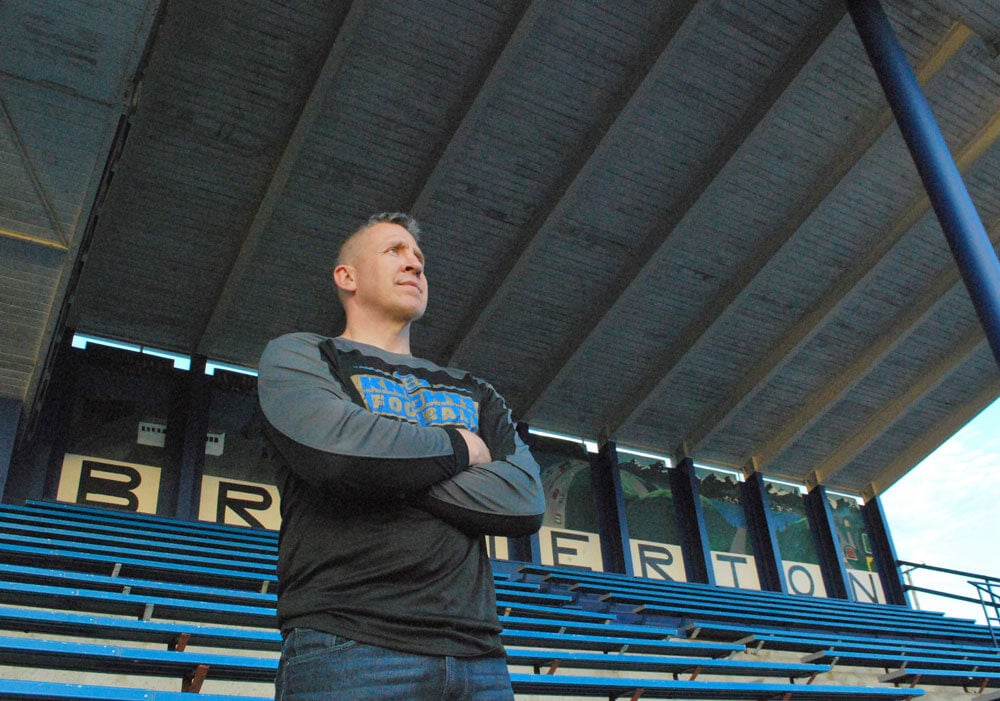
Last week, on Wednesday, August 23, a three-judge panel of the U.S. Court of Appeals for the Ninth Circuit handed down its ruling in the case of Joe Kennedy, a high school football coach at Bremerton High School in Washington State who was fired over his postgame, on-the-field prayers.
“According to the Ninth Circuit, it is unconstitutional for a coach to make a sign of the cross or bow his head in prayer when a player gets hurt,” stated Mike Berry, Deputy General Counsel to First Liberty. “We are deeply disappointed by the decision.”
The court allowed the school to ban Coach Kennedy from praying and argued that Coach Kennedy’s prayers were made in his capacity as a public employee, rather than being personal, private speech protected by the First Amendment.
Fox News’ Shannon Bream interviews Coach Kennedy and Kelly Shackelford
The problem with Coach Kennedy’s prayers, according to the Ninth Circuit, is that he prayed in a place where he could be seen.
“It’s almost like prayer is the new pornography,” Shackelford told Fox News.
The court stated, however, that he would have been protected by the First Amendment had Coach Kennedy simply prayed by himself in his office while brainstorming plays, if he prayed “non-demonstratively,” or if he prayed in a secluded place at the school, like somewhere in the press box.
FIRED FOR POSTGAME PRAYER
Before coaching his first game, Coach Kennedy made a commitment to God that he would give thanks after every game—regardless of the outcome—for his players and for the opportunity to be a coach. So, after his first football game ended in 2008, he waited until the players cleared the field. He then took a knee.
Coach Kennedy prayed after games for seven years without complaints. In fact, it wasn’t until receiving a compliment—not a complaint—that the school district told Coach Kennedy in 2015 to stop his practice. First Liberty sent a response letter to the school, explaining that:
“No reasonable observer could conclude that a football coach who waits until the game is over and the players have left the field and then walks to mid-field to say a short, private, personal prayer is speaking on behalf of the state.”
The school district fired Coach Kennedy after he went alone to midfield, took a knee, and said a brief, silent prayer approximately 15 to 30 seconds long.
Coach Kennedy’s case received national attention, with then Presidential Candidate Donald Trump voicing his support  for Coach Kennedy in meetings and on social media.
After the Ninth Circuit’s ruling, Coach Kennedy appeared on Fox News twice, once with Shackelford and once with First Liberty General Counsel Hiram Sasser.
Fox News’ Martha MacCallum interviews Coach Kennedy and First Liberty’s Hiram Sasser
DANGEROUS IMPLICATIONS FOR PUBLIC SCHOOL EMPLOYEES
The Ninth Circuit’s ruling set a widely-applicable precedent with dangerous consequences for the millions who live in the area under the court’s jurisdiction. It logically follows from the court’s opinion that school districts may ban any form of religious expression made by a school employee that occurs in front of students and is connected to school activities.
In his Fox News interview, Shackelford commented on the implications of the Ninth Circuit’s opinion. He said:
“That would mean that a teacher couldn’t bow their head over the meal in the lunch cafeteria. A Jewish teacher couldn’t wear a yarmulke. You couldn’t wear a cross. That is an incredibly extreme ruling that whenever anyone is ‘on duty’ or wearing a logo from the school that they can’t be a person of faith. That’s not the law and not the Constitution, and what they did to Coach Kennedy is wrong.”
In addition, the court stated that part of Kennedy’s job was “modeling good behavior while acting in an official capacity in the presence of students and spectators.” The court reasoned that Coach Kennedy was a “role model and moral exemplar” who was “responsible for communicating the [school] District’s perspective on appropriate behavior through the example set by his own conduct.”
But apparently, the school district considers prayer by Coach Kennedy to be inappropriate for student viewing—and the Ninth Circuit agreed.
Those implications were evident to many observers across the nation, who reacted with alarm to the ruling and the wording of the opinion.
SCHOOL EMPLOYEES HAVE RELIGIOUS FREEDOM RIGHTS—EVEN ON THE JOB
However, just because teachers or school employees can be seen by students doesn’t mean that they lose their religious freedom rights. As the U.S. Supreme Court recognized in its landmark Tinker v. Des Moines Independent Community School District (1969) decision, teachers do not “shed their constitutional rights to freedom of speech or expression at the schoolhouse gate.”
First Liberty is committed to continuing to defend the free speech rights of Coach Kennedy and coaches and teachers like him. For more information about religious freedom in the public schools, download First Liberty’s free Religious Liberty Protection Kit for Students and Teachers.

News and Commentary is brought to you by First Liberty’s team of writers and legal experts.

The Making of the First Amendment: Religious Freedom’s Crowning Legal Achievement

The Making of the First Amendment: Religious Freedom’s Crowning Legal Achievement

Discover the history behind the First Amendment and why George Washington called religious freedom “a policy worthy of imitation.”

Share:   
September 1, 2017

Editor’s Note: The First Amendment guarantees of freedom of religion and speech are coming under increased pressure today, as seen in numerous cases in which First Liberty Institute and others defending religious freedom are involved. In this environment, it is crucial that more citizens know the history and significance of the First Amendment. It is indeed a “crowning achievement”—and one worth fighting to keep. First Liberty writer Catherine Frappier examines this history below.

With the rise of religious liberty violations and religious hostility in America today, many Americans can likely imagine a world without the First Amendment–and give thanks that the founding generation had the foresight to implement a constitutional protection for the “free exercise” of religious faith.
As part of America’s highest written law for over two centuries, the First Amendment is synonymous with America’s exceptional regard for religious and political freedom.
However, the original Constitution adopted by the 1787 Constitutional Convention did not include a bill of rights with provisions protecting religious freedom and other liberties. So how did religious freedom come to be protected in America’s most basic governing document?

“RELIGIOUS LIBERTY…IS NOT SUFFICIENTLY SECURED”
While the Constitution originally did not include the First Amendment’s expansive religious liberty protection, it did include a few specific religious liberty provisions in “a spirit and purpose similar to…the free exercise clause,” noted the Honorable Michael McConnell  (a law professor who later became a federal appellate judge) in a Harvard Law Review article titled “The Origins and Historical Understanding of Free Exercise of Religion.” An example he listed was Article VI, which banned religious tests for “office[s] or public trust[s] under the United States.”
But the Constitution’s lack of a bill of rights–including its lack of religious liberty protection–caused some concern. For example, in a letter to Thomas Barbour, the Virginia Baptist minister John Leland listed his objections to the Constitution–objections that ended up being forwarded to James Madison. One of these objections was that “Religious Liberty, is not Sufficiently Secured.”
Leland argued that the Constitution’s ban on religious tests wasn’t enough. He wrote:
…if a Majority of Congress  with the president favor one System more than another, they may oblige all others to pay to the Support of their System as Much as they please, & if Oppression does not ensue, it will be owing to the Mildness of Administration & not to any Constitutional defense, & if the Manners of People are so far Corrupted, that they cannot live by republican principles, it is Very Dangerous leaving religious Liberty at their Mercy–… (spelling modernized)
In a December 20, 1787, letter to James Madison, Thomas Jefferson stated what he “[did] not like” about the Constitution, arguing that it lacked “a bill of rights providing clearly and without the aid of sophisms” protection for various rights. The first of these mentioned by Jefferson was “freedom of religion.”
In addition, several state ratifying conventions (or minorities at these conventions) proposed amendments to the Constitution. For example, one amendment proposed by the New York Ratifying Convention was the following:
That the People have an equal, natural and unalienable right, freely and peaceably to Exercise their Religion according to the dictates of Conscience, and that no Religious Sect or Society ought to be favoured or established by Law in preference of others.
As scholar James H. Hutson stated in his book Church and State in America: The First Two Centuries, Federalists didn’t believe a bill of rights was needed. But he also noted that Federalists agreed to seek constitutional amendments after the Constitution was adopted in order to make sure that the states ratified the Constitution.

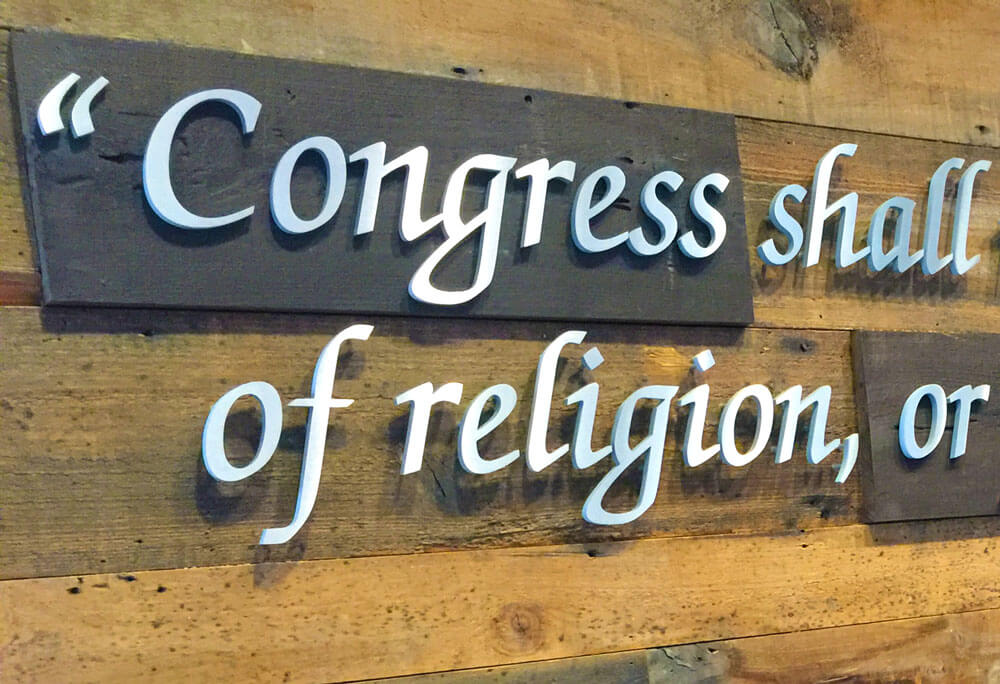
“CONGRESS SHALL MAKE NO LAW…”
So in 1789, James Madison (now a member of the U.S. House of Representatives) introduced several amendments in Congress, including the religious freedom amendment that developed into the religion clauses of the First Amendment.
Madison’s original amendment read as follows:
The civil rights of none shall be abridged on account of religious belief or worship, nor shall any national religion be established, nor shall the full and equal rights of conscience be in any manner, or on any pretext infringed….
Madison also proposed two other religious liberty provisions, but these were not adopted by the Senate.
The House of Representatives and the Senate produced different wordings of the amendment. But a conference committee composed of members of both houses of Congress reached agreement on the provision’s language, and the First Amendment (originally the third amendment on the list sent to the states) was ratified on December 15, 1791. It read:
Congress shall make no law respecting an establishment of religion, or prohibiting the free exercise thereof…
Originally, the First Amendment only applied to the federal government, but the Supreme Court later applied the religion clauses of the First Amendment to the states, observed legal scholars the Honorable Arlin Adams (a former federal appellate judge) and Charles J. Emmerich in A Nation Dedicated to Religious Liberty: The Constitutional Heritage of the Religion Clauses.

AMERICA: A MODEL FOR THE REST OF THE WORLD
 America can lay claim to many important and special accomplishments, but one of these is the espousal of religious freedom as opposed to the less expansive and inadequate notion of religious “toleration.”
In their work The Sacred Rights of Conscience: Selected Readings on Religious Liberty and Church-State Relations in the American Founding, scholars Daniel L. Dreisbach and Mark David Hall pointed out that from a historical standpoint, the concepts of religious toleration and religious liberty have meant different things.
They noted that toleration has seen freedom of religion as a gift of government that can be taken away, not as a natural right of mankind. In addition, toleration has also often been associated with an established church.
But America chose a different path. As George Washington stated in a 1790 letter to a Hebrew congregation in Rhode Island:
The Citizens of the United States of America have a right to applaud themselves for having given to mankind examples of an enlarged and liberal policy: a policy worthy of imitation. …It is now no more that toleration is spoken of, as if it was by the indulgence of one class of people, that another enjoyed the exercise of their inherent natural rights. For happily the Government of the United States, which gives to bigotry no sanction, to persecution no assistance requires only that they who live under its protection should demean themselves as good citizens… (emphasis added)
Dr. Dreisbach and Dr. Hall called this victory of religious freedom over simple toleration “arguably America’s greatest contribution to, and innovation of, political society.”

PRESERVING RELIGIOUS FREEDOM TODAY
The First Amendment is America’s crowning achievement in the legal protection of religious freedom. In addition, America has instituted several statutory laws that build on the First Amendment and reinforce the concept of religious freedom over toleration.
From the Religious Freedom Restoration Act (RFRA) to the Religious Land Use and Institutionalized Persons Act (RLUIPA) and other federal and state laws, America is a nation that protects its citizens’ “free exercise” of faith.
Today, however, religious freedom is under attack today from hostile governmental and cultural agendas. But America must safeguard its exceptional commitment to religious liberty as a natural, God-given inalienable right of mankind upon which the government must not infringe.
If America does this, its citizens can continue, in George Washington’s words, to “applaud themselves for having given to mankind examples of an enlarged and liberal policy: a policy worthy of imitation.”

News and Commentary is brought to you by First Liberty’s team of writers and legal experts.

Media stoking racism, black serial killer in KC, white privilege is a LIE

Published on Sep 2, 2017

Sinus, comment I made on KC Odea Show, Serial Killer in Kansas City, fake white privilege #whiteprivilege #whiteguilt Liberal media on President Trump and FLOTUS Millennia, #SPLC Southern Poverty Law Center. Liberal hypocrisy

Democrats plan to make 2020 election a referendum on single-payer health care

Democrats plan to make 2020 election a referendum on single-payer health care

 
Democrats plan to make 2020 election a referendum on single-payer health care
Sen. Kamala Harris (D-Calif.) and other Democrats hope to make the 2020 election a referendum on single payer healthcare in the United States. (Photo by Chip Somodevilla/Getty Images)
The way-too-early smart money on the 2020 Democratic presidential primary is on freshman California Sen. Kamala Harris. This is true both figuratively and literally — Harris checks all the boxes the Democrats are looking for in a candidate, and she hasalready begun corralling the formidable Clinton money machine in preparation for a widely anticipated presidential run.
Add all this up, and Harris’ announcement that she will co-sponsor a single-payer health care bill with liberal favorite Sen. Bernie Sanders (D-Vt.) likely signals that Democrats believe the time to run on the issue has officially come.

No Democratic nominee has openly embraced single-payer before

Of course, it is no secret that most Democratic nominees for president have harbored a desire to see single-payer health care implemented in the United States, but it is rare for a legitimate front-runner to openly embrace a single-payer platform. 2016 nominee Hillary Clinton studiously avoided discussion of a single-payer plan during her last run for president. Although she walked a fine tightrope during the period that Sanders challenged her from the left in the primary, when she engaged in the general election, both her campaign website and her stump speeches refused to endorse any single-payer system in America.
Likewise, Barack Obama was caught on tape in 2003 saying that he believed in a single-payer health care system, but during the 2008 campaign he walked back this statement and even attempted to pretend that he had never been in favor of a single-payer system.
Former President Bill Clinton may have had the most ambitious health care rhetoric of any Democratic candidate in memory, but even his plan consisted of a mandate for employers to provide health care coverage for all employees, not outright government control of the health care sector.

Harris and Warren move the entire field to the left

Harris’ main early potential primary foe, Sen. Elizabeth Warren (D-Mass.), is likewiseopenly in favor of a single-payer health care system.
By staking out an early position that is openly in favor of a single-payer system, Harris and Warren have made it exceedingly difficult for any of their potential Democratic challengers to take a more moderate approach on health care, for fear of being labeled a conservative toady or quisling. This is especially true in light of Democrats’ belief that Hillary Clinton’s 2016 loss signals that triangulation is a losing strategy.
Whether true or not, many Democrats believe that Clinton lost because she didn’t stand up for liberal principles enough. It seems like a virtual certainty that any candidate who is not well to the left of where Clinton was will be doomed when the vote counting begins. The Democratic 2020 pump has been primed to produce an unprecedentedly liberal nominee since the day Trump won.
Now, with both of the early favorites openly embracing the crown jewel of liberal policy, any candidate who does toe the line will begin with a huge disadvantage with Democratic primary voters. One axiom of politics is that in any contested primary, the also-rans shoot for ideological purity and the front-runners avoid firm policy positions in order to allow themselves as much room as possible to triangulate in the general.
If the front-runners are already for single-payer, how can any also-ran grab any oxygen at all unless they also openly advocate for single-payer?

An issue destined for center stage

Any issue as potentially monumental as the nationalization of a huge portion of the American economy will, of necessity, take center stage in the general election — and Democrats are increasingly optimistic that this is a fight they can win. Polling suggests that America is slowly coming around to the idea of a single-payer health care system. In just two years, support for a single-payer system jumped from 28 percent in 2014 to 33 percent in 2016. More worryingly, 60 percent of Americans stated in 2016 that it was the government’s responsibility to make sure everyone has health insurance, as opposed to only 39 percent who said that wasn’t part of the government’s responsibility at all.
Although some recent polling has been more ambiguous on public support for a single-payer system, the polling does show one consistent trend: as more time goes by, more Americans are in favor of it. Democrats are betting that in four years, the tables will have turned completely in their favor, especially with the looming troubles (primarily induced by Obamacare) that the private insurance market is expected to face over the next four years.
In other words, having set up a legal framework that doomed the private health care system to failure, the Democrats hope they can reap the rewards when the system fails under Trump.
Time will tell if their strategy will ultimately succeed with the voters, but it seems clear that the Democrats plan to give it their best shot in 2020.

Seismic Increase (M6.5-M7.5) 3-8 September 2017

Published on Sep 2, 2017

With 5 planetary alignments between 3 and 7 September, a seismic increase is expected. The first critical alignment will be Earth-Mercury-Mars on the 3rd. This may cause a mid 6 to 7 magnitude earthquake between the 3rd and 5th.

Contact Form

Name

Email *

Message *