Tisha B’Av in the Warsaw Ghetto

TRENDING

6 min read


Emanuel Ringelbaum, a chronicler of the Warsaw Ghetto, called that day in 1942 “the blackest day in Jewish history in modern times.”
Before the Germans captured the city of Warsaw in the 1939 Blitzkrieg, there were 360,000 Jews in the Polish capital. Its Jews were forced into the Warsaw Ghetto, which was enforced by the Nazis on November 15, 1940.
Many of the ghetto's inhabitants perished from disease and starvation but the population was maintained by the continual influx of Jewish refugees. Warsaw’s Jewish population soon reached 460,000.1 The Jews of the Ghetto initially didn’t realize that they were being forced into what was a holding pen for the death camps, most to the slaughterhouse – Treblinka, which would execute 800,000 people, the vast majority of whom were Jews, within the span of months.
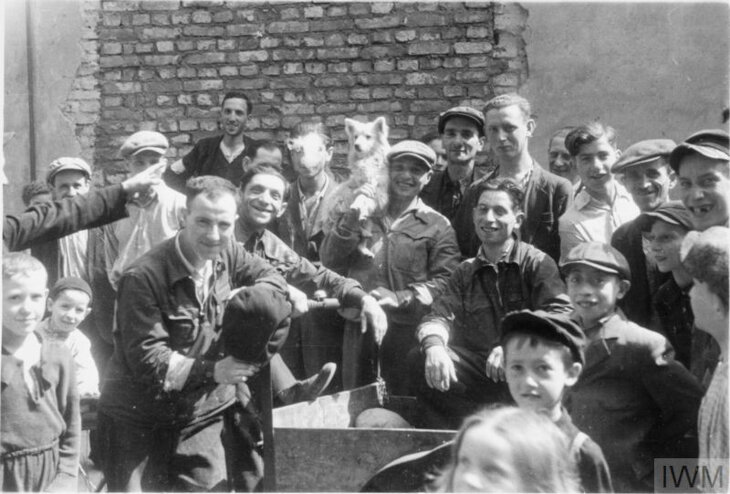 A group of Jewish men and children posing for a photograph in the street of the Warsaw ghetto, 1941. Photo by Willy Georg
On July 22, the eve of Tisha B’Av 1942, the death sentence for Warsaw’s Jews was issued. In the early morning hours, the Judenrat (Jewish police) was convened and the authorities for 'Resettlement Affairs' ordered the “resettlement in the east of all Jews residing in Warsaw regardless of age and sex.” The order called for 6,000 Jews per day to be rounded up and deported.
A week before the announcement of deportations, rumors had already spread in the ghetto, and the Jews were gripped with terror. Head of the Judenrat, Adam Czerniakow asked Nazi officials for an explanation and received nothing but denials.
On the 22nd of July, at 7:30 in the morning, Czerniakow, along with the members of the Judenrat, were told that the deportations were to begin the next day – Tisha B’Av – and the expulsions would include children. He immediately realized the gravity of such an order and that his previous cooperation with the Germans was a grievous error. This was an order he would not sign. The night following the first deportation, he took his own life, leaving a note, “I am powerless my heart trembles in sorrow and compassion. I can no longer bear all this.”2
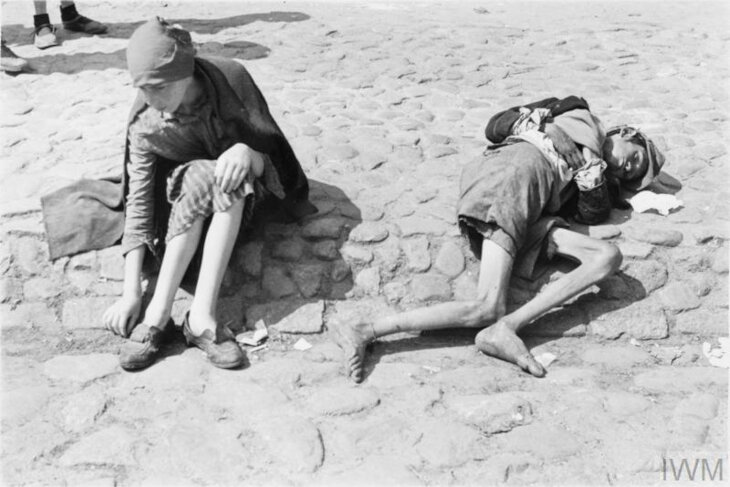 Two emaciated children, one of them asleep or unconscious, begging on the street of the ghetto, summer 1941. Photo by Willy Georg
Chaim Kaplan, in a diary on the Warsaw Ghetto, Scroll of Agony, foresaw the doom that awaited the Jews of Warsaw with the issuance of the decree. He had surmised that the deportations can only be a death sentence and those who deny it “grasp at straws.”3 In a July 26 entry, Kaplan wrote, “We, the inhabitants of the Warsaw ghetto are now experiencing the reality. Our good fortune is that our days are numbered – that we shall not have to live long under conditions as these.”4
The decree ordered all Jews to be deported except those who worked in German industries and the Judenrat. Over the next nine days 66,701 Jews were deported to Treblinka.
At Treblinka, a sign displayed at the entrance intended to maintain calm stated, “Do not worry about your future. … all of you are headed for the east, to work; while you work, your wives shall take care of your houses. But first you must bathe and your clothes must be cleaned of lice.”5 Only moments later, after merciless beatings by SS and Ukrainian guards, the victims were sent to their execution.
On July 29, the next round of Warsaw’s deportations began. The SS, along with Latvian and Lithuanian troops, closed off individual blocks and forced people from their homes. Many were shot on the spot; others were savagely beaten. When the crowd’s numbers reached a few thousand, they were herded off to the “Umschlagplatz”—a deportation railway yard, to be transported. Every morning and evening, the roundups took place.
 Jews being deported from the Warsaw ghetto board a freight train. Warsaw, Poland, July-September 1942.
Over the month of August, 142,525 Jews were deported, with 135,120 being sent to Treblinka. By mid August, it was widely understood that “resettlement” was a myth. Enough evidence had already reached the ghetto by witnesses to Nazi atrocities.
By October 3, 310,000 Jews were deported, including most members of the Judenrat. Many were deported on September 21, Yom Kippur, the Day of Atonement.
Dr. Hillel Seidman wrote in an entry in a Warsaw Ghetto diary entitled The Night of Tears:
As Night falls I finally reach home, my brain bursting with terrifying images. Crossing our courtyard I notice our small shtiebl. About twenty men sit on upturned benches – it’s Tisha B’Av tonight! Two flickering candles dimly light up the bent heads, with their eyes staring into the far distance, as that heartrending tune wells up: “Eichah…”
The tune that was perhaps first composed at the exile from Jerusalem and has since absorbed the tears of generations.
We Jews of Warsaw, sons of those exiles, sit on the ground to mourn our own personal churban [destruction], the destruction of a major kehillah [community] – the largest and most vigorous in Europe – which resulted from that earlier Churban [the destruction of the Temple in Jerusalem]. We weep at our fate, a nation without a land, within the grasp of our fiercest enemy and condemned to death. We grieve both for the loss of the Beis Hamikdash [Holy Temple] and the extinction of our lives.” 6
On Tisha B’Av 1942, the well-organized Nazi killing machine whose horror knew no bounds was set into high gear in the city of Warsaw.7 A chronicler of the Warsaw ghetto, Emanuel Ringelbaum, called the eve of that Tisha B’Av in 1942 “The blackest day in Jewish history in modern times.”8
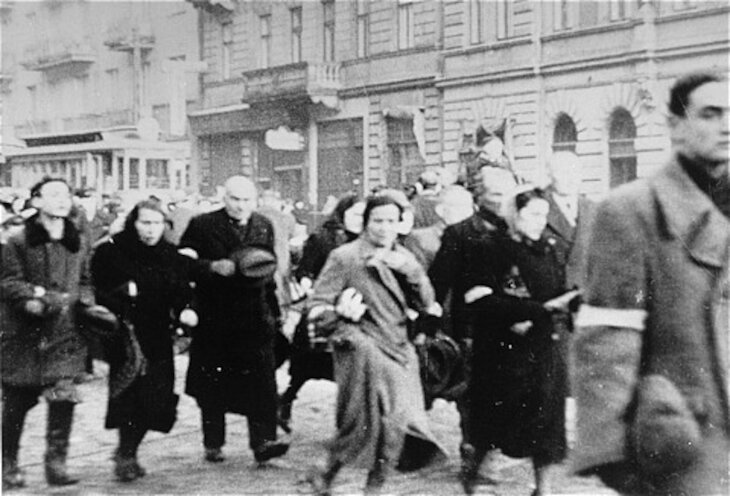 Jews from the Warsaw ghetto are marched through the ghetto during deportation. Warsaw, Poland, 1942–43.
- Courage Under Siege: Starvation, Disease and Death in the Warsaw Ghetto, Charles Roland, Oxford University Press, New York, 1992, p.27
- The Warsaw Diary of Adam Czerniakow, Introduction by Josef Kermisz, pg. 23
- Schroll of Agony: The Warsaw Diary of Chaim Kaplan, Translated and Edited by Abraham I. Katch, Collier Books, New York, 1973, pg. 380
- Ibid. p. 383
- The Warsaw Diary of Adam Czerniakow, pg. 46
- Dr. Hillel Seidman, The Warsaw Ghetto Diaries, Targum/Feldheim New York/Jerusalem, 1997, pgs. 55,56
- Of the forty thousand Jews who remained in the Warsaw Ghetto following the deportations, several hundred armed themselves and fought against their oppressors when they came to liquidate the ghetto in April of 1943.
- Notes From the Warsaw Ghetto;The Journal of Emmanuel Ringelbaum, edited and Translated by Jacob Sloan, Schocken Books, New York, P. 126
RECOMMENDED NEXT READ






 Posts
Posts


Thank you for the important article. One correction, though: the article states that the Judenrat refers to the Jewish Police. This is incorrect. The Judenrat was the Jewish Council, in charge (by force) of running Jewish life on behalf of the Nazis and executing their orders. The Jewish Police (Judischer Ordnungsdienst) is not the same as the Judenrat, although it also was under the Nazis. The Jeiwsh Police were involved in collecting ransoms, guarding ghettos, and taking Jews to forced labour (also under Nazi force).
Does Aish really need to recount Jewish defeats?
Do we really have to be eternal victims?
It's depressing.
How about something truly revolutionary!
Articles about Jewish victories to cheer us all up!
And that is exactly the fate that awaits Israel's 7.2 million Jews should its enemies triumph. Now might be a good time to make sure those nukes and Jericho 2's and 3's are in good working order.