|
Sunday, March 1, 2020


‘Never dialogue with the devil,’ Pope Francis says
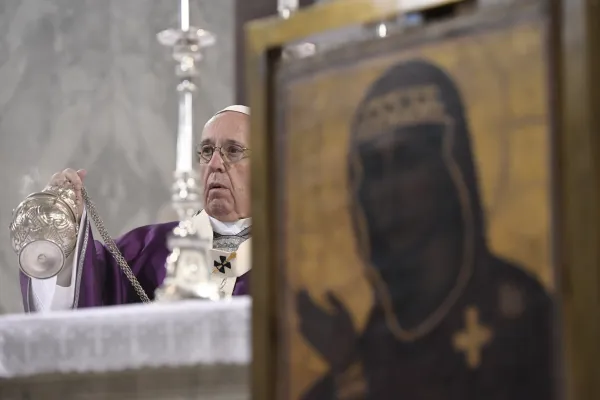
Vatican City, Mar 1, 2020 / 07:08 am (CNA).- Pope Francis said Sunday to follow Christ’s example when dealing with the temptation to sin: send the devil away or answer with the Word of God, but never engage in debate.
When being tempted by the devil in the desert, “Jesus does not talk with the devil. Jesus responds to the devil with the Word of God, not with his word,” the pope said March 1.
Francis noted that in times of temptation one may start to debate with the devil about sin.
“Never talk to the devil,” he advised. “Jesus does two things with the devil: he chases him away or, as in this case [in the desert], he answers with the Word of God. Be careful: never dialogue with temptation, never dialogue with the devil.”
Pope Francis’ address before the Angelus Sunday was on Jesus’ 40 days in the desert, where he goes to fast after being baptized in the Jordan River. There Jesus “prepares to begin his mission,” Francis said.
But at the end of his fasting, the devil comes and tries to tempt Jesus three times, he explained.
According to the pope, “even today Satan bursts into people’s lives to tempt them with his enticing proposals.”

“Messages come from many directions inviting [us] ‘to be tempted’ to experience the thrill of transgression,” he stated.
He explained that temptation tries to propose alternatives to God’s way, suggesting there is no problem, that God will forgive us, or that something is not a sin.
These give the feeling of self-sufficiency, that the purpose of life is its enjoyment, Francis said.
“But all this is illusory: soon we realize that the more we distance ourselves from God, the more we feel defenseless and helpless in the face of the great problems of existence.”
Pope Francis prayed that the Virgin Mary, who crushed the head of the serpent, will help everyone during Lent to “be vigilant in the face of temptations, not to submit to any idol of this world, to follow Jesus in the fight against evil.”
After praying the Angelus, the pope asked especially for prayers for the many immigrants seeking safety from war.
“I am a little saddened by the news that many displaced people arrive, many men, women, children driven away because of the war, many migrants who seek refuge in the world, and help,” he said.

“These days, it has become very strong. Let us pray for them.”
He also asked for prayers for the members of the Roman Curia who will make their annual retreat in Ariccia March 1-6.
Pope Francis, who has had a cold for several days, said he will not be joining them this year as planned, but will follow the meditations from home at the Vatican.


If you value the news and views Catholic World Report provides, please consider donating to support our efforts. Your contribution will help us continue to make CWR available to all readers worldwide for free, without a subscription. Thank you for your generosity!
Click here for more information on donating to CWR. Click here to sign up for our newsletter.
Pope Francis to miss Lent retreat due to cold
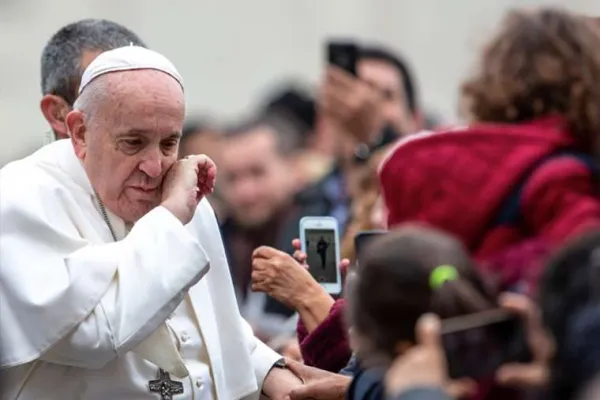
Vatican City, Mar 1, 2020 / 04:59 am (CNA).- Pope Francis said Sunday he will not take part in his annual Lenten retreat with the Roman Curia in Ariccia this week due to a cold he has had for several days.
“I also ask you to remember in prayer the spiritual exercises of the Roman Curia, which will begin this evening in Ariccia,” the pope said March 1.
“Unfortunately, a cold forces me not to participate this year: I will follow the meditations from here.”
The pope announced the decision to stay at the Vatican after giving his Sunday catechesis and leading the Angelus prayer from a window of the apostolic palace.
Francis, who canceled his public audiences starting Thursday, had to pause several times to cough during the Angelus and address.
He added that he will join “spiritually” the curia and all those praying or doing the spiritual exercises at home.
The retreat begins in the evening March 1 with bishops and cardinals of the Roman Curia. It ends March 6.
Starting Feb. 27, a slight illness has kept Pope Francis close to home. He has canceled his larger audiences for three days but continued to offer his early morning Mass in Santa Marta and to keep individual meetings.
Since 2014, the five-day spiritual exercises have been held at the Casa Divin Maestro retreat house in Ariccia, which is about 16 miles south-east of Rome.
Nestled in the woods on Lake Albano, Casa Divin Maestro is just a short distance from the papal summer residence at Castel Gandolfo.
Pope Francis every year chooses someone to lead the spiritual exercises. In 2020, he selected Fr. Pietro Bovati, SJ, a Scripture scholar and secretary of the Pontifical Biblical Institute.
Bovati, 79, will preach on the “encounter between God and man” focusing on the books of Exodus, the Gospel of Matthew, and the Psalms, according to the Vatican.
The practice of the pope going on retreat with the heads of Vatican dicasteries each Lent began around 80 years ago under Pope Paul XI. The spiritual exercises were held in the Vatican, but beginning in Lent 2014, Pope Francis chose to hold the retreat outside of Rome.
According to the Pauline priest who runs the retreat center, a typical day during the retreat begins with Mass then breakfast.
The bishops and cardinals then listen to the first meditation in the chapel. The second meditation is heard after lunch, Fr. Olinto Crespi told CNA in 2017. Other time is devoted to prayer. The retreat house has internet, so dicastery heads who need to answer emails or do some work during the week may do so.

If you value the news and views Catholic World Report provides, please consider donating to support our efforts. Your contribution will help us continue to make CWR available to all readers worldwide for free, without a subscription. Thank you for your generosity!
Click here for more information on donating to CWR. Click here to sign up for our newsletter.
Legion of Christ seeks forgiveness, change with new norms
Rome, Italy, Feb 29, 2020 / 03:44 pm (CNA).- Following the conclusion of the Legionaries of Christ’s general chapter, the religious order’s new leader has vowed to instill ideals for protection and transparency in the face of the sexual abuse crisis.
Father John Connor, the first U.S. leader of the order, announced Feb. 28 the release of two documents containing the reflections of the 2020 General Chapter in Rome, which included over 66 representatives from the order around the world.
“My councilors and I, together with the General Chapter gathered these days in Rome, have committed ourselves to face with courage, transparency and justice the consequences of sexual abuse that occurred in the history of our Congregation and that we published in the Report 1941-2019,” Connor said.
Connor was elected earlier this month following widespread public criticism of the Legionaries of Christ. A December 2019 report found that, since its establishment in 1941, 33 priests from the order have committed sexual abuse of minors, victimizing 175 children.
The Legionaries of Christ was founded by Mexican-born Fr. Marcial Maciel, who himself abused at least 60 minors. He is also accused of using the religious order to provide him access to the victims he abused, and to fund his mistresses, children he fathered, and an alleged drug habit.
The general chapter produced two documents, “Conversion and Reparation” and “Protect and Heal.” According to these documents, the order will investigate and determine the responsibility for each instance of past abuse.
In “Conversation and Reparation” the order asked for the forgiveness from the victims affected by the sexual abuse crisis and retracted negative criticism posed against 11 named-victims, who presented “legitimate and necessary accusations” against Maciel.
The document also encouraged its members to reflect on how to best comfort the victims of these scandals and correct these instances of abuse moving forward. According to the statement, the congregation seeks to instill a new attitude.
“In addition to confronting past cases of abuse and accountability, the Congregation seeks a change of mentality, a change of habits and a change of the institutional culture that allowed so much suffering to occur, and also to continue the effort of renewal based around the creation of safe environments together with the whole Church.”
“Protect and Heal” is a legislative document that strengthens the Safe Environment Policy issued after the 2014 General Chapter. It reinforces prevention measures, guarantees a rapid response to allegations or accusations of sexual abuse, and promises cooperation with ecclesial and civil authorities.
The document offers new provisions in its commitment to transparency and the means to handle abuser priests. It not only promises a swift response to accusations, but it also emphasizes steps to take toward any congregational members proven to have poorly handled these abuse cases. Members found guilty of negligence will be barred from holding office in the congregation.
“It establishes sanctions for those guilty of failing to report or of obstructing the proper handling of sexual abuse cases; it calls for, as standard procedure, petitioning the Congregation for the Doctrine of Faith to impose the penalty of dismissal from the clerical state and expulsion from the Congregation.”
Connor decried the failures brought under the community but expressed hope that reconciliation and healing will take place.
“Up to now we have failed in caring for many of the victims of members of our Congregation, but we commit, as far as possible and respecting the privacy and willingness of each victim, to walk the road of reparation and reconciliation with each of them, with their families and with the affected communities. We know that it will take us many years,” he said.

“This is part of our mission and a sign of the authenticity of our vocation.”
Shortly after Connor was elected, the new leader received criticism about his negligence regarding past abuses. He was accused of mishandling abuse complaints surrounding Fr. Michael Sullivan, a Legion priest who reportedly acted inappropriately with women through touching and other interactions.
Gail Gore, a spokesperson for the Legion, told CNA Feb. 7 that Connor and the order handled the situation with the proper levels of communication, including sending an open letter about the situation to all members of the Legion in December. He said the accusations do not accurately represent the exchange.
For his part, Connor has indicated that more change is needed.
Connor has met with a variety of experts to analyze a holistic approach to enable the victims of sexual abuse a safe environment to seek “truth, justice, and reparation,” the order said.

If you value the news and views Catholic World Report provides, please consider donating to support our efforts. Your contribution will help us continue to make CWR available to all readers worldwide for free, without a subscription. Thank you for your generosity!
Click here for more information on donating to CWR. Click here to sign up for our newsletter.
Subscribe to:
Comments (Atom)
Subscribe To The New Under Ground Church


 Posts
All Comments
Posts
All Comments