Sexual assault reports increase at US military academies
LOLITA C. BALDOR
Scroll back up to restore default view.
WASHINGTON (AP) — Reported sexual assaults at U.S. military academies shot up during the 2021-22 school year, and one in five female students told an anonymous survey that they had experienced unwanted sexual contact, The Associated Press has learned.
U.S. officials said student-reported assaults at the Army, Navy and Air Force academies jumped 18% overall compared with the previous year. The increase was driven largely by the Navy, which had nearly double the number of reported assaults in 2022, compared with 2021. It’s unclear whether the phasing out of COVID-19-related restrictions contributed to the increase, including at the U.S. Naval Academy, which is directly adjacent to bars in downtown Annapolis, Maryland.
A student survey accompanying the report found increases in all types of unwanted sexual contact — from touching to rape — at all the schools. And it cites alcohol as a key factor.
The military services and the academies have struggled for years to combat sexual assault and harassment, with myriad prevention, education and treatment programs. But despite reams of research, and expanded programs, the numbers continue to grow. Young Army soldiers last month dismissed videos and training as outdated, and told service leaders that small group discussions would be more effective.
The increases have triggered outrage on Capitol Hill and a steady stream of legislation. But as yet, the changes have not appeared to make a dent in the problem, although officials argue that expanded assistance programs have encouraged more victims to report the crimes.
According to U.S. officials, 155 students reported assaults during the 2022 school year, compared with 131 the previous year. Of those, students at the U.S. Naval Academy reported 61 — nearly double the school’s total for the previous year, when there were 33, which was by far the lowest of all the academies for that year.
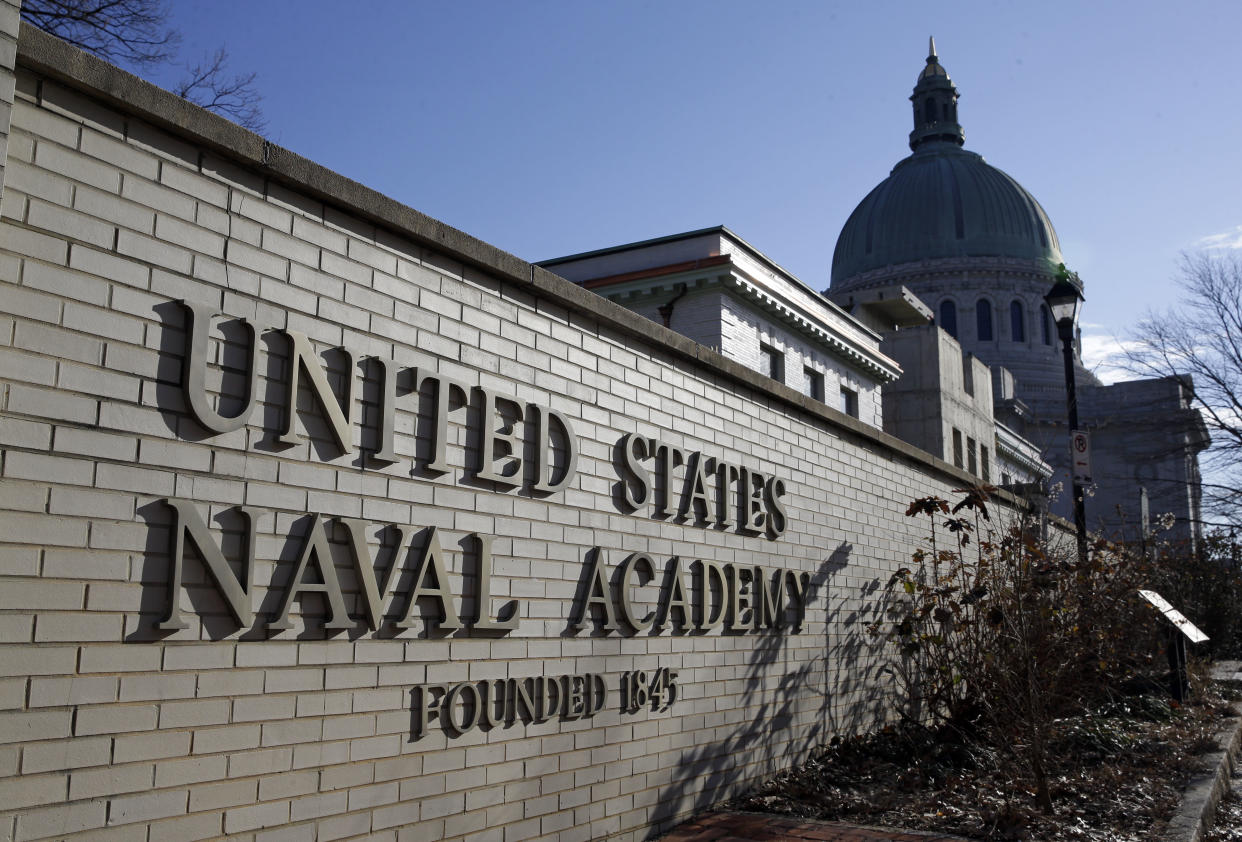
An entrance to the U.S. Naval Academy campus in Annapolis, Md. (AP Photo/Patrick Semansky)
Cadets at the Air Force Academy in Colorado reported 52, the same as the previous year, and those at the U.S. Military Academy at West Point in New York reported 42, a slight decrease from last year's 46.
Not all of the assaults in the report happened while the students were enrolled in the academies. Because students are encouraged to report assaults, they sometimes will come forward to talk about events that happened in the years before they started school there. As a result, 16 students reported an assault in the 2021-22 school year that occurred prior to joining the military.
As well, 35 cases involved civilians, active-duty service members and prep school students who allegedly were assaulted by someone who was a student. Altogether, the total number of reported assaults with any connection to a student was 206 — about 28% higher than last year’s total of 161.
U.S. officials provided details about the findings on the condition of anonymity because the report had not yet been released. The report was expected to be released later Friday.
The COVID-19 pandemic led to a brief dip in cases at the academies during the shortened 2019-20 school year, when in-person classes were canceled and students were sent home in the spring to finish the semester online.
At the start of the 2020-21 school year, students faced a number of restrictions due to the ongoing pandemic. But as those slowly scaled back and bars and restaurants reopened, the numbers began to increase again. Officials said it's hard to tell what, if any, impact COVID-19 had on the 2021 school year.
The Pentagon puts out two reports every year on the number of sexual assaults reported by military academy students and by U.S. service members. But because sexual assault is such an underreported crime, the department also conducts anonymous surveys every two years to get a clearer picture of the problem among both the students and the active duty population. Pentagon leaders believe the survey provides a more accurate depiction of the assaults and the contributing factors.
Based on the surveys, students at the academies are less likely to report an assault than service members who are out of school. Students may worry more about the impact on their military career or even on the career of their attacker.
Alcohol use was involved in more than half of the cases
According to the latest survey of academy students, 21.4% of women said they experienced unwanted sexual contact in the 2022 school year, compared with about 16% in 2018, the last year the survey was done, due to COVID-19 restrictions. For men, the rate went from 2.6% in 2018 to 4.4% in 2022.
Based on the survey, attacks against women were most often by a male who was usually in the same class year and more than half the time knew them from school or other activities. Attacks on men were more often — 55% of the time — by a female who was in the same class year and knew them.
Alcohol use was involved in well more than half of the cases reported in the survey, with a high of 65% at the Naval Academy. The report recommends additional alcohol use policies.
The report also found that sophomores and junior men were most at risk. And women are still far more likely to actually report an assault than men.
Pentagon leaders have for years pushed public campaigns urging students to report any attacks, and they argue that an increase in assault reports suggests that students feel more comfortable coming forward to seek help.
According to the report, the rates of unwanted sexual contact reported in the survey are “at or above civilian rates” based on 2014 and 2018 statistics from the American Association of Universities. No other more recent statistics were available, so it's difficult to accurately compare the military academies with other non-military universities.
Scroll back up to restore default view.
WASHINGTON (AP) — Reported sexual assaults at U.S. military academies shot up during the 2021-22 school year, and one in five female students told an anonymous survey that they had experienced unwanted sexual contact, The Associated Press has learned.
U.S. officials said student-reported assaults at the Army, Navy and Air Force academies jumped 18% overall compared with the previous year. The increase was driven largely by the Navy, which had nearly double the number of reported assaults in 2022, compared with 2021. It’s unclear whether the phasing out of COVID-19-related restrictions contributed to the increase, including at the U.S. Naval Academy, which is directly adjacent to bars in downtown Annapolis, Maryland.
A student survey accompanying the report found increases in all types of unwanted sexual contact — from touching to rape — at all the schools. And it cites alcohol as a key factor.
The military services and the academies have struggled for years to combat sexual assault and harassment, with myriad prevention, education and treatment programs. But despite reams of research, and expanded programs, the numbers continue to grow. Young Army soldiers last month dismissed videos and training as outdated, and told service leaders that small group discussions would be more effective.
The increases have triggered outrage on Capitol Hill and a steady stream of legislation. But as yet, the changes have not appeared to make a dent in the problem, although officials argue that expanded assistance programs have encouraged more victims to report the crimes.
According to U.S. officials, 155 students reported assaults during the 2022 school year, compared with 131 the previous year. Of those, students at the U.S. Naval Academy reported 61 — nearly double the school’s total for the previous year, when there were 33, which was by far the lowest of all the academies for that year.
An entrance to the U.S. Naval Academy campus in Annapolis, Md. (AP Photo/Patrick Semansky)
Cadets at the Air Force Academy in Colorado reported 52, the same as the previous year, and those at the U.S. Military Academy at West Point in New York reported 42, a slight decrease from last year's 46.
Not all of the assaults in the report happened while the students were enrolled in the academies. Because students are encouraged to report assaults, they sometimes will come forward to talk about events that happened in the years before they started school there. As a result, 16 students reported an assault in the 2021-22 school year that occurred prior to joining the military.
As well, 35 cases involved civilians, active-duty service members and prep school students who allegedly were assaulted by someone who was a student. Altogether, the total number of reported assaults with any connection to a student was 206 — about 28% higher than last year’s total of 161.
U.S. officials provided details about the findings on the condition of anonymity because the report had not yet been released. The report was expected to be released later Friday.
The COVID-19 pandemic led to a brief dip in cases at the academies during the shortened 2019-20 school year, when in-person classes were canceled and students were sent home in the spring to finish the semester online.
At the start of the 2020-21 school year, students faced a number of restrictions due to the ongoing pandemic. But as those slowly scaled back and bars and restaurants reopened, the numbers began to increase again. Officials said it's hard to tell what, if any, impact COVID-19 had on the 2021 school year.
The Pentagon puts out two reports every year on the number of sexual assaults reported by military academy students and by U.S. service members. But because sexual assault is such an underreported crime, the department also conducts anonymous surveys every two years to get a clearer picture of the problem among both the students and the active duty population. Pentagon leaders believe the survey provides a more accurate depiction of the assaults and the contributing factors.
Based on the surveys, students at the academies are less likely to report an assault than service members who are out of school. Students may worry more about the impact on their military career or even on the career of their attacker.
Alcohol use was involved in more than half of the cases
According to the latest survey of academy students, 21.4% of women said they experienced unwanted sexual contact in the 2022 school year, compared with about 16% in 2018, the last year the survey was done, due to COVID-19 restrictions. For men, the rate went from 2.6% in 2018 to 4.4% in 2022.
Based on the survey, attacks against women were most often by a male who was usually in the same class year and more than half the time knew them from school or other activities. Attacks on men were more often — 55% of the time — by a female who was in the same class year and knew them.
Alcohol use was involved in well more than half of the cases reported in the survey, with a high of 65% at the Naval Academy. The report recommends additional alcohol use policies.
The report also found that sophomores and junior men were most at risk. And women are still far more likely to actually report an assault than men.
Pentagon leaders have for years pushed public campaigns urging students to report any attacks, and they argue that an increase in assault reports suggests that students feel more comfortable coming forward to seek help.
According to the report, the rates of unwanted sexual contact reported in the survey are “at or above civilian rates” based on 2014 and 2018 statistics from the American Association of Universities. No other more recent statistics were available, so it's difficult to accurately compare the military academies with other non-military universities.
China, Russia and climate change: 2023 threat assessment sees U.S. faced with unprecedented challenges
ALEXANDER NAZARYAN
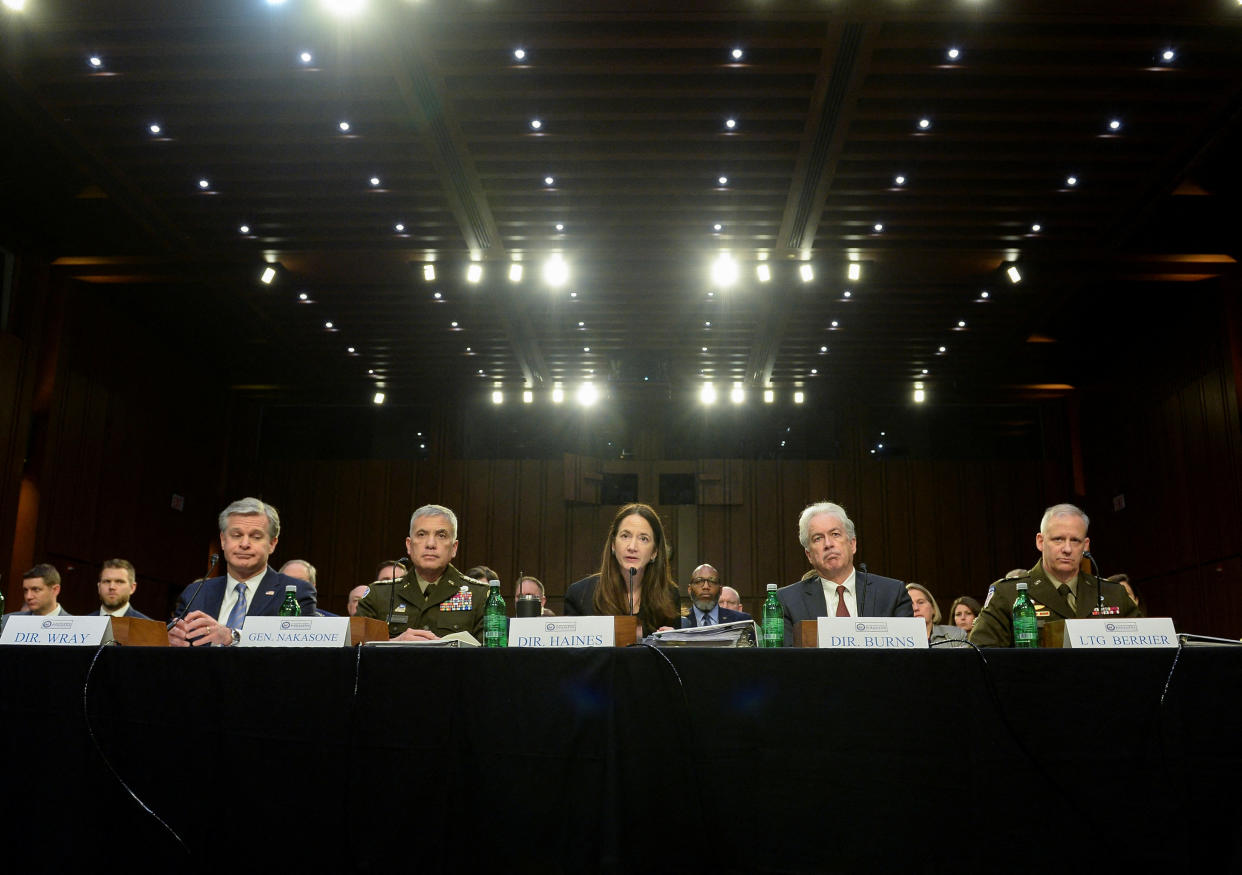
Left to right, FBI Director Christopher Wray, National Security Agency Director Paul Nakasone, Director of National Intelligence Avril Haines, Central Intelligence Agency Director William Burns and Defense Intelligence Agency Director Scott Berrier testify before a Senate Intelligence Committee hearing on worldwide threats, March 8. (Mary F. Calvert/Reuters)
WASHINGTON — Having stood as the world’s lone superpower since the end of the Cold War, the United States now faces unprecedented challenges to its global influence, the intelligence community concluded in the annual threat assessment made public this week.
Those threats include, above all, an ascendant China, but also a belligerent Russia whose invasion of Ukraine could be part of a broader regional plan. Then there are the worldwide consequences of climate change and technological advancements in artificial intelligence, which will require cooperation on an unprecedented scale.
As the war in eastern Ukraine continues into its second year and Xi Jinping solidifies power in his third term as China’s leader, the United States “will confront a complex and pivotal international security environment,” the assessment concludes.
China
Xi Jinping, president of China and also general secretary of the Communist Party of China Central Committee. (Li Gang/Xinhua via Getty Images)
The Chinese Communist Party “represents both the leading and most consequential threat to U.S. national security and leadership globally,” Director of National Intelligence Avril Haines told lawmakers this week.
The 2023 threat assessment — which her office produced — concludes that while China does not seek an outright military confrontation with the United States, deepening competition is inevitable.
“Beijing sees increasingly competitive U.S.–China relations as part of an epochal geopolitical shift and views Washington’s diplomatic, economic, military, and technological measures against Beijing as part of a broader U.S. effort to prevent China’s rise and undermine CCP rule,” the threat assessment says.
Both the White House and Congress have focused on China in recent months. Committees are investigating the origins of the coronavirus pandemic and legislators seeking to ban TikTok, a social media platform whose parent company Bytedance is believed to be improperly harvesting users’ data.
The recent shoot down of a Chinese surveillance balloon only deepened suspicions between Washington and Beijing, with Secretary of State Antony Blinken abruptly canceling a visit to the Chinese capital.
But no issues looms as large as that of Taiwan, the island whose contested status could become a military flashpoint.
“They’re understating the threat — and the very real possibility of war,” China expert Isaac Stone Fish told Yahoo News of the 2023 threat assessment. “There's a real lack of discussion of what happens if China invades Taiwan. Is that World War III?”
According to the so-called Davidson Window, an analysis developed by retired Navy Adm. Philip Davidson, China is likely to invade Taiwan by 2027. Biden has twice pledged to defend Taiwan militarily in what some deemed an irresponsible provocation to Beijing, which like Moscow tends to bristle at Western meddling in what it considers its own sphere of influence.
In testimony before the House on Thursday, Haines said that Xi had been “sobered” by the breadth and consistency of the Western alliance defending Ukraine. But Fish believes the comparison does not hold.
“They’re radically different situations,” he said. “Russia is a declining power; China is not.”
Russia
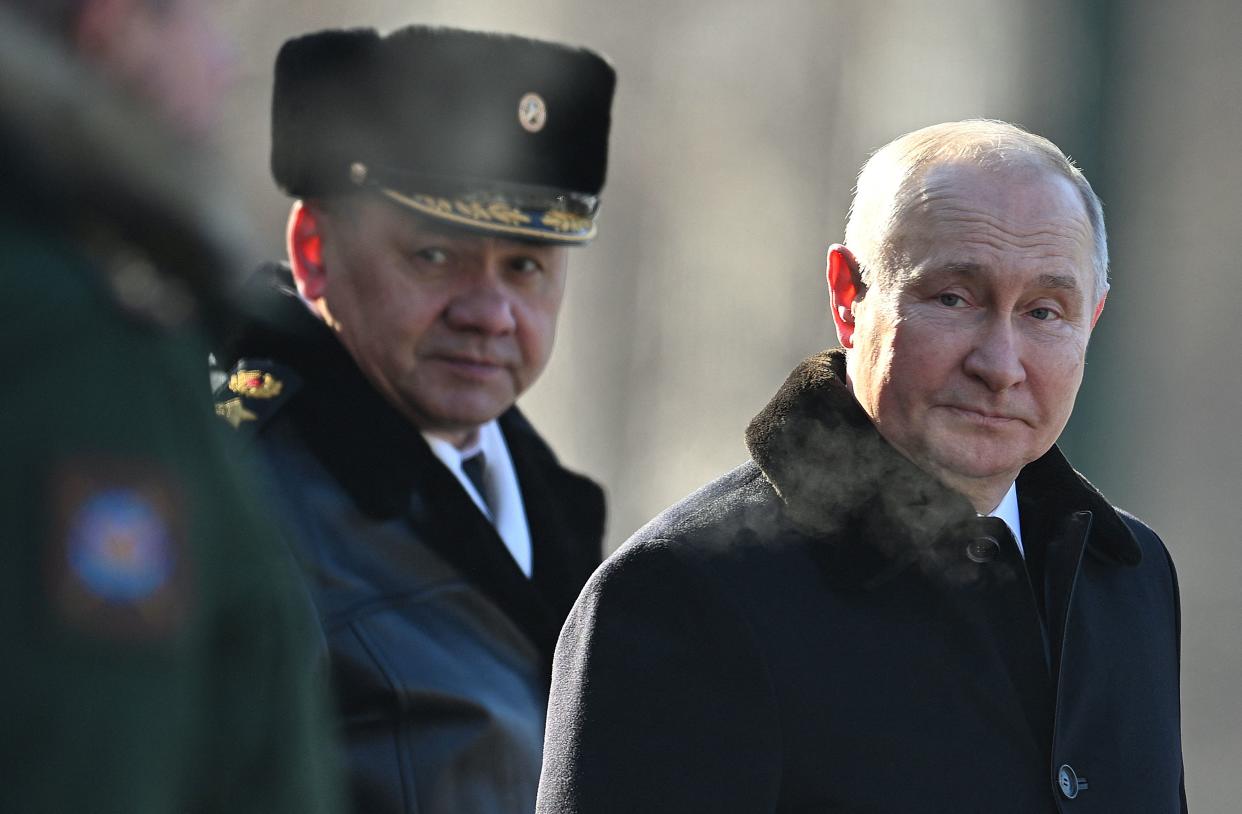
Russian President Vladimir Putin, right, with Russian Defense Minister Sergei Shoigu. (Pavel Bednyakov/Sputnik/AFP via Getty Images)
“The Russia section has few surprises, given how much about Russia-Ukraine has been put out publicly already,” former Central Intelligence Agency officer and visiting George Mason University scholar David Priess wrote on Twitter, though he highlighted a passage predicting that Russia would “become even more reliant on nuclear, cyber, and space capabilities as it deals with the extensive damage to Russia’s ground forces.”
Russian President Vladimir Putin has made nuclear threats several times since launching the invasion of Ukraine in early 2022, but most analysts do not believe those threats suggest a genuine intention to instigate a nuclear strike.
Still, as the assessment noted, Russian motives and tactics can be difficult to predict. And anti-Western grievances run deep.
“Russia probably does not want a direct military conflict with U.S. and NATO forces, but there is potential for that to occur,” the report says. “Russian leaders thus far have avoided taking actions that would broaden the Ukraine conflict beyond Ukraine’s borders, but the risk for escalation remains significant.”
Extremists at home
Far-right extremist Proud Boys march in support of President Donald Trump in Washington, D.C., Dec. 12, 2020. (Evelyn Hockstein/Washington Post via Getty Images)
The 2023 threat assessment confirms those findings, describing “a decentralized movement of adherents to an ideology that espouses the use of violence to advance white supremacy, neo-Nazism, and other exclusionary cultural-nationalist beliefs. These actors increasingly seek to sow social divisions, support fascist-style governments, and attack government institutions.”
The findings elicited a show of incredulity from Sen. Tom Cotton, R-Ark.
“Are you serious?” he asked of Haines during a Wednesday hearing, seemingly unaware that an identical assessment of the homegrown threat had been made during the Trump administration.
A warming, increasingly digitized planet
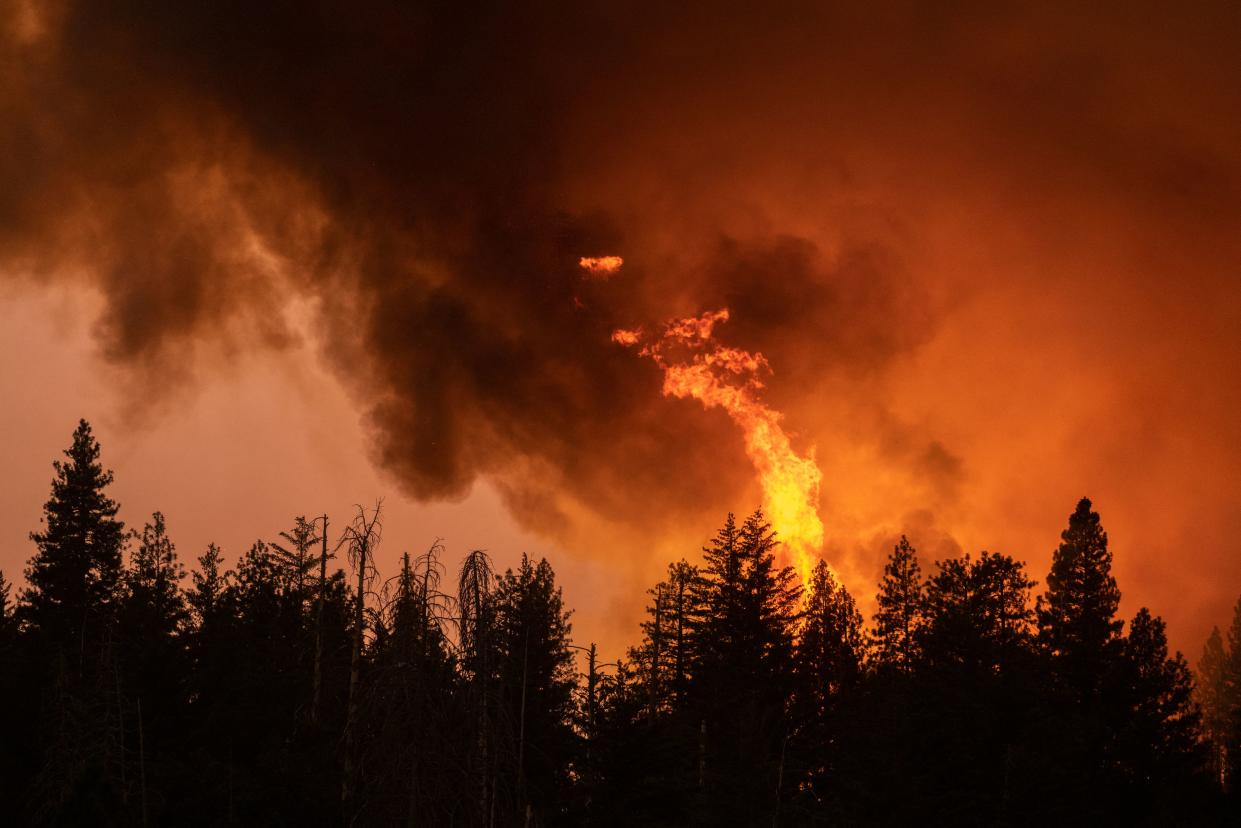
The Oak Fire near Midpines in Northern California, on July 23, 2022. (David McNew/AFP via Getty Images)
While the assessment calls China and Russia the biggest geopolitical threats the United States will have to manage in 2023, they are far from the only ones.
Climate change is putting an ever-growing number of people “under threat from extreme weather, food insecurity, and humanitarian disasters, fueling migration flows and increasing the risks of future pandemics as pathogens exploit the changing environment,” according to the assessment.
And while the coronavirus pandemic may be receding, conditions are only becoming more ripe for another outbreak: “Countries globally remain vulnerable to the emergence or introduction of a novel pathogen that could cause a devastating new pandemic.”
There are technological perils too. The assessment says that advances in artificial intelligence could leave the United States exposed, with foreign “intelligence services ... adopting cutting-edge technologies — from advanced cyber tools to unmanned systems to enhanced technical surveillance equipment — that improve their capabilities and challenge U.S. defenses.”







 Posts
Posts

