Students for Justice in Palestine
Overview
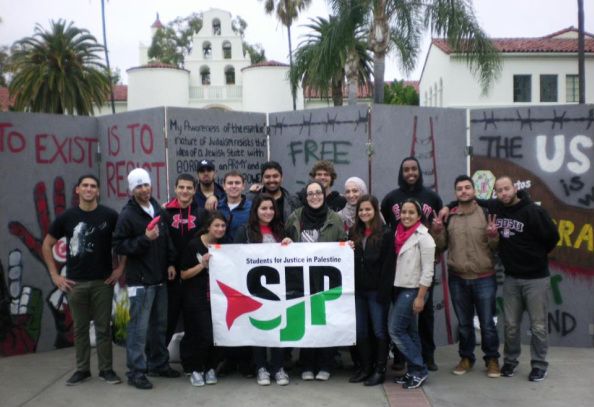
Students for Justice in Palestine (SJP) is the primary student organization engaging in anti-Israel activity on North American campuses.
SJP was co-founded in 2001 at the University of California at Berkeley (UC Berkeley) by Professors Hatem Bazian and Snehal Shingavi.
Bazian served as president of the General Union of Palestinian Students (GUPS) while studying at San Francisco State University (SFSU) and headed the Muslim Students Association (MSA) while earning his M.A. at UC Berkeley. In 2004, while the second intifadawas already winding down in Israel, he called for an intifada in the United States.
Shingavi, an activist tied to the International Socialist Organization (ISO), has been criticizedfor using his literature course as a vehicle for promoting anti-Israel propaganda.
SJP has grown to become the primary student movement advancing the Palestinian national agenda on North American campuses and is the primary force behind Boycott, Divestment, Sanctions (BDS) campaigns at most schools.
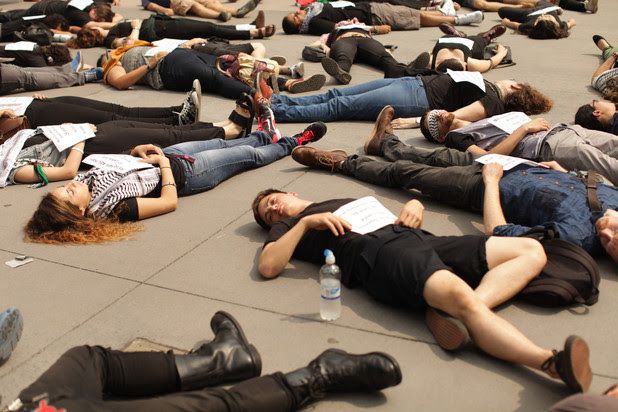
SJP describes itself on its website as being against racism, sexism, homophobia, Islamophobia, classism, bigotry and anti-Semitism. The group’s focus, however, is almost entirely on its anti-Israel campaigns, including BDS resolutions, Israel-Apartheid initiatives, drives comparing Israel to Nazi Germany, mock checkpoints, “die-ins” and public rallies.
SJP is believed by many to be an outgrowth of the General Union of Palestinian Students (GUPS), originally founded in Egypt in the 1950s and established at San Francisco State University (SFSU) in 1973.
To read an in-depth Canary Mission report on SJP, click here.
Disruption, Intimidation and Violence
SJP activists frequently intimidate and harass Jewish and pro-Israel students. SJP members have physically assaulted Jewish students, aggressively disrupted pro-Israel events and possibly vandalized communal property. SJP rallies regularly include hate-speech and chants such as “Long Live The Intifada!” and “From the River to the Sea Palestine will be Free!” — calls for violence and for the dismantling of Israel as a Jewish state.
Temple University, August 2014: A Jewish student was hit in the face by someone who was part of a group of students, many of whom were confirmed as SJP members. Two witnesses heard members of SJP call him a “kike” after the attack. “Before this, I just thought Students for Justice in Palestine was crazy”, the victimsaid after the incident, “but I didn’t know it would lead to violence.”
Loyola University, September 2014: Members of SJP at Loyola University Chicago verbally assaulted Jewish students affiliated with Hillel who were staffing a table with literature for a Birthright Israel trip. SJP members reportedly surrounded the table, blocking the movement of the Hillel students and preventing others from approaching. One student witness told The College Fix, a news website that covers campus issues, that one Jewish student became “worried about attending future Hillel events for fear of being attacked.”
Northeastern University, 2013: The entire SJP was suspended from campus for a school year after intimidating students on campus. In 2011 the chapter chose to interrupt an on-campus Holocaust remembrance event by whipping out anti-Israel signs and yelling insults at the audience and speakers before storming out.
Florida Atlantic University, April 2012: SJP members posted eviction notices on the dorm room doors of 200 students, most of them Jewish. The tactic has been repeated at various campuses. As one NYU student said, “this made me feel targeted and unsafe in my own dorm room and I know others feel exactly the same as myself.”
UC Berkeley, March 2010: Husam Zakharia, while serving as president of the SJP chapter on campus, rammed a female pro-Israel student with a shopping cart. She was holding a sign reading “Israel Wants Peace.”
Shutting Out Dialogue
SJP is frequently criticized for creating a hostile and unsafe environment on U.S. campusesfor all who do not share their anti-Israel views.
In August of 2014, a document was leaked to the public entitled “Declaration of Principles and Strategies of Binghamton University Students for Justice in Palestine.”
The document outlined the tactics and organizational details for the Binghamton University branch of SJP and provides insights into the organization’s guiding principles.
The document shut down any possibility of dialogue with pro-Israel students, entrenching a policy known as “anti-normalization” which “prohibit(s) the leadership of SJP from engaging in any form of official collaboration, cooperation, or event co-sponsorship with the following student organizations and groups, due to their unyielding support for the Apartheid State of Israel.”
The document listed examples of pro-Israel groups subject to this exclusion such as Hillel, CAMERA and AEPi and clarified that this would include collaborations on publications, discussions or events with them.
The document also gave its members directives on how to disrupt pro-Israel activities with maximum impact while staying “within the bounds of what is not widely considered to be legally reprehensible.”


 Posts
Posts